
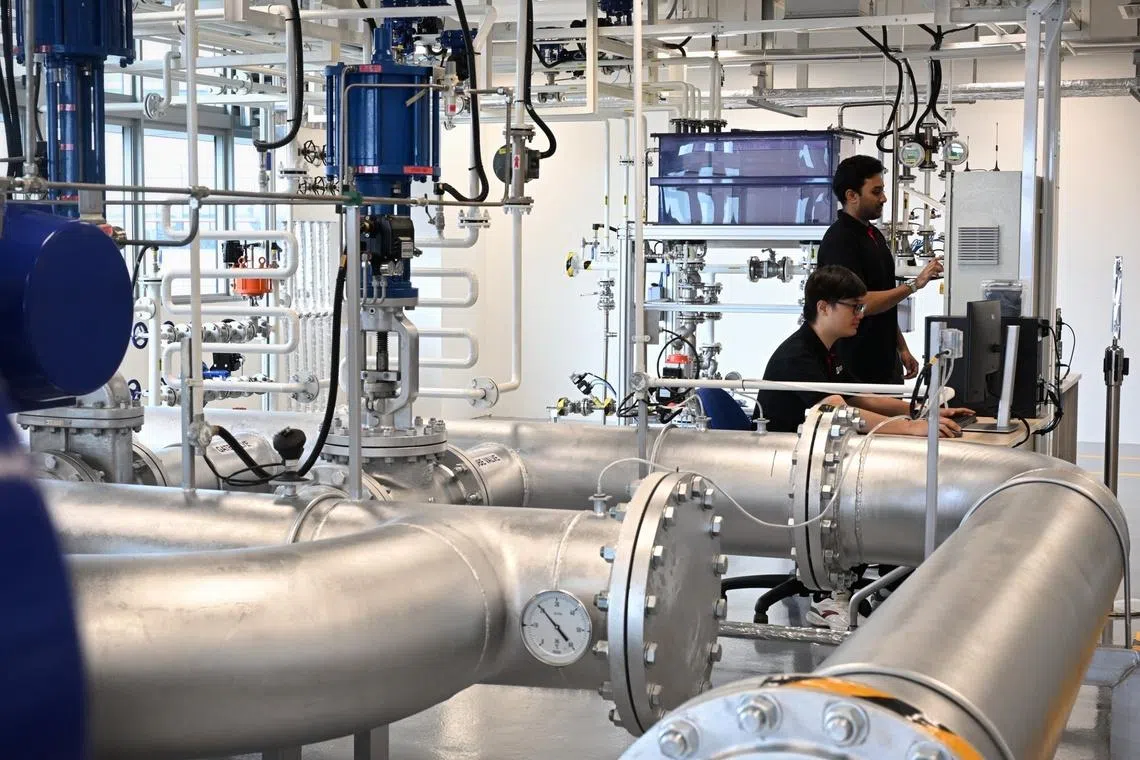
SINGAPORE – A new facility aimed at training students and professionals in energy efficiency assessments was launched on Feb 9 at the Singapore Institute of Technology (SIT) Punggol Campus.
The Energy Efficiency Training Facility provides students and industry professionals with a controlled environment to acquire practical energy audit skills without disrupting live operations.
It is part of the Energy Efficiency Technology Centre (EETC), a collaboration between SIT and the National Environmental Agency.
The training facility is the first of its kind in Singapore, with comprehensive industrial systems that simulate real-world manufacturing conditions found in small and medium-sized enterprises (SMEs). It will be able to train 400 professionals and students annually.
Energy efficiency is achieved when technologies and designs use less energy while providing the same or a better output, and is a cost-effective measure for reducing greenhouse gas emissions, according to the United Nations Environment Programme.
Previously, students would mainly receive training during lectures, said SIT president Chua Kee Chaing. Occasionally, training programmes would also be conducted at SIT’s satellite campuses across the five local polytechnics.
But with the new 430 sq m training facility, roughly the size of five four-room HDB flats, participants can gain hands-on experience using industrial systems typically found in the manufacturing sector.
Speaking at the launch, Senior Minister of State for Sustainability and the Environment Janil Puthucheary said: “The launch of the Energy Efficiency Training Facility today marks a pivotal and exciting step towards improving our energy efficiency outcomes in Singapore.”
“By combining classroom learning with real-world industrial practices, this new facility enhances the readiness of professionals and students to better support
Singapore’s energy efficiency and decarbonisation goals,
” he added.
The facility houses several comprehensive industrial systems, such as a boiler steam system and a fan system. These systems were chosen as they are known to use a lot of energy in all types of industries, such as chemical, pharmaceutical and manufacturing, said Prof Chua.
“Learners will be able to benefit from more structured, scalable and immersive training,” he added. “Our vision is to build a strong and continuous pipeline of capability development so that our workforce and companies remain competitive.”
Participants will get to experiment with different parameters, such as the sizing and smoothness of pipes, to find out how to improve energy usage and do more optimisation. As the facility aims to build awareness and competency in energy efficiency, EETC also hopes to use it for certification training in the future that will enable energy professionals to have in-depth experience in industrial systems, said Professor Lock Kai Sang, head of EETC.
“This means that in the future, a professional energy manager, instead of just passing a theoretical exam, will be required to be able to do the real thing,” he added.
With increasing energy costs and
changes in Singapore’s carbon tax
, it is timely and important to look at how industries can save energy and money even through simple measures, Prof Lock said.
Student Muhammad Zabir Imran, 25, who is currently attached to EETC as part of SIT’s Integrated Work Study Programme, said the training facility provided a safe environment for testing and studying the systems in-depth.
“In this space, we can understand how the numbers are actually derived,” he said. “So when you apply that same procedure on industries during audits, we can identify when the benchmarks are off and investigate the reasons for it.”
The experience also enabled him to gain a deeper understanding and appreciation of industrial systems, and piqued his interest in becoming an energy auditor, especially given the job’s relevance today, he added.
“It’s actually a boost in our arsenal of skills that we have. We are not really limited to just being auditors. We can go to pretty much any engineering industry because we are equipped with those skills,” he said.
Energy professionals from SMEs stand to benefit as EETC focuses on making energy efficiency support accessible, since many SMEs have limited resources or expertise to assess and improve their energy usage, said Prof Chua.
Energy manager Chen Kai Pow, who works at local instant noodle manufacturer Tat Hui Foods, expressed interest in the training facility, saying it would consider sending its staff for training.
“Nowadays, sustainability and decarbonisation are the ‘in’ thing. So surely we need to equip our staff with the knowledge, and that’s something we’re still doing continuously.”