
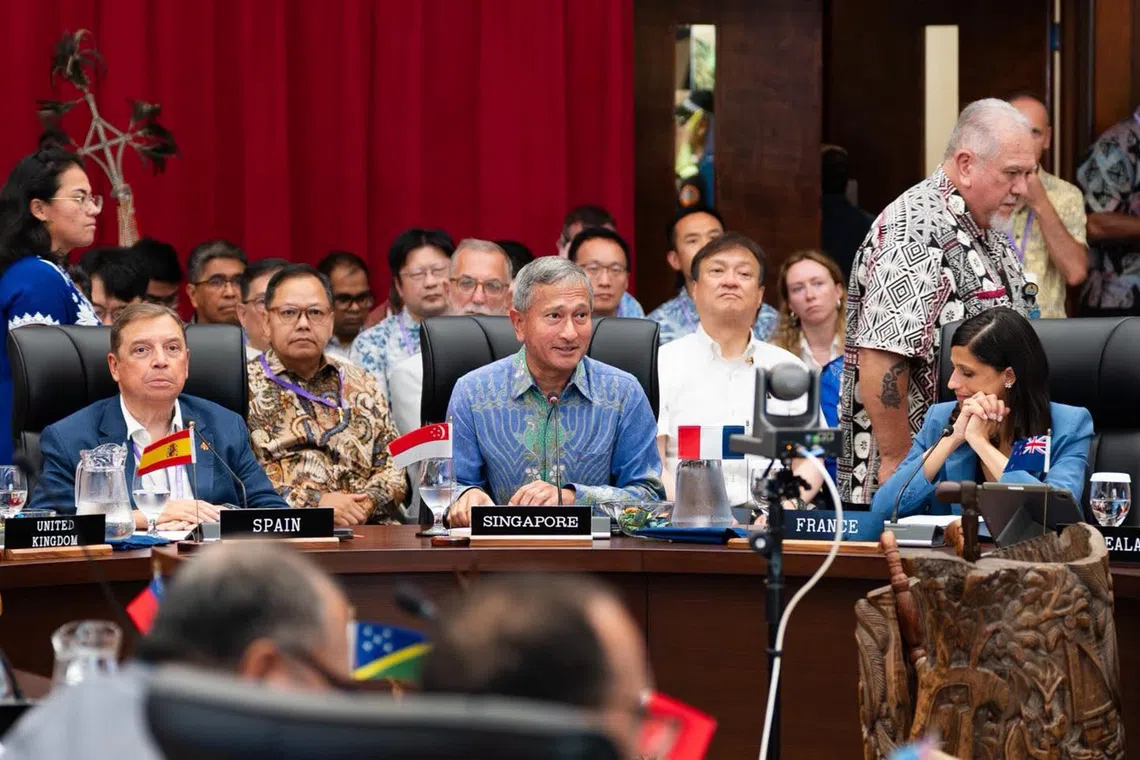
SINGAPORE – Singapore has extended two capacity building packages to help Pacific island states strengthen their governments and institutions, Foreign Minister Vivian Balakrishnan announced on Sept 1.
The first programme, called the Singapore-Pacific Resilience and Knowledge Sharing (SPARKS), will run from January 2027 to December 2029 and train mid-to-senior level Pacific officials through courses on leadership and governance, as well as financial management and macroeconomic fundamentals.
The second programme, known as SIDS of Change, will run from April 2027 to March 2029, with customised courses on artificial intelligence for governance and public service transformation, as well as civil aviation and maritime fellowships, the Ministry of Foreign Affairs (MFA) said in a statement.
SIDS refers to Small Island Developing States, a United Nations grouping of 39 states and 18 associated members, many of which face challenges linked to their small size, remoteness and exposure to environmental and economic shocks.
Pacific island states make up one of the three main regional groupings in SIDS, alongside countries in the Caribbean and the Atlantic, Indian Ocean and South China Sea.
Speaking at the 55th Pacific Islands Forum Leaders Meeting with Dialogue Partners in Palau, Balakrishnan said Singapore supports a strong and Pacific-led regional architecture, and that the city-state does not want the Pacific to be an arena for proxy contests.
“Our experience in South-east Asia has shown the value of ASEAN centrality: By building a strong regional core, we can engage major powers while retaining our agency, retaining strategic choice and options, and shaping our own regional agenda,” Balakrishnan said.
The Foreign Minister said it is more crucial than ever that ASEAN and the Pacific region work together to advance shared priorities in areas such as climate change, connectivity and sustainable development, as well as economic and strategic relevance.
The Republic looks forward to bringing the two groupings closer when Singapore takes on the ASEAN chairmanship in 2027, Balakrishnan added.
Emphasising the need to continually invest in people and local institutions, he noted that nearly 10,000 Pacific officials have participated in the Singapore Cooperation Programme (SCP) and related programmes since 1992.
The two renewed packages come under the SCP, which is the Republic’s primary platform for offering technical assistance and human resource training to other countries.
Singapore launched SPARKS in 2023, when it attended the Pacific Islands Forum Leaders Meeting as a dialogue partner for the first time.
It introduced SIDS of Change a year later, at the Fourth International Conference on Small Island Developing States.
MFA said the two packages reaffirm Singapore’s commitment to supporting Pacific capacity building in priority areas identified in the 2050 Strategy for the Blue Pacific Continent.
Singapore has conducted more than 90 customised programmes and study visits tailored for Pacific island states.
At the dialogue in Palau, Balakrishnan said that while Singapore and the Pacific island nations are small, size does not dictate a country’s fate, nor should it limit one’s agency.
Countries gain agency when their people and institutions are strong, their regions are cohesive, and when international rules and law are respected, he added.
“We cannot choose the world we live in, but we can strengthen our internal resilience nationally, we can extend our hands to partnerships across our boundaries, and we must insist that we have collective agency,” said Balakrishnan.