
SINGAPORE – While browsing online shopping platform Taobao in 2021, Ms Loy Xing-Yi found a Tibetan copy of Harry Potter And The Philosopher’s Stone and bought it.
This became the start of another language journey for the then Secondary 2 student.
“I thought to myself: ‘If I spent $20-something on this book, I need to be able to understand it,’” she said. She went on YouTube and Chinese video-sharing platforms Douyin and Bilibili to learn to read the Tibetan alphabet and understand the words. Each page took her two weeks to a month to decipher.
This is not her first time using a Harry Potter book to dive into a new language. In fact, reading the translated editions is her favourite way to do it.
“I like to read Harry Potter in a new language, because I know the plot very well, and it just so happens that it was published in a lot of languages, so it helps me better contextualise all the vocabulary or the grammar.”
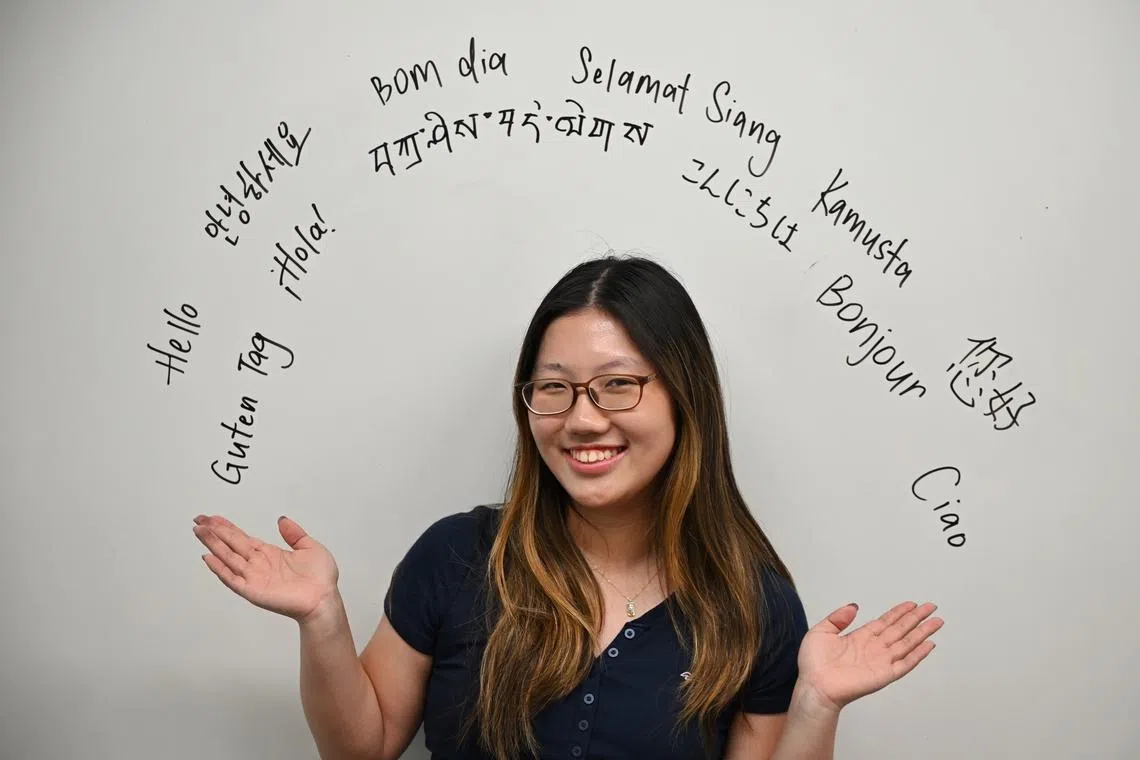
Ms Loy, now 18, is a hyperpolyglot, a person who is fluent in six or more languages.
She can speak English, Chinese, French, Japanese, Spanish and Korean, as well as Italian, Portuguese, German, Tagalog, Bahasa Indonesia, Tibetan and Tujia – the language of a minority ethnic group in China.
“I don’t really go out of my way to look for new languages to learn,” she said. “The opportunity pops up, and I feel like I have to take it, because it’s such a good chance for me to get to know this new community and to speak this new language.”
She has always been someone who likes new experiences.
When she was in upper secondary at Raffles Girls’ School, she did not have to take the O levels as she was under the Integrated Programme (IP). However, out of boredom, she self-studied and sat the International A levels in geography and sociology.
The IP would have moved her on to Raffles Institution, like her peers, but she wanted to challenge herself with a new education system and community. She applied for and received the SJI International Local Merit Scholarship and joined St Joseph’s Institution International (SJII).
“I wanted to prove to myself that I could take that leap of faith,” she said.
She graduated from SJII with an International Baccalaureate score of 44 out of 45 in 2025. She hopes to go on to study linguistics in university in the United States.
Ms Loy got her first glimpse of foreign languages early. Her kindergarten taught English, Chinese and Japanese. She also often saw French expatriate children at the playground near her home around Bukit Timah then, but was unable to play with them.
“I used to be really left out because I couldn’t speak French,” said Ms Loy, who has two younger brothers who now also speak French. “So I asked my parents whether they could put me up for some French lessons.”
They did, and she later became friends with the French kids. She also took up Spanish as a third language in secondary school. When the Covid-19 pandemic hit, she used the time to pick up Korean, Italian and Portuguese.
Ms Loy recalled how, when she was seven, a tourist asked her for directions at a bus stop. The tourist was speaking another language, and she was unable to help. Years later, when she encountered the Italian language, she realised that was likely what the tourist was speaking. “Looking at Italian made me remember this experience, and then it motivated me to go and learn it,” she said.
She said her knowledge of Spanish helped her to learn Italian and Portuguese, which are also Romance languages derived from Latin.
Ms Loy also does not shy away from minority languages. After meeting a teacher of Tujia at a conference in 2022, she picked up the language and worked on projects to conserve it.
It is a difficult task, she said, as Tujia is an oral language and cannot be written down. Hence, it has to be saved in recordings that have to be collected in a repository with sufficient storage space, which may not always be available.

“I don’t really go out of my way to look for new languages to learn. The opportunity pops up, and I feel like I have to take it, because it’s such a good chance for me to get to know this new community,” Ms Loy Xing-Yi says.
ST PHOTO: KUA CHEE SIONG
On why she is keen to preserve languages and heritage, Ms Loy said: “I think that every generation should have the right to decide for themselves which part of their culture, which part of their traditions they want to practise and conserve.
“What we are responsible for is to keep all this knowledge, even if we choose not to practise them, for the future generations.”
To this end, Ms Loy started an initiative in 2024 to increase English literacy among students in South-east Asia, using local myths and folk tales.
Supported by a National Youth Council grant, Project FantaSEA has taught more than 2,500 students in Vietnam, Indonesia and the Philippines.
“Everyone knows Disney, but not everyone knows the folklore and the fairy tales from our own cultures,” Ms Loy said.
She recalled how she heard the tale of Snow White at the age of two or three, but learnt about Singapore’s legend of Redhill only when she was eight or nine.
Ms Loy wants to make it easier for children to grow up with stories from their own cultures, and for more people to take an interest in their cultures.
“I’m quite interested in Chinese culture, but when I try to learn about it, I feel that’s quite a niche thing among the people that I’ve met, and sometimes, it feels like I can’t really talk to anyone about it,” she said.
She said it makes her sad that some practices known by her grandparents’ generation may be lost.
“If languages and cultures become homogenous because of globalisation… if everyone spoke one language, then there won’t be any more diversity in the world, and I think that would make for quite a colourless, sad world.”
Ms Loy feels similarly about Singlish. “I definitely think Singlish is something we have to preserve,” she said.
“When you’re overseas, you hear someone else speaking Singlish, you know instantly that they’re Singaporean. And for me, I always feel a connection to them.”
Ms Loy is most interested in how language shapes society.
For instance, she finds it meaningful how some groups reclaim slurs and give new meanings to those words, as seen in the Black Lives Matter movement.
“Words like these, which might seem insignificant, I think if we really can make them mainstream, can reshape society. And I think that language is a gateway into looking at how society can evolve, how society can regress, and how the power of language can push us to believe one way or another,” she said.