
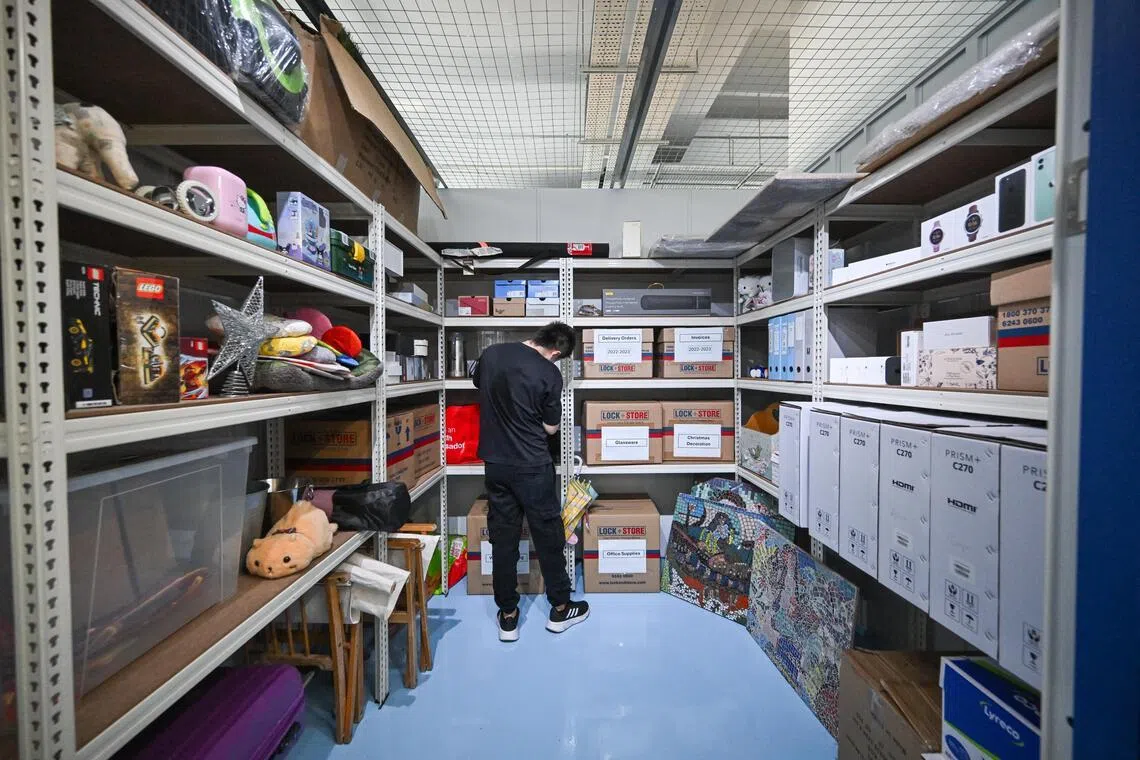
SINGAPORE – A man once told storage provider Lock and Store that he wanted to rent a space.
But when storage manager Nur Haziqah, 31, asked what he was going to use the space for, he told her off.
She said: “He told me, ‘You don’t need to know. I’m just storing five boxes.’” Following company protocol on handling dubious items, she turned him away.
In other incidents, potential clients insisted on paying in cash and refused to provide documentation.
Such requests were also rejected by Ms Haziqah.
While such cases are rare, storage providers here said they do have basic screening procedures for potential clients and will reject suspicious ones.
Still, they are concerned about the new anti-vaping laws passed on March 6.
Called the Tobacco and Vaporisers Control Act, the legislation introduced a new offence which puts the onus on storage providers to prevent clients from storing vapes on their properties.
If they do not do so, they face jail time of up to three years and a $100,000 fine for a first offence, and double that for a repeat offence.
On March 6, Dr Koh Poh Koon, Senior Minister of State for Health, had announced details of the Act in Parliament, saying the new laws are expected to be operationalised from May 1.
They come after several cases of illegal vape operations were uncovered in warehouses and storage units. The largest seizure exceeded 400,000 vapes and components worth over $5 million.
Storage providers said they were seeking greater clarity from the Ministry of Health (MOH) on what is expected of them, as it is not possible to check every box or carton that enters their premises.
On March 9, in response to the new laws, the Self Storage Association Asia issued a statement saying Customs authorities should be the ones conducting checks.
Ms Helen Ng, who chairs the association, said: “As customers typically store their belongings in sealed cartons, operators are not able to inspect the contents of every box. Enforcement is therefore more appropriately carried out at the point of import by Customs authorities.”
The Health Sciences Authority (HSA) published a 10-page handbook titled Exercising Due Care For Owners And Occupiers Of Commercial Premises on its website the same day the new laws were passed. It outlined the “due care” required of operators.
This includes conducting basic screening of tenants’ identities and contact details, regular inspections and spot checks, and training of staff to spot and report suspicious goods and activities.
However, operators said they needed more specifics about these requirements, citing challenges with both client privacy and manpower constraints in checking boxes and cartons.
Ms Ng, who is also the chief executive of Lock and Store, said operators are not enforcement agencies and there are practical manpower limitations.
She said: “Items are usually stored in sealed cartons, making it unrealistic for operators to verify the contents of every box.

Clients must declare they do not store prohibited items, such as lithium batteries which pose a fire hazard, drugs, explosives and ammunition.
ST PHOTO: SHINTARO TAY
“If prohibited items are difficult to detect even at the point of import, it would be equally challenging for storage operators to identify them once they are packed and stored.”
She said many operators included vapes on their list of prohibited items after the Government escalated its crackdown on vaping in 2025.
Clients must declare they do not store prohibited items, such as lithium batteries which pose a fire hazard, drugs, explosives and ammunition. If they breach this, they are immediately kicked out, with their deposit forfeited.
Deposit amounts differ for each provider, and not all of them require one. Some accept deposits of under $50, while others collect a deposit of at least one month’s rental fees.
Ms Ng added that in past cases involving contraband items like drugs or duty unpaid cigarettes, it was usually the authorities who alerted the operator, who would then cooperate with them.
Mr Jes Johansen, chief executive of Storefriendly, said that because of privacy issues, operators cannot enter their clients’ storage units. Clients use their own padlocks to secure the shutters of each unit.
Personal data protection guidelines also prevent operators from having access to customers’ full NRIC details. They said they are allowed to get only the last four digits of the NRIC number.
When asked for clarity on this, an HSA spokeswoman on March 21 referred ST to the handbook.
It stipulates that operators should check identity cards, passports, contact details and registered addresses.
The spokeswoman said HSA will be engaging industry associations in April to explain how they can comply with the new laws.
This means operators have only about a month to clarify, train staff and implement measures, or risk being prosecuted.

A spokesman for Spacehub, which provides storage facilities in Woodlands, said front-line staff are not trained to be enforcement officers.
“Vape devices are small and easy to conceal, and unless someone is using them openly, it can be difficult for staff to detect.
“As private operators, we do not have enforcement powers, so our role is largely limited to discouraging such activities and cooperating with the relevant authorities if necessary,” he said.
HSA said owners and occupiers of commercial premises can write to HSA_IS@hsa.gov.sg if they require assistance.