
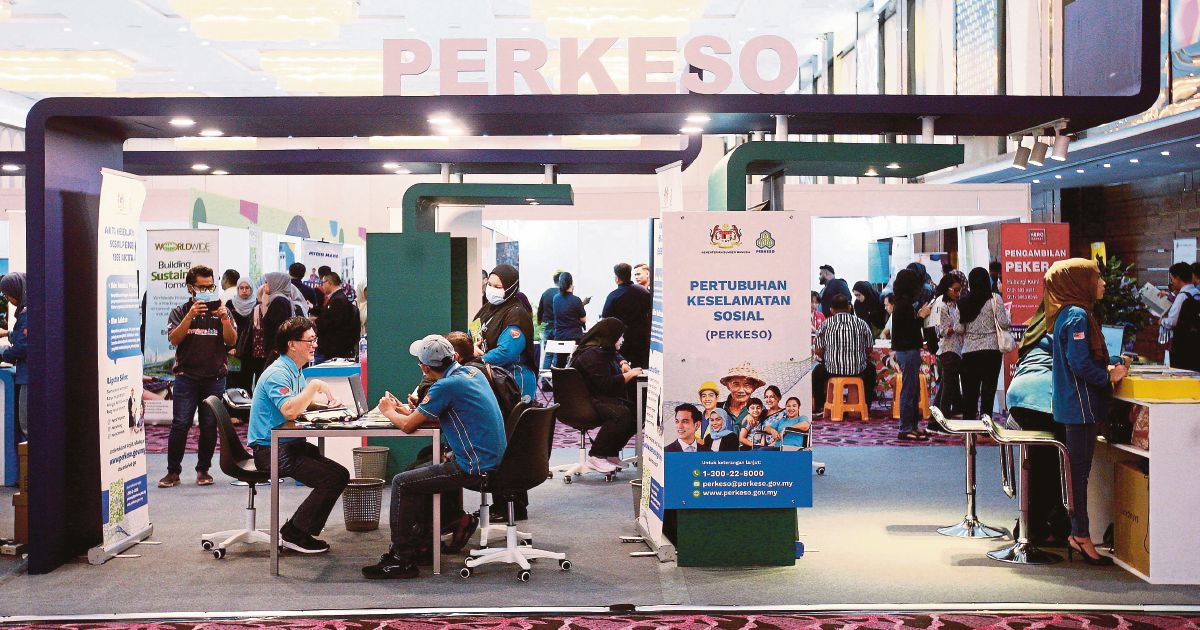
KUALA LUMPUR: Malaysia’s labour market has continued to demonstrate resilience despite economic shifts, rapid technological advancements and changing work practices.
While many economies face rising job uncertainty, Malaysia’s employment ecosystem remains relatively stable, with encouraging outcomes for fresh graduates and first-time jobseekers.
Recent labour market indicators suggest that job creation and workforce absorption are keeping pace with structural changes in the economy.
According to the Statistics Department, the recent national unemployment rate had declined to 2.9 per cent in November last year, the lowest level in the past 11 years, showing that the country’s labour market performance continues to record encouraging progress and is on a stable path of recovery and growth. The increase in total employment reached 17.09 million persons, while the employment-to-population ratio rose to 68.8 per cent.
This indicates that more Malaysians have successfully entered the labour market.
For young Malaysians entering the market, this is a crucial development; it indicates that the economy is not only providing more jobs but, more importantly, improving the quality of those jobs.
Sustaining this momentum remains a top priority will remain a key priority for the Human Resources Ministry in strengthening comprehensive and focused human capital development policies.
Under the Madani Economy framework, the ministry continues to implement various strategic initiatives to ensure better job opportunities, dignified and reasonable wages and comprehensive worker protection.
To operationalise these strategic goals, the ministry leverages MYFutureJobs developed by the Social Security Organisation (Perkeso) as the national employment platform.
Powered by real-time labour market data, MYFutureJobs plays a key role in connecting jobseekers with suitable employment opportunities while helping employers identify candidates who meet operational needs.
Data from MYFutureJobs demonstrates a sustained and strong orientation towards skilled employment in Malaysia.
In 2024, 90.1 per cent of job placements were concentrated in high- and semi-skilled roles, with only 9.9 per cent in low-skilled occupations, underscoring the dominance of skills-based employment.
Last year, although the share of high and semi-skilled placements had moderated slightly to 86.7 per cent, these roles continued to constitute the majority of placements, whereas low-skilled jobs increased marginally to 13.3 per cent.
The year-on-year increase in skilled job placements underscores Malaysia’s structural transition towards a more knowledge and competency-driven workforce, aligned with industry demand for higher productivity, digital capabilities and specialised skills.
This progression also highlights the effectiveness of MYFutureJobs in facilitating job matching that supports workforce upskilling, economic resilience and sustainable growth. This trend challenges the perception that graduates are struggling due to a lack of opportunities. Although job mismatches remain, they are largely driven by salary alignment and geographic preferences, rather than a shortage of vacancies.
Encouragingly, graduate employment outcomes have continued to improve year-on-year, pointing to a labour market that is steadily strengthening.
Parallel to these developments, the growth in entry-level opportunities highlights the foundational strength of the Malaysian labour market.
This is evidenced by the consistent demand for junior talent within the services, manufacturing, logistics, hospitality and community services sectors.
Statistically, a total of 304,026 entry-level vacancies were recorded on MYFutureJobs across these sectors, with service and operations roles accounting for approximately 72.9 per cent of total opportunities.
This highlights the critical role of service-oriented and operational sectors in absorbing new labour market entrants, particularly school leavers, graduates and young jobseekers.
However, the graduate labour market has become more complex. Digitalisation, post-pandemic restructuring and evolving workplace practices have reshaped employer expectations. As a result, successful employment outcomes increasingly depend on better alignment between graduate expectations and employer requirements.
Hence, Perkeso plays a critical role as a labour market facilitator. MYFutureJobs provides a transparent, data-driven job-matching ecosystem that supports informed decision-making by both jobseekers and employers.
[[nid:1356239]]
Its data shows that a large proportion of entry-level positions still require physical on-site presence, while hybrid and remote work arrangements remain limited and mainly concentrated in technology and professional services.
By making such information visible upfront, MYFutureJobs helps reduce expectation gaps and supports more sustainable employment matches. In today’s labour market, transparency is essential to effective job matching.
Labour market intelligence also guides Perkeso’s targeted re-employment and reskilling efforts.
Last year, nearly 90 per cent of recorded job losses were concentrated in the services and manufacturing sectors. In response, the government prioritised its employment support and reskilling initiatives in those areas.
The Employment Insurance System (EIS) registered 74,841 loss of employment (LOE) applications from displaced workers. The majority of them were from the manufacturing, construction, wholesale and retail trade sectors.
Notably, most displaced workers remained within the same sectors as their previous employment, reflecting strong skills transferability and effective job matching.
Nevertheless, EIS has played a key role in supporting displaced workers’ return to employment, with around 70 per cent of approved LOE recipients successfully re-employed between 2020 and 2025, reflecting effective job matching and re-employment support by Perkeso.
Wage data further shows that higher salaries are typically associated with high-skill occupations, including leadership, engineering, technology and specialised professional roles.
Comparatively, sectoral trends indicate that industries such as mining and quarrying, utilities and information and communication offer higher average wages, reinforcing the need to support workforce mobility into high-value sectors.
Looking ahead, MYFutureJobs insights point to growing demand in sunrise sectors aligned with Malaysia’s future economic priorities. Strong employment growth is expected in digital services, e-commerce logistics, green technology, healthcare support and advanced manufacturing.
Occupations such as renewable energy specialists, data analysts and data scientists, construction and engineering professionals, healthcare support specialists, as well as ICT, automation and electronics professionals are projected to see sustained demand.
Hence, aligning employment services and training initiatives with these trends is essential to ensuring long-term workforce relevance.
Bridging the gap between graduate expectations and labour market realities is central to Malaysia’s long-term economic development.
Therefore, MYFutureJobs is not only addressing immediate labour market challenges but also strengthening Malaysia’s workforce readiness to support sustainable economic growth in the years ahead.
© New Straits Times Press (M) Bhd