
SINGAPORE – Over the past three years, more than 350 pre-school children from lower-income families have taken part in a tele-dentistry programme, with findings showing a reduced risk of tooth decay.
It led to earlier dental intervention and improved follow-through on treatment recommendations compared with an earlier study. More parents also brought their children for regular dental care at primary care clinics.
Launched in January 2023, the initiative is part of the National University Hospital’s (NUH) Health and Development Support in Pre-school Partnerships (HEADS-UPP) programme. The collaboration with social service agency Care Corner Singapore and pre-school operator PCF Sparkletots is funded by the Ministry of Health.
It is targeted at children aged between 18 months and six years. As of Jan 20, 355 children from 17 PCF Sparkletots pre-schools in western Singapore have benefitted, NUH said on April 22.
Nurses and case management officers visited the children in school to take intraoral images, or photographs of the inside of the mouth.
Parents were asked to complete a questionnaire on matters such as the oral hygiene and dietary habits of their children, frequency of dental visits, as well as the family history of caries, or tooth decay.
Each questionnaire was reviewed by a paediatric dentist from the dentistry faculty of NUS, who assessed the photographs for signs of dental plaque and caries.
A personalised report, including images of teeth, was generated for each child. It indicated areas of concern and decay risk level, as well as recommended follow‐up actions.
The report was then reviewed with the parents, focusing on key recommendations and preventive practices.
High-risk children were referred to the National University Centre for Oral Health, Singapore (NUCOHS) for specialist care, while those at lower risk were referred to appropriate primary care.
The reports showed that 93.3 per cent of the children were at moderate to high risk of dental caries, with the images showing that 30.7 per cent had inflamed gums and 54.9 per cent had poor oral hygiene.
About six to nine months later, parents completed another questionnaire to assess whether they had followed through on recommendations such as arranging dental visits or changing their child’s oral health habits.
The programme led to earlier intervention, with 57.5 per cent of the children receiving specialist dental treatment between four and six months after it was recommended.
This is an increase from the 13.3 per cent of children from lower-income families who received such treatment in a 2019 National University Health System study.
About 51 per cent of parents followed recommendations for regular dental care for their children at primary care dental clinics, compared with 28.9 per cent in the earlier study.
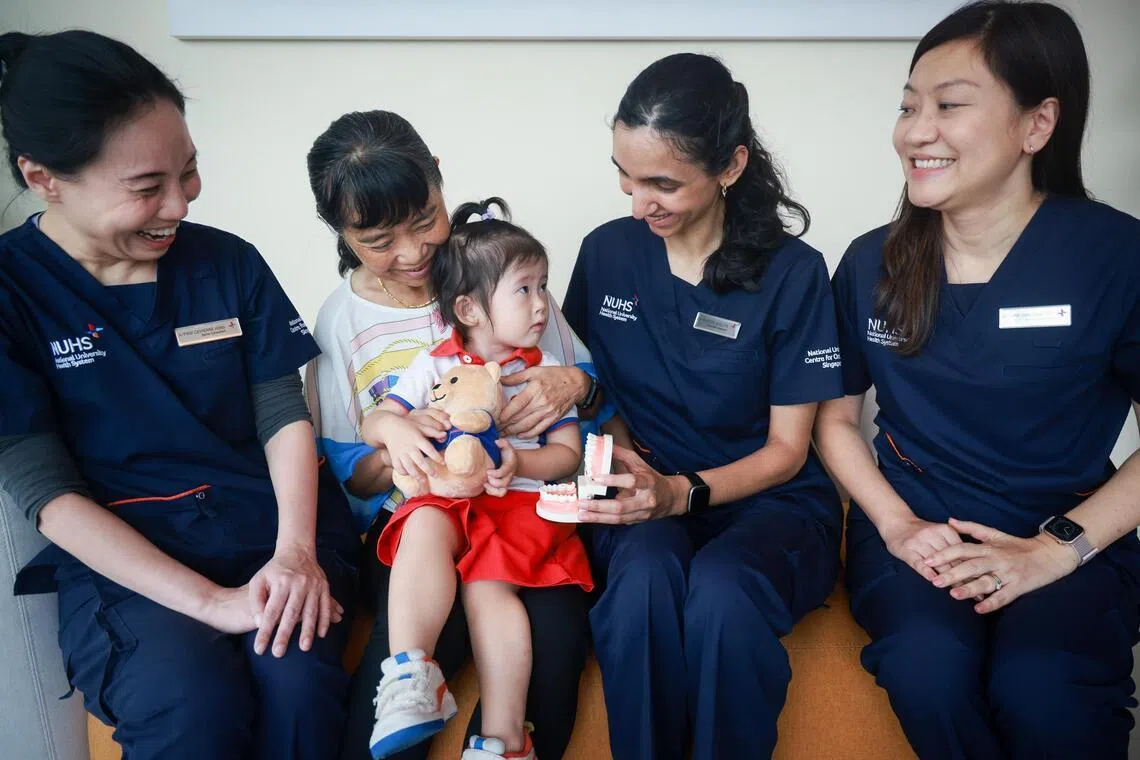
Two‐year‐old Rhianne Lee was assessed to be at high risk of dental caries, with signs of inflamed gums.
Her grandmother, Madam Peggy Tan, said she had learnt how to better manage the toddler’s dental health.
“Even though Rhianne still cries when brushing, we try to comfort her, and I plan to check with the dentist on how to make the routine more comfortable,” said the 65-year-old part-time customer service officer.
The programme involved experts from NUS Dentistry, NUCOHS, and the NUS Yong Loo Lin School of Medicine.
“By bringing dental assessment and clinical advice closer to where children are, we are able to identify risks earlier and support lower‐income families who might otherwise face barriers to timely care,” said Associate Professor Catherine Hong, NUS Dentistry vice-dean for research, innovation and enterprise.
Prof Hong noted that compared to a mobile dental clinic – which would require a dentist and specialised equipment – tele-dentistry is more efficient and cost-effective.
Adjunct Associate Professor Chong Shang Chee, programme lead of HEADS-UPP, said the team aims to benefit another 300 children over the next three years.
They also aim to use artificial intelligence to review intraoral images, evaluate questionnaire responses, and generate oral health reports.
“These enhancements will streamline the dental screening process, enabling the programme to reach more children and expand to additional preschools, while reducing reliance on manual processes,” said Prof Chong, who also heads the developmental and behavioural paediatrics division at NUH’s paediatric arm.