
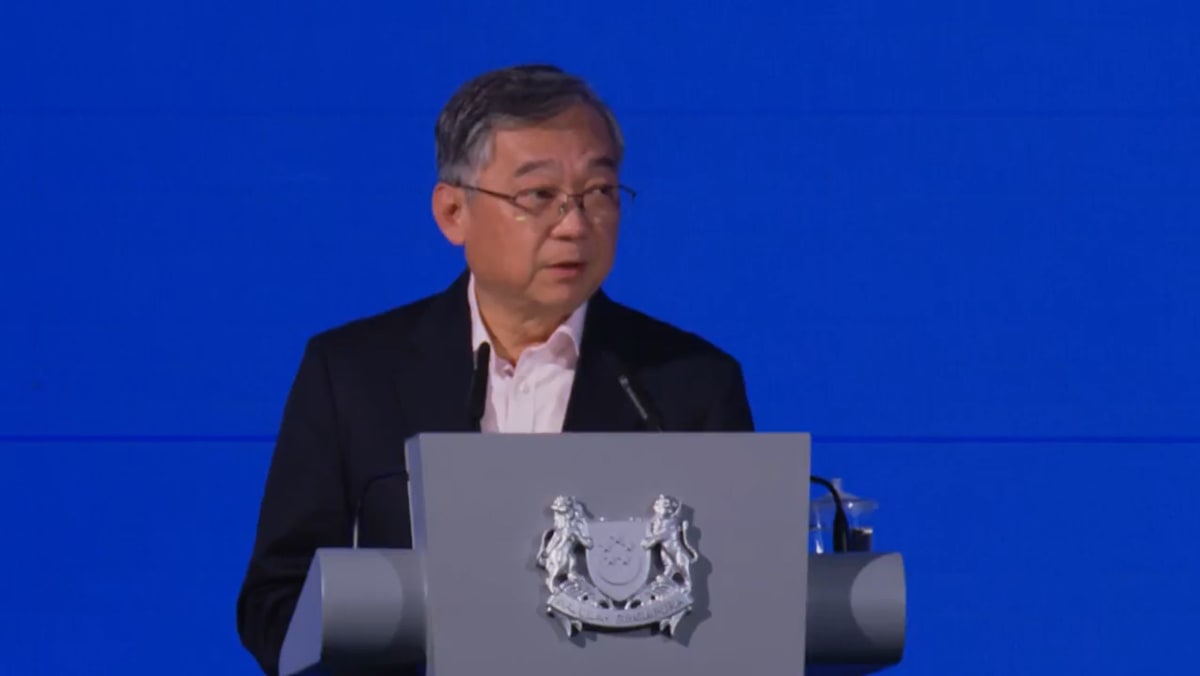
SINGAPORE: In a time when pressures are pulling systems apart, maritime hubs that anchor connectivity, standards and trust become even more important, said Deputy Prime Minister Gan Kim Yong on Tuesday (Apr 21).
Mr Gan was speaking at the Singapore Maritime Week at Suntec Singapore Convention and Exhibition Centre, where he spoke on the developments in the Strait of Hormuz and what Singapore can do as a maritime hub.
He said that in a “fragmented system” amid the global geopolitical situation, “trust carries a premium”.
“Shipping depends not only on infrastructure, but also on confidence – that confidence that international frameworks will be respected, that ports will operate reliably, that rules will be applied consistently, and that contracts will be honoured,” he said.
“Singapore’s maritime ecosystem is built on these foundations – strong rule of law, transparent governance is very ecosystem of maritime services such as finance, insurance, legal and arbitration.”
For much of the past 50 years, maritime networks have operated within a system that was “broadly stable”, underpinned by navigational rights and freedoms enshrined in the United Nations Convention on the Law of the Sea (UNCLOS), said Mr Gan.
“These rights and freedoms are existential, not only to Singapore status as a maritime power, but also to the growth and functioning of the global economy.”
He noted that Singapore was one of the architects of UNCLOS, which “clearly stipulates the right of transit passage for all ships and aircraft through straits used for international navigation.
“This right is important for all nations around the world that depend on maritime connectivity and trade.”
While UNCLOS continues to be the important for the “international rules-based maritime order”, the system is now “increasingly fragile”.
Developments in the Strait of Hormuz stemming from the Middle East conflict have “brought this reality into sharp focus”.
“In recent days, the US and Iran have sent mixed messages about the status of the strait, underscoring just how volatile and fluid the situation has become,” said Mr Gan.
What began as a disruption in a narrow waterway has “quickly cascaded across the global economy”, said Mr Gan. This can be seen through energy prices, transport costs and production chains.
“This is not just a regional disruption – it is a systemic shock, a reminder that instability at a single maritime chokepoint can transmit quickly across the global economy within days, with its knock-on effects lasting for months or longer,” he said.
It is thus not surprising that interdependence is “increasingly seen through a different lens”.
“Not just as efficiency, but as exposure. Not just as connectivity, but vulnerability,” he said.