
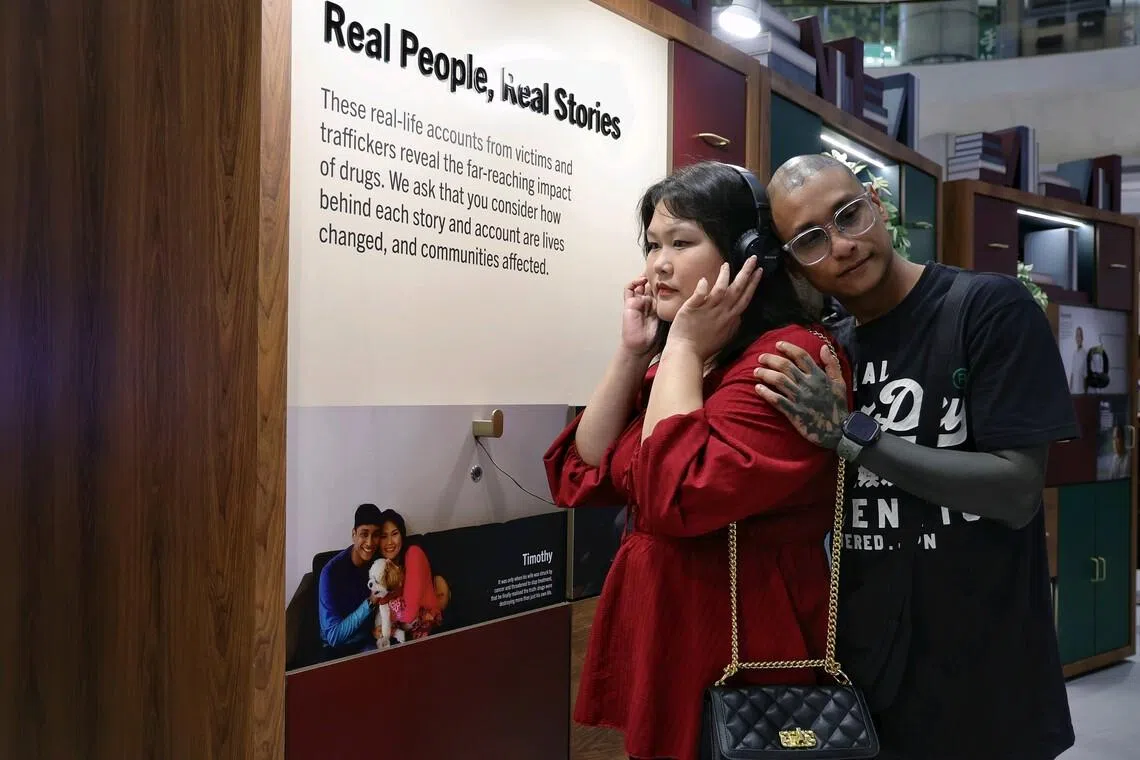
When he was just 16, his father turned him in to the authorities for drug abuse. For years after, the cycle – rehabilitation, then relapse – continued for Timothy York James.
It was only after he got married that the weight of it fully landed. In 2022, his wife was diagnosed with ovarian cancer three months into their marriage.
She told him she would rather forgo treatment and die than watch him keep abusing drugs.
It was only then that James promised he would stop.
“I want to tell addicts that you are not alone. Don’t be afraid or ashamed to ask for help,” says the 44-year-old.
His story was among those featured at The Library of Stories, Unfinished, an installation at Suntec City atrium held as part of Singapore’s third Drug Victims Remembrance Day observance last May. Every account reflected lives shaped, disrupted and, in some cases, cut short by drug abuse – stories left unfinished.
Central Narcotics Bureau’s deputy director of Partnerships and Outreach, DrugFreeSG Office Kaye Chow says: “When people hear these stories, we hope it does not just move them, but also prompts them to ask harder questions about what is happening around them and potentially consider if there is something that we, as members of society, can do to prevent such harms from occurring.”
The 2025 National Drug Perception Survey found that more than 87 per cent of youth respondents said they understood the harms and consequences of drug abuse. However, awareness of harm is not the same as an accurate read of what is happening in one’s own social circle.
Dr Jasmin Kaur, a senior principal psychologist at the Home Team Psychology Division, says: “It’s not just about being tough or simply saying no to drugs. It’s also about building conditions and communities where drug abuse becomes harder to justify, and drug abstinence becomes easier to sustain.”
Chow adds that sustaining such an environment also depends on people being able to critically assess what they see online, where misleading or glamorised portrayals of drugs can quietly shape attitudes, weaken perceptions of harm and make drug use seem more socially acceptable over time.
“Young people today are navigating an information environment where cannabis is portrayed as harmless, where drug abuse is framed as a lifestyle choice and where these ideas spread quickly and subtly. When that becomes the backdrop of their social world, it shifts their sense of what is normal,” says Chow.
This is the premise behind the DrugFreeSG Video Competition 2026, which invites young Singaporeans to engage with the issue of drug abuse more critically: to investigate, examine and respond to it on their own terms.
“We are not looking for young people to repeat messages they have already heard. We want them to put on a journalistic lens – to look at the world around them, ask what is really going on, and respond in their own voice,” says Chow.

The DrugFreeSG Video Competition 2026 challenges young Singaporeans to use a journalistic lens to expose the hidden influences that quietly normalise drug abuse among peers.
PHOTO: SPH MEDIA
What it is:
A nationwide competition challenging young Singaporeans aged 12 to 25 to create videos exploring the influences quietly normalising drug abuse among their peers. The theme: Exposing and Preventing the Hidden Influences That Destroy Lives.
This is not about the overt pressure of a stranger offering drugs. It is about the subtler kind: an influencer casually mentioning microdosing, an online community framing drug use as self-care, a Reddit thread insisting marijuana is “just a plant”. These are the repeated messages that can shift attitudes without anyone noticing – until it is too late.
Why it matters:
With drug abusers now as young as 12 and over half of new arrests under age 30, the competition takes a peer-to-peer approach: young people speaking to other young people in formats and platforms they actually use to challenge permissive attitudes towards drug abuse and build a community where drug abuse is not normalised.
Who can enter: Ages 12 to 25 (solo or teams up to 5)
Video length: Maximum 5 minutes
Deadline: August 23, 2026
Top prize: $3,000 cash
Submit at: drugfree.sg
Three creative approaches:
-
Content creator – Platform-native, shareable social content
-
Reporter – Investigative, fact-driven breakdown
-
Filmmaker – Cinematic storytelling with emotional impact
What is required:
Videos must be grounded in research and factual accuracy (30 per cent of judging score). Through the DrugFreeSG Video Competition 2026 website, participants get access to real accounts from those affected by drug abuse – not sanitised stories, but the actual consequences of arrest and addiction.
The goal:
Create something young adults will actually watch, believe and share – not a lecture, but a message that lands.
If you know a young creator, student filmmaker, or tech-savvy teen who could tackle this challenge, share this opportunity. Submissions close August 23, 2026, at drugfree.sg.
