
SINGAPORE – When tiger dancers from Hainan first arrived in Singapore, their craft was overshadowed by the more established and popular southern lion dance.
To appeal to the masses, members of the Guang Wu Club, the last Hainanese martial arts organisation in Singapore, created the Hainan lion dance, fusing elements of the traditional Hainanese tiger dance with the more familiar Foshan lion dance, said Mr Raymond Foo, president of Guang Wu Club.
The Hainan lion dance was last performed in public in 1967 before Mr Foo revived it in 2016. He noted that the Hainan lion dance is culturally unique to Singapore.
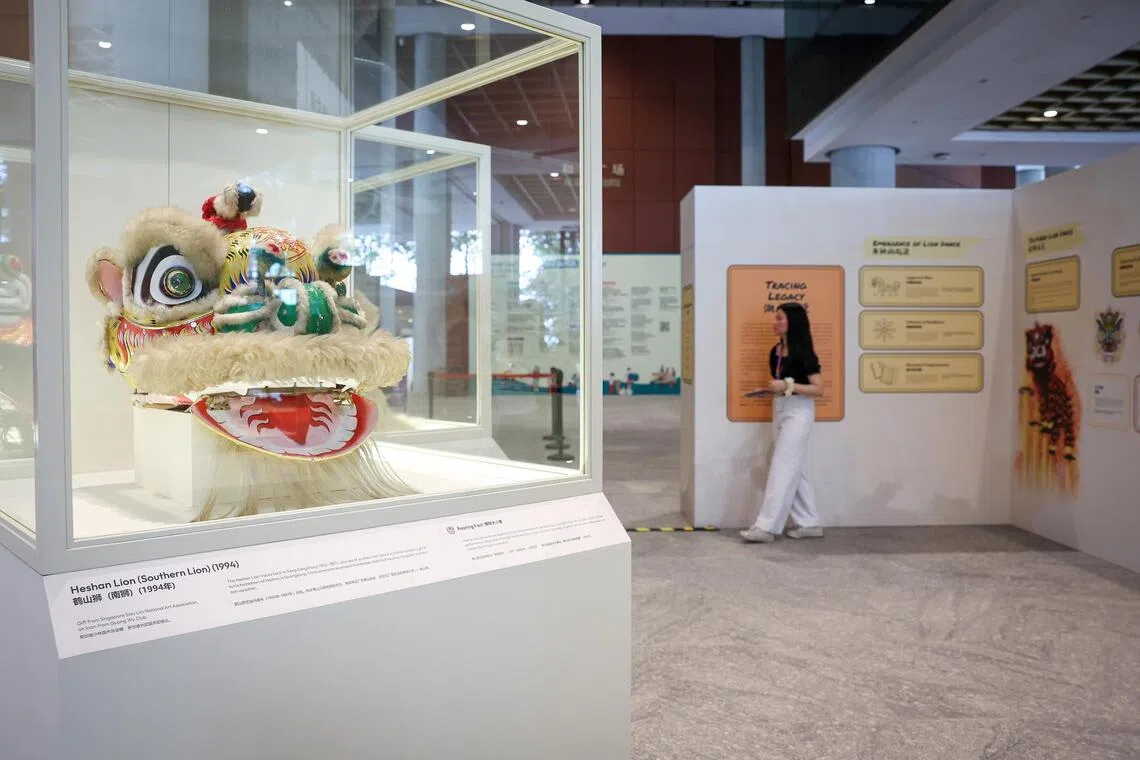
The Hainan lion head, with a flatter and more bulbous head than the more commonly known southern lion dance head, is one of eight lion heads displayed at a new exhibition launched by the Singapore Chinese Cultural Centre (SCCC).

An early generation Hainan lion in the 1950s.
PHOTO: COURTESY OF RAYMOND FOO
Titled Tradition In Motion: Singapore’s Lion Dance Heritage, the exhibition showcases the rich history, evolving customs and contemporary expressions of lion dance in Singapore.
More than 50 artefacts, photographs, posters and figurines are displayed at the 120 sq m exhibition across three thematic zones.
SCCC chief executive Alvin Tan said the centre wanted to highlight the different types of lion dance that are unique to Singapore, such as the Fo He lion that was created by veterans of Foshan and Heshan lion dances who combined their two styles.
The displays of eight lion heads, comprising the familiar southern lion dance ones from Guangdong, China, and less common variants from Hainan and Fujian, form the centrepiece of the exhibition.
“Through the exhibition, we hope that visitors can learn more about lion dance, including its early roots, the unique traits of lion dance in Singapore, how it continues to be manifested through popular culture and more,” Mr Tan said.
Visitors can also learn about how lion heads are made. A display of a lion head, handmade by Singapore’s last lion head master craftsman, Mr Henry Ang, shows the first and final stages of production.
Mr Justin Lee, the assistant curator at SCCC, said that during his research for the exhibition, he witnessed what he describes as an enduring tradition.
“What I saw is a very enduring tradition, where participants from different age groups, different ethnicities, are all enjoying and participating in this integral cultural heritage that is lion dance,” Mr Lee said.
One such non-stereotypical lion dance practitioner is Arielle Ng, 11.

Arielle Ng, 11, is the youngest member of the Singapore Hok San Association Lion Dance Troupe.
ST PHOTO: LIU YING
The Primary 5 pupil from Tanjong Katong Primary School started lion dance when she was eight. She was amazed by a lion dance performance she saw at school and immediately went home to ask her mother to sign her up to a lion dance troupe.
“I like the costume and the dancing,” Arielle said. The cat lover added that she particularly liked the fur on the costume.
Arielle, the youngest member of the Singapore Hok San Association Lion Dance Troupe, performs in a customised mini lion dance costume.
As a solo act, she performs as both the head and tail of the lion.
Noting that she has performed with the troupe for shop openings and during festive seasons, she said: “I like the dancing and the performing. I like to entertain people.”
Arielle said her troupe members have supported and guided her, and she hopes to continue performing in the future.
Lion dance has also evolved to become a suitable routine that seniors can participate in. The first senior-focused troupe in Singapore, the Silver Pride Lion Troupe, was founded in 2023 to help seniors stay active and healthy.
Such lion dance routines are modified to enable even those with mobility issues to participate. Around 25 seniors, with the youngest aged 63 and the oldest 99, perform in the multi-ethnic troupe.
The exhibition will run daily till April 30, 2026, from 9am to 10pm, at the SCCC Concourse. Admission is free.