
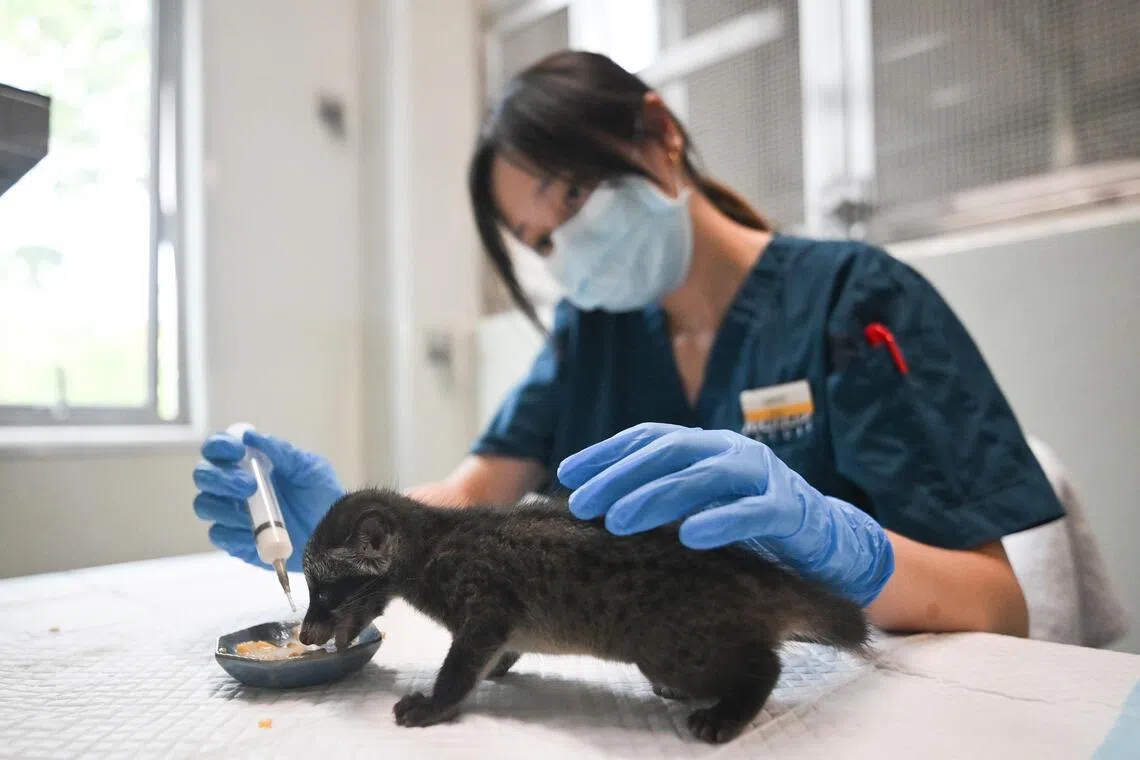
SINGAPORE – As day turns to dusk, junior veterinary nurse Nadhrah Hassan patiently feeds three energetic baby common palm civets abandoned by their mother.
The 22-year-old is part of a pioneering four-member team at the Mandai Wildlife Centre, a dedicated hospital for rescued native wildlife officially opened on July 22 by Mandai Nature, the group’s non-profit conservation arm.
Despite the kits’ indefatigable determination to leap off the table, Nadhrah shows no sign of fatigue.
Their meal of fruit and milk replicates what they would eat in the wild, an essential step toward helping them eventually survive in Singapore’s urban landscape.
“No words can truly capture the joy of knowing you helped give an animal a second chance at life. Every small improvement is a milestone worth celebrating,” Nadhrah told The Straits Times.
Unlike the group’s other veterinary hospitals, which primarily serve zoo animals, the new centre will aim for the full rehabilitation and release of its animals into the wild. Simultaneously, the hospital will act as a living observatory, gathering crucial medical data on Singapore’s wild fauna.
Tending to injured pangolins, feeding an orphaned bat, and X-raying a dehydrated changeable hawk-eagle were all part of a day’s work during ST’s visit to the hospital on July 2.

Head of Mandai Wildlife Centre, (right) Dr Charlene Yeong, and Junior Veterinary Nurse Nadhrah Binte Hassan, bringing the rescued changeable hawk-eagle to the wards at the new Mandai Wildlife Centre on July 2.
ST PHOTO: LIM YAOHUI
Building on over two decades of wildlife rescue experience, the new facility at the Rainforest Wild Adventure East features a larger rehabilitation yard and a suite of diagnostic tools including a moveable surgery table.
Visitors to the attraction can also get a glimpse of the hospital’s conservation work through a viewing gallery.

Visitors are able to view the surgical suite, treatment room, intensive care ward and food preparation area at the new Mandai Wildlife Centre.
ST PHOTO: LIM YAOHUI
The dedicated facility comes as overall intake at Mandai’s Wildlife Healthcare and Research Centre, where rescued wildlife had previously been taken, has declined. Annual admissions dropped from over 2,700 prior to 2015 to about 1,100 annually between 2022 and 2025 as more centers for Singapore’s wildlife opened over the years.
Greater public awareness has also reduced unnecessary admissions, explained Mandai Wildlife Centre’s head Charlene Yeong. She recalled how healthy pythons used to be rushed to Mandai from construction sites and dormitories. Education outreach with workers has helped bring down some of these unnecessary transfers.
“This shift allows us to focus our resources on species requiring highly specialised care,” Yeong said.
Young animals, in particular, demand intensive labour, on occasions resulting in round-the-clock care.

Head of Mandai Wildlife Centre, Dr Charlene Yeong, feeding milk to the common fruit bat, also known as the lesser dog-faced fruit bat, inside the intensive care ward.
ST PHOTO: LIM YAOHUI
For instance, an orphaned lesser dog-faced fruit bat required milk formula feedings seven times a day, with the final feed given at midnight.
The young bat was originally rescued clinging to the teat of its dead mother, but with the care at Mandai Wildlife Centre, it has since graduated from intensive care to eating solid foods.
“His poos have been good, and that makes me happy,” said Yeong with a smile, as she fed the baby bat.
The new hospital’s 10m-long yard gives recovering bats and birds enough flight space to test their wings and rebuild endurance before release.

One of the three common palm civet babies inside one of the wards at the new Mandai Wildlife Centre.
ST PHOTO: LIM YAOHUI
Despite how endearing the animals can be, the team remains clear-eyed about their mission.
“We don’t want to hold them longer than necessary,” Yeong stressed. “The longer they stay in human care, the higher the risk that they become habituated. We definitely want to avoid a situation where they lose their natural fear of humans.”
To date, 62 percent of animals admitted to the facility have made a full recovery and been released successfully back into natural habitats, in collaboration with the National Parks Board.
Beyond treatment, the centre aims to leverage rescue data to fill critical knowledge gaps in native wildlife medicine, particularly for the elusive, globally critically-endangered Sunda pangolin.
“Ecological field surveys are ideal, but they are incredibly resource-intensive,” said Yeong. “Rescue and rehabilitation data provide an insight into changes experienced by populations.”
She cited how veterinarians were initially alarmed when ultrasounds revealed abdominal fluid in admitted pangolins, with the the sign typically linked to illness in most mammals. Through repeated monitoring, however, the team discovered that a small amount of abdominal fluid is actually normal for the species.

Head of Mandai Wildlife Centre, Dr Charlene Yeong, showing an X-ray of the Sunda pangolin outside the Diagnostic Imaging room at the new Mandai Wildlife Centre on July 2.
ST PHOTO: LIM YAOHUI
All reported wild Sunda pangolins in Singapore are taken to the Mandai Wildlife Centre, which has taken over this duty from the Wildlife Healthcare and Research Centre. Annual pangolin admissions rose from 15 in 2015 to between 30 and 40 annually from 2023 to 2025.
The heavily trafficked mammal is primarily threatened by habitat loss and traffic accidents in Singapore.
During ST’s visit, Yeong examined two juvenile pangolins recovering from their injuries. One was receiving antiseptic care for gashes linked to barbed wire, while the other had suffered a fractured limb, likely from a vehicle collision.

Head of Mandai Wildlife Centre, Dr Charlene Yeong, cleaning the wound on the Sunda pangolin inside one of the wards at the new Mandai Wildlife Centre.
ST PHOTO: LIM YAOHUI
To support long-term conservation research, biological samples are collected from high-priority species like the pangolin.
Microchips are also implanted in the scaly mammal, with identification numbers engraved onto the pangolins’ scales.
Similar tracking is used for reticulated pythons, the center’s most common patient.
Low recapture rates suggest that released pythons disperse widely, noted Yeong. Tracking data has revealed that they are capable of travelling great distances, such as one python that had been released in western Singapore and eventually made its way back to the north.
“Pythons are naturally drawn to rodents, and rodents hang around rubbish areas, which is why snakes frequently end up in urban spaces,” said Yeong. She advised the public that healthy pythons spotted in drains should be left alone, as they are likely to be simply hunting for rats. Rescue services should be called only if a snake is visibly injured or in immediate danger.
Looking ahead, the Mandai Wildlife Centre aims to serve as a regional training hub, collaborating with local institutes of higher learning and international researchers to advance applied conservation science across South-east Asia.

Head of Mandai Wildlife Centre, Dr Charlene Yeong, and Junior Veterinary Nurse Nadhrah Binte Hassan, in front of the new Mandai Wildlife Centre on July 2.
ST PHOTO: LIM YAOHUI
For team members like Nadhrah, the daily motivation remains personal.
“The challenges I face in this work are minor compared to what wild animals endure in today’s rapidly developing world,” she said.
“I feel a responsibility to use my skills to give these animals the best possible chance of returning to where they belong.”
Members of the public interested in supporting the Mandai Wildlife Centre’s conservation and rescue efforts can learn more at this website.
