
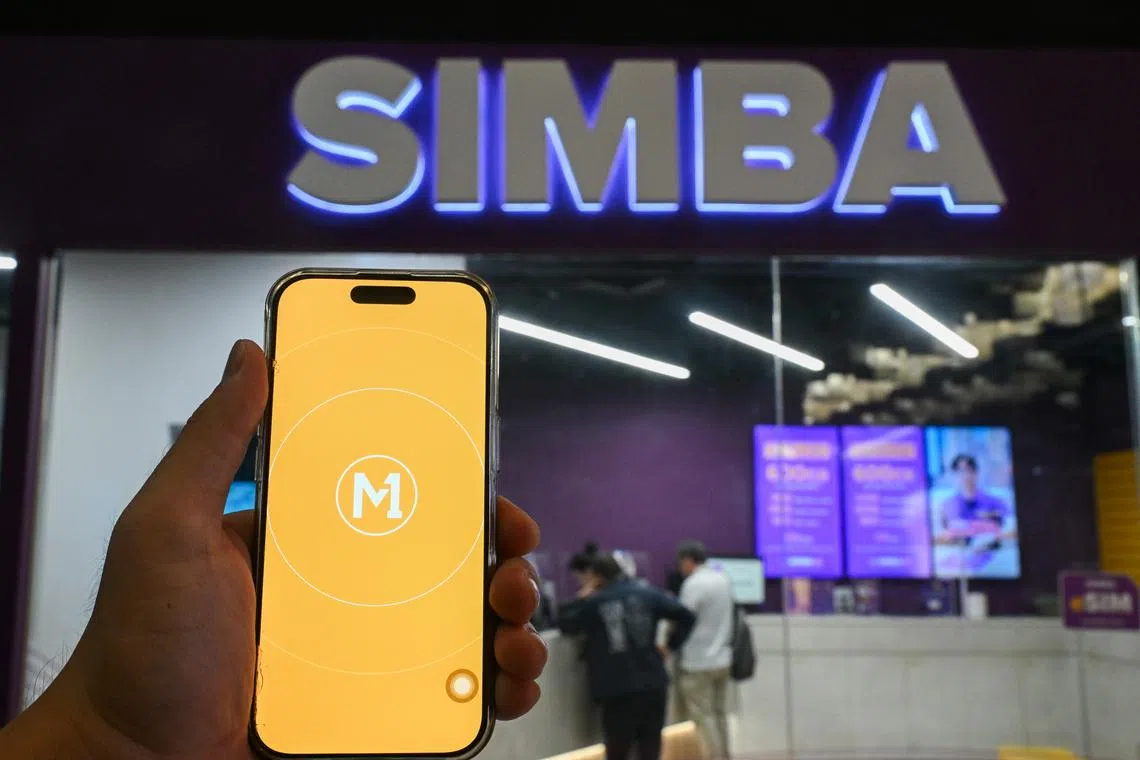
SINGAPORE – On May 18, the Infocomm Media Development Authority (IMDA) suspended its review of Simba Telecom’s $1.43 billion bid for M1’s telecommunications business, citing an ongoing probe into Simba.
IMDA said Simba could be using certain radio frequency bands to provide mobile services without authorisation, which constitutes a breach of regulatory requirements.
What could have happened? What are radio frequency bands? And why is it important for telcos to stay on their approved bands? The Straits Times explains.
Radio frequency bands, or spectrum, are invisible airwaves that carry wireless signals. They make everyday communications possible, including radio and TV broadcasts, aviation and maritime satellite communications and mobile cellular transmission.
IMDA allocates and assigns spectrum frequencies to mobile operators for their dedicated use, and telcos are allowed to use only the spectrum frequency assigned to them.
Assignment of dedicated spectrum for the provision of mobile services is typically done via a competitive process, such as IMDA’s auctions.
From time to time, telcos may ask for the use of certain frequencies on a temporary basis for a limited time and place to enhance their ability to serve customers during major events like the New Year’s Eve countdown. Separate approvals are required for this.
Experts said that straying from one’s allocated lane may be accidental – caused by human or system configuration errors – or intentional, done to increase network speed or capacity.
Poor tuning, ageing equipment or aggressive power settings in mobile base stations could contribute to straying, said Mr Aaron Ang, vice-president of non-profit cybersecurity organisation Digital Defence Alliance Singapore.
Mobile base stations are fixed radio transceivers that bridge the gap between smartphones and the core telecommunication network.
“It could be a genuine engineer error of entering a wrong value or changing the setting to grab more capacity, equivalent to widening one’s assigned lane,” said Mr Ang.
Sometimes, telcos combine their allocated lanes to enable faster surfing. “If no one is doing strict audits, the system can quietly add an empty lane that belongs to another telco into the bundle,” said Mr Ang.
In-building antennas installed in shopping malls, MRT stations and office buildings could also be a source of violations. Because such systems are often deployed by external contractors, an antenna may be tuned to the frequency that provides the strongest or cleanest coverage, even if it belongs to another telco.
If an operator uses a spectrum frequency not assigned to it, this allows the operator to gain an unfair advantage and possibly cause interference with services on other telco networks, said IMDA on May 18.
The amount of spectrum a mobile operator obtains will have an impact on its network planning, infrastructure investment and deployment to serve its customers, said IMDA, adding that it views unauthorised use as a serious matter.
“This is similar to why cars need to keep to their own lanes on any road and planes need to fly along their assigned paths, to prevent collisions,” said the authority.
Ms Asha Hemrajani, senior fellow at the S. Rajaratnam School of International Studies, said that straying by one telco could affect another telco’s services. For instance, it could lead to poorer voice quality, slower downloads and access to websites.
Concurring, Mr Ang said: “Telcos pay real money at auctions for spectrum. Unauthorised use is effectively theft of an asset that distorts competition.”