

Freelance social media manager Merlyn Tay began her career working from home.
She graduated from Singapore Polytechnic at the height of the Covid-19 pandemic in 2020, with a diploma in visual communications. Working from home provided her with flexibility, but it also meant far fewer check-ins than she had had during her pre-pandemic internships.
“My managers and my colleagues could not really see, at least not physically, how I worked,” Tay says. “They only saw my capabilities through my output.”
That early gap in guidance has stayed with her. Tay lost her previous role as a creative and public relations strategist after a restructuring exercise in May 2025, and has been job hunting since January.
Now 27, Tay is still looking for public relations and strategy roles, though she remains unsure about how to develop her career.
She is not alone in feeling this way. Despite Singapore having one of the lowest youth unemployment rates in the world – 6.6 per cent in 2025, according to data from the Ministry of Manpower – career concerns persist among young people across life stages.
Nearly half (49 per cent) of youth say they are stressed by future uncertainty, and 52 per cent worry that they may not keep up with the skills needed in a fast-changing economy.
The findings come from the National Youth Council’s (NYC) engagements with over 60,000 youth aged 15 to 35 between late-2024 and early-2026 to shape the SG Youth Plan.

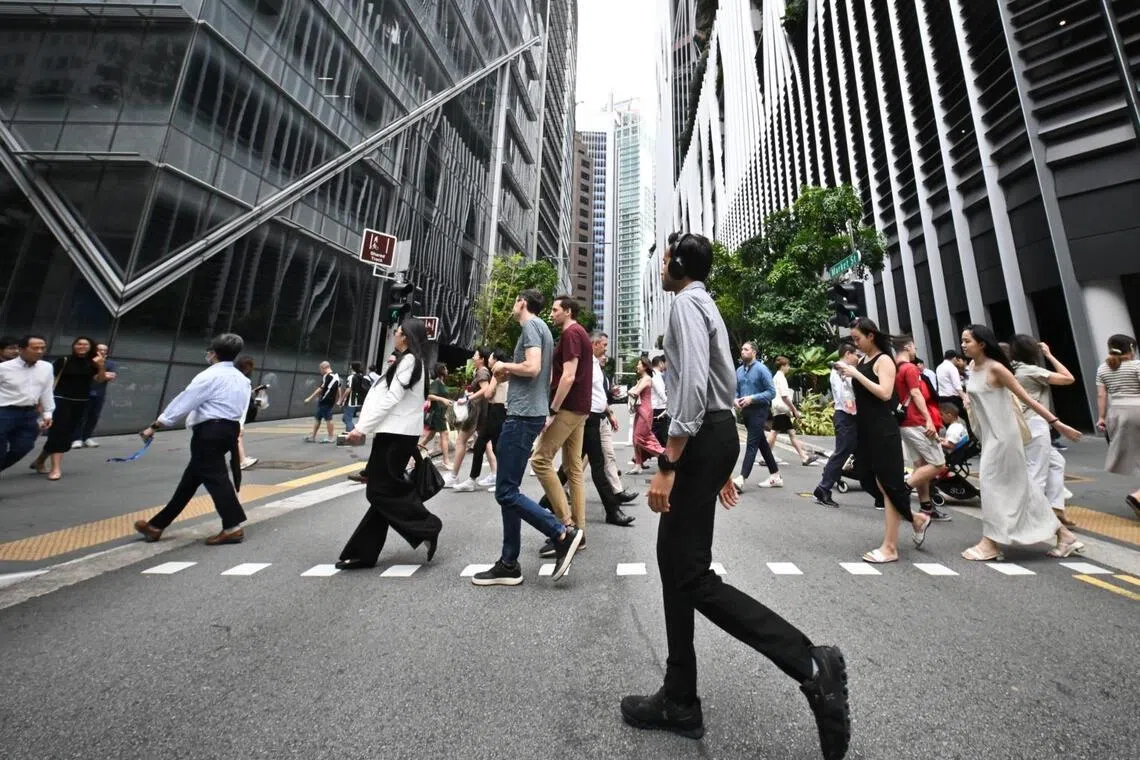
Nearly half of youth surveyed as part of the National Youth Council’s engagements for the SG Youth Plan say they are stressed by future uncertainty.
PHOTO: BT
Unveiled in July, the SG Youth Plan is a five-year roadmap that aims to help young Singaporeans become more confident, connected, and contributing citizens.
Looking for guidance
One of the plan’s key moves is expanding both short- and long-form mentorship opportunities under Mentoring SG, a national initiative launched in 2022.
Mentoring SG aims to offer 20,000 mentoring opportunities a year, and grow its pool of mentors from more than 1,000 to 5,000 by 2030.
Tay welcomes the move. A lack of guidance, she says, has been one of the biggest challenges in her career so far.
Derrick Teo, a certified senior professional at the Institute for Human Resource Professionals, says that young people who entered the workforce amid the pandemic suffered a “subtle” loss: casual workplace interactions.
“They still graduated and started jobs, but many missed the informal learning that happens simply from being around experienced colleagues, like watching how somebody manages a client,” he explains.
Having missed that experience early on, Tay now values growing her capabilities, receiving feedback and building connections in her career. She hopes mentors can share insights and advice from their own experiences.
Navigating tech disruptions

Nearly two in five youth view artificial intelligence as a threat to job opportunities, according to the SG Youth Plan.
PHOTO: GETTY IMAGES
Beyond finding connections and landing jobs, larger technological shifts loom over young professionals.
Young Singaporeans fear AI is eroding entry-level jobs and making certain skill sets redundant. Nearly two in five youth view artificial intelligence as a threat to job opportunities, according to the SG Youth Plan. More than half worry about keeping up with the skills required in a fast-changing economy.
Spearheaded by the Ministry of Culture, Community and Youth (MCCY) and the National Youth Council (NYC), the SG Youth Plan is a five-year roadmap shaped by responses from over 60,000 youth aged between 15 and 35.
Janelle Ling, a fresh graduate from Nanyang Technological University, hopes to one day direct long-form documentaries.
But the 23-year-old, who graduated with a degree in communication studies in July, worries AI will take away opportunities in related industries and make employers undervalue her skills.
“I worry companies will budget less for certain roles like social media writing because they believe they can just use AI for it, or hire someone for less money because they can use AI to write,” she says.
Francois Lancon, regional president of Asia-Pacific and Middle East at ManpowerGroup, says these concerns are understandable, but candidates should not fear broad job losses. Instead, they should focus on adapting to workplace transformations driven by AI.
While employers are willing to pay a premium for AI-related skills – such as AI literacy, and AI model and application development – they continue to rate soft skills like critical-thinking, problem-solving and teamwork highly, he says.
NYC says the SG Youth Plan will include opportunities for young Singaporeans to build “AI bilingualism” – defined as combining human strengths with the effective use of AI across different fields – and boost employability.
“Competitive advantage will come less from access to technology itself,” says Lancon, “and more from the ability to combine technical expertise with human strengths such as judgment, communication, creativity, and leadership.”
Exploring possibilities
Concerns among youth vary by life stage. Among schooling youth aged 15 to 19, the biggest worry is what to study and work towards. They want career exposure, but 58 per cent say they are unsure about how to begin, and 29 per cent do not know how to start looking.
Janelle Ling, a graduate from Nanyang Technological University, shares that uncertainty. The 23-year-old, who majored in communication studies and graduated in July, has not applied for any permanent roles yet.
She is considering carving out a freelance career, but remains open to opportunities in production and journalism.
“I’m afraid to click and apply for roles, because the thought of not liking what I’m doing and then having to leave quickly – it doesn’t feel like a good thing to do,” she says.
Initiatives like job-tasting programmes outlined in the SG Youth Plan aim to help young people like Ling test the waters. Job-tasters are short-term career exploration programmes ranging from half a day to a few weeks.

Fresh graduate Janelle Ling, who has yet to apply for any permanent roles, says she would like a chance to try out a job before committing to it.
PHOTO: COURTESY OF JANELLE LING
NYC plans to offer 10,000 such opportunities in 2026, partnering public, private and people sectors to reach 30,000 job taster opportunities a year by 2030. Job-tasters can be found on NYC’s Discover, a one-stop online platform to support youth through key life transitions.
Teo believes this kind of low-stakes exposure is especially useful for first-time job seekers.
“Sometimes a short experience teaches someone: ‘I thought I wanted this career. Now I know I don’t.’ That is not a failure. That is valuable information to discover early,” he says.
Ling says she would jump at the chance for a job-tasting opportunity in an industry she is curious about.
“If there was a three-week or month-long job-taster for being a video journalist, I would apply for that programme faster than I would apply to it as an actual job – even if it was unpaid,” she says.
“I just want a real insight of what I’m signing up for and whether I like it, before I commit to it fully,” Ling adds.
Francois Lancon, regional president of Asia-Pacific and Middle East at workforce solutions giant ManpowerGroup, says the holistic approach of the SG Youth Plan to help young Singaporeans build a fulfilling professional life is important in a changing labour market.
“By combining career exploration, mentorship, workplace exposure, overseas experiences, and future-focused skills such as AI literacy, it recognises that careers are becoming less linear and require different forms of support at different stages,” he says.
His advice to those looking for a job or considering a career switch: stay curious.
“Be willing to explore different opportunities, and view each experience as a chance to learn,” he says. “Every role may not be the final destination, but it can still be an important step in helping you find the path that is right for you.”

-
In Perspective is a research-led content programme by SPH Media that combines insight-driven storytelling with expert perspectives on key issues shaping society.
In partnership with the National Youth Council