
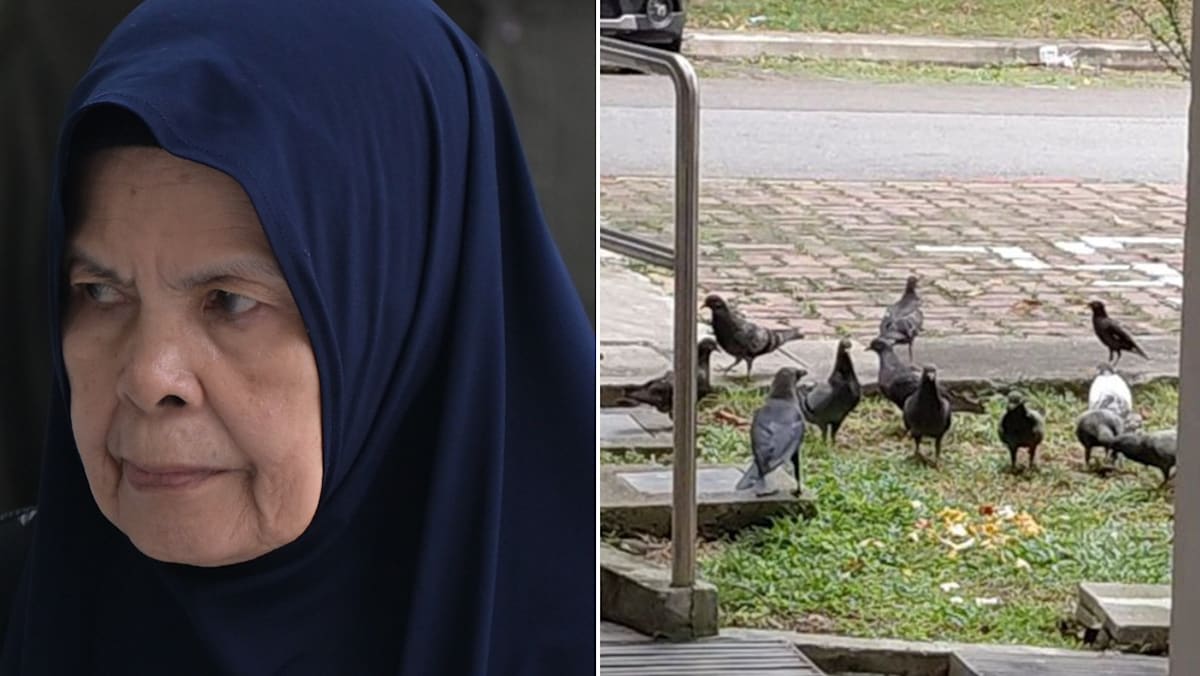
The officer approached Rogayah and advised her to stop her feeding the birds.
Rogayah refused to comply and continued doing so.
When the officer tried to hand her a pamphlet stating that the feeding of wildlife was prohibited, Rogayah refused to take it, saying she already had one.
The officer later made a report to NParks’ enforcement and investigation branch.
On the morning of Oct 14, 2025, a surveillance officer engaged by NParks was performing enforcement duties near the same block when she saw Rogayah standing outside her flat with a plate of fried rice.
The officer later noticed that the plate had been left on a grass patch.
She took the plate to Rogayah’s flat and advised her to stop feeding the pigeons.
Rogayah disregarded her advice and became aggressive, swinging her hands at the victim and striking her abdomen.
She also challenged the officer and cursed at her in a five-minute confrontation that was captured by the victim’s body-worn camera.
Despite this, NParks continued to receive public feedback on wildlife feeding in that area.
Enforcement officers at the same location on Jan 9 this year saw Rogayah tossing bread and grains to pigeons and other wildlife at the grass patch.
In a statement recorded in February, Rogayah admitted that she had fed pigeons on the two occasions. She also said it was not her first time.
She also acknowledged that she had previously been warned for feeding wildlife in September 2021.
Deputy Principal District Judge Ong Chin Rhu told Rogayah, who has dementia, that she must stop doing this. She agreed with the prosecution that this was an exceptional case where a fine could be considered.
She referred Rogayah for a court conference where there are specialists, including trained psychologists and counsellors, to assess what support may be given to her.
Rogayah paid the fine in full.
NON-NATIVE SPECIES: NPARKS
NParks said in a statement to CNA that rock pigeons are a non-native species in Singapore that tend to flock and roost near residential areas in big groups due to the availability of human food.
This results in soiling and hygiene issues which can potentially impact public health in the spread of pathogens that can cause zoonotic diseases.
NParks said town councils and agencies take a “science-and-community-based” approach in managing the pigeon population.
This includes measures such as food source reduction, habitat modification and population control.
NParks said that managing pigeon populations requires the efforts of the community along with agencies and town councils.
This includes reducing human-generated food sources.
The public also plays an important role in reducing the population growth of pigeons by not feeding them, and by properly disposing of food scraps.
The agency monitors feedback on illegal bird feeding and undertakes active enforcement, which includes physical surveillance and the deployment of closed-circuit television cameras at identified feeding hotspots.
For feeding wildlife without approval under the law in force at the time of her offences, Rogayah could have been fined up to S$5,000.
The current penalties for first-time offenders feeding wild animals is a fine of up to S$10,000, while repeat offenders can be jailed for up to 12 months and fined up to S$20,000.
For using criminal force on a public servant executing their duty, an offender can be jailed for up to four years, fined, or both.