
SINGAPORE – Using extremely small amounts of tiny genetic markers, a new device developed by researchers at Nanyang Technological University (NTU) could cut the detection time for a range of diseases from hours to just 20 minutes.
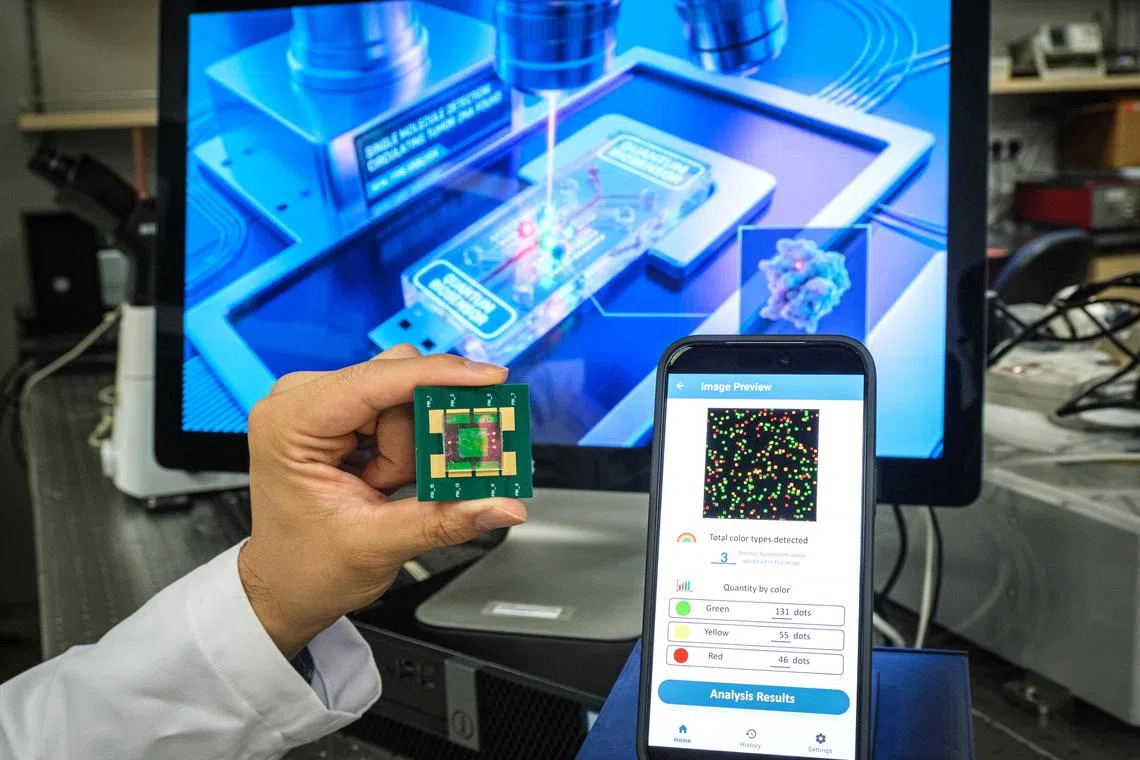
The device combines a specially designed nanophotonic chip – which uses photons, or light particles, to process and transmit data – with artificial intelligence-automated image analysis.
A single drop of blood or saliva loaded onto the chip allows it to rapidly detect multiple microRNA biomarkers, which are analysed using the integrated AI imaging.
MicroRNAs are small ribonucleic acid molecules involved in many essential biological processes. Changes in microRNA levels are linked to many diseases, and they have been studied as possible biomarkers for conditions ranging from cardiovascular disease to neurodegenerative disorders.
“Our successful tests with lung cancer cells show that, with the right probes targeting different biomarkers, this technology could potentially be adapted for many other cancers and diseases, including cardiovascular and viral diseases,” said Associate Professor Chen Yu-Cheng from NTU’s School of Electrical and Electronic Engineering.
At a media briefing on April 15, Prof Chen told reporters that he expects the technology to be used at polyclinics and general practitioner clinics to quickly detect disease.
He expects the technology to be commercially available in the next three years, adding that it could even eventually be available to consumers in the form of test kits, similar to those that test for Covid-19 and influenza.
The team’s findings were published in the peer-reviewed scientific journal Advanced Materials in February.
The study was supported by the Ministry of Education’s Academic Research Fund Tier 1 grant and A*STAR’s Manufacturing, Trade and Connectivity Interdisciplinary Research Grant.
The team has constructed a compact prototype, which includes a camera that can capture images of the nanophotonic chip, as well as a mobile phone application, which analyses these images for microRNA using AI algorithms.
Their innovation is supported by NTU’s Innovation and Entrepreneurship initiative, and a technology disclosure – the first step in getting intellectual property protection – has been filed through NTUitive, the university’s innovation and enterprise company.
Associate Professor Sunny Wong, a consultant in Tan Tock Seng Hospital’s gastroenterology and hepatology department who was not involved with the study, said the technology could have “huge clinical applications” such as earlier detection of cancer and the monitoring of treatment response or disease recurrence.
“Such a technology could potentially enable more accessible and precise clinical decision-making in oncology and across a range of diseases,” he added.
The detection of disease via genetic markers has typically been done using polymerase chain reaction (PCR) – a common laboratory technique used to make millions of copies of a particular region of DNA, allowing for detailed study.
While PCR is considered the gold standard, it has its shortcomings in that it can take up to eight hours to detect a disease, requiring specialised equipment often found only in labs, said Prof Chen, who is also a professor at NTU’s Lee Kong Chian School of Medicine.
However, the small size of microRNAs and their tendency to be found in tiny amounts make them difficult to detect, with closely related microRNAs sharing similar sequences, which also makes it hard to differentiate them.
To overcome these limitations, the NTU team designed a nanocavity – a tiny light-trapping structure hundreds of times smaller than the width of a human hair.
Using extremely tiny mirrors, the nanocavity reflects and boosts fluorescent signals that glow when a target microRNA binds to its matching probe, enhancing the detection of even single microRNA molecules.
The system was able to measure three microRNAs associated with lung cancer using human lung cancer cell extracts, without amplification or complex preparation.
A deep-learning model – referring to AI models where computers are taught to process data in a manner similar to the human brain – known as Mask R-CNN was also developed to automatically analyse microscopic images.
The AI is able to distinguish between different microRNA types, reducing human error.
The platform can detect microRNAs with just a few molecules in a sample, achieving more than 99 per cent accuracy in identifying its targets.
“By combining nanophotonic signal enhancement with AI-based image analysis, we were able to detect tiny amounts of RNA molecules across thousands of nanocavities within minutes,” said Mr Bowen Fu, a PhD student at NTU’s Institute for Digital Molecular Analytics and Science and one of the study’s authors.