
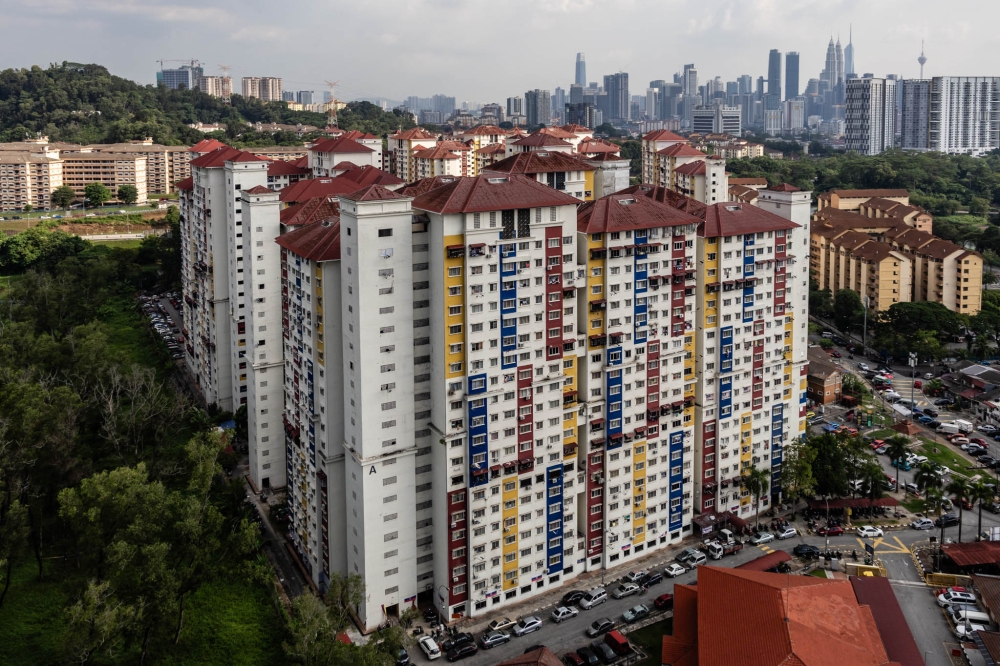
KUALA LUMPUR, May 24 — Public housing in Malaysia, originally designed as short-term shelter for the urban poor, now risks keeping its tenants for far longer than intended, according to a recent Think City study.
The report found that almost three-quarters of some 3,000 People’s Housing Project (PPR) residents surveyed are vulnerable to economic shocks.
Nearly 20 per cent of households surveyed said they had no savings at all, while 56 per cent said they had enough savings to last only one to three months.
The report, titled “From Roof to Resilience”, polled 2,884 people across 10 public housing communities in the Klang Valley. It was part of Think City’s Kita-untuk-Kita (K2K) initiative, funded by the Finance Ministry.
Around 40 per cent of the households rely on a single income-earner and close to one in 10 households — mostly with at least one person with disabilities (PWD) — reported having no breadwinner at all.
The situation has led to multigenerational households, where grandparents, parents and children live under the same roof, with most respondents saying they have lived in public housing for over 30 years.
Nearly half of the households surveyed also had more than five family members — higher than the national average of about four people in a house.
“It also suggests that the next generation who have grown up in public housing are unable to achieve social mobility and remain stuck where they are.
“Of concern is the fact that eight out of the 10 sites had multigenerational households of more than 5 per cent, suggesting that one in 20 households were stuck in a poverty trap in these geographies,” the report said.
To make matters worse, living conditions for most PPR residents surveyed appeared to have either stagnated or further declined since the Covid-19 pandemic.
Enduring pervasive littering, vandalised infrastructure and recurring lift breakdowns have become a daily routine for most of them.
Nearly half of the 3,000 respondents said they had never used the public facilities in their PPRs due to hygiene reasons and safety concerns because of rubbish thrown from the upper floors.
Lift breakdowns, which some residents said have taken years to resolve, have also forced some residents to pay more for household necessities.
“In PPR Bandar Tun Razak, for instance, residents reported that gas cylinder cost rises from RM28 to RM50 every time the lift stops working.
“Residents also report paying higher costs for bottled water and other services like food and grocery delivery due to the frequent lift breakdowns,” the report noted.
However, Think City stressed that policy band-aids and incremental fixes will not fully resolve the challenges that PPR residents currently confront.
Instead, it called on the government to expand the Forum Komuniti (Forkom) — a robust community-led platform that Think City initiated during the K2K project in selected PPRs — to all public housing complexes.
The government, it added, should also work with Forkom to identify and formulate a local database of vulnerable public housing residents to roll out targeted social protection support.
Think City also urged the government to establish a high-level task force to conduct a public expenditure review and propose a new roadmap to transform the public housing sector in the long run.
Think City is a Malaysia-based organisation set up by Khazanah Nasional Berhad in 2009.
Its work includes urban policy advisory, regeneration projects, research and community-based programmes aimed at making cities more liveable and sustainable.