
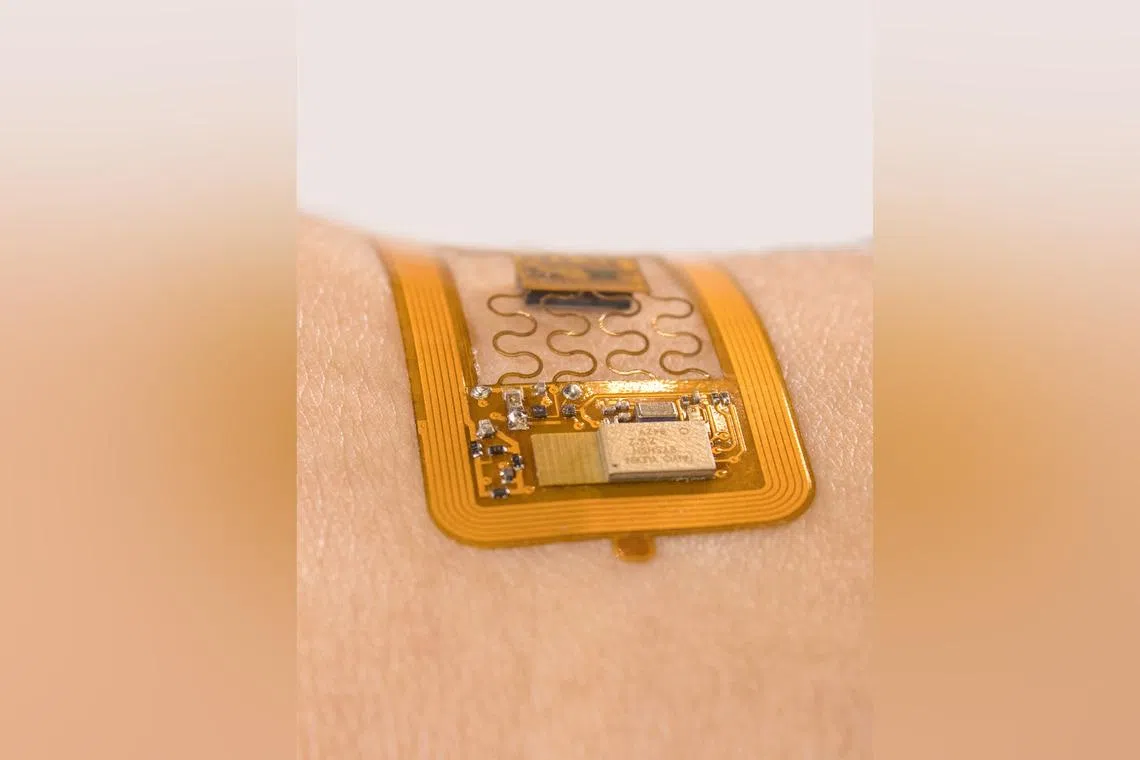
SINGAPORE – Local researchers have developed a battery-free skin patch prototype for continuous blood pressure tracking, marking a major leap forward in wearable cardiovascular monitoring.
This innovation allows for everyday tracking of vital signs without cumbersome cuffs that require one to sit still or the need to recharge batteries.
Continuous blood pressure monitoring is especially key during deep sleep and the point of waking up – which are times when blood pressure mostly goes unmeasured, said researcher Selman Kurt of the National University of Singapore’s (NUS) Electrical and Computer Engineering department, who was involved in the project.
A sharp surge in blood pressure on waking and a blunted drop in blood pressure when sleeping have been shown to be strong predictors of stroke and other cardiovascular problems.
“Peak blood pressure reached during exercise is also clinically meaningful,” said Kurt, who led a team of four researchers and professors on the project at NUS.
“Studies have shown that a deviation from the normal range – whether the peak is abnormally high or low – is associated with greater long-term risk of cardiovascular disease, stroke and early mortality.”
Traditional blood pressure monitors that use cuffs are highly reliable. But because they require the user to sit still, they capture only a snapshot of vitals in a resting state. Blood pressure fluctuations during physical activity or daily routines are not captured.
Wrist wearables, on the other hand, allow for continuous and unobtrusive monitoring during daily activities, but the trade-off for this convenience is clinical accuracy. Their batteries also need to be recharged.
Work on the skin patch prototype began in NUS’ Wireless Bioelectronics Group in 2021, and the team worked alongside researchers from the University of Arizona and Tsinghua University.
The prototype comprises a sensor placed over the heart, which picks up electrical signals when the heart contracts and pushes blood to the rest of the body, and another optical sensor on the wrist to read changes in blood volume.
The time taken for the blood to reach the wrist from the heart – which happens in milliseconds – is inversely related to blood pressure, said Kurt, adding that lower blood pressure will cause a longer delay.
Any form of bulk, such as batteries that could shake as a result of movement from the user, had to be removed as it would interfere with sensor readings and produce inaccurate signals.
Instead, the team designed the sensors to draw power from a smartphone that sits on the user’s bicep, via conductive fabric stitched to a regular long-sleeved shirt. The two sensors sit on the ends of this conductive fabric track made of a copper-nickel alloy.
The team at NUS owns the patent for this underlying textile technology through the university’s technology transfer and innovation department.
Power is harvested from the smartphone via near-field communication, or NFC, the same technology used to transmit data to make contactless payments. A coil in the phone generates a magnetic field, and a receiving coil in the sensor converts that into an electrical current.
As the sensors fire up, data picked up is transmitted back to the phone via Bluetooth, essentially creating a “wireless network” around the user’s body that relays frequencies between the sensors and phone, said Kurt.
Results from a trial involving five users were detailed in a paper that was recently published in peer-reviewed scientific journal Nature Electronics.
While continuous blood pressure monitoring is the “holy grail in biomedical research”, Kurt said the project was also motivated by his own father’s troubles with white coat syndrome.

A sensor connected to two dry platinum electrodes. The research team designed the sensors to draw power from a smartphone that sits on the user’s bicep.
PHOTO: COURTESY OF DR SELMAN KURT
White coat syndrome is a phenomenon where a person’s blood pressure temporarily spikes owing to stress or anxiety in a clinical or medical setting.
Because of this anxiety, his father was provided with a portable blood pressure device to measure vital readings every 30 minutes for 24 hours. The device became uncomfortable for him because the cuff would inflate around his arm during sleep.
While the goal is for the skin patch technology to be commercialised for the benefit of those at risk of hypertension or cardiovascular disease, the team’s immediate priority is to refine the technology to make it more user-friendly.
Areas for refinement include having the device show real-time blood pressure readings on a user’s smartphone via an app, as well as improving the conductive material.
Said Kurt: “We are also working to improve the conductive fabric’s durability, which currently can withstand around 10 wash cycles before its ability to transmit data and power begins to degrade.”