
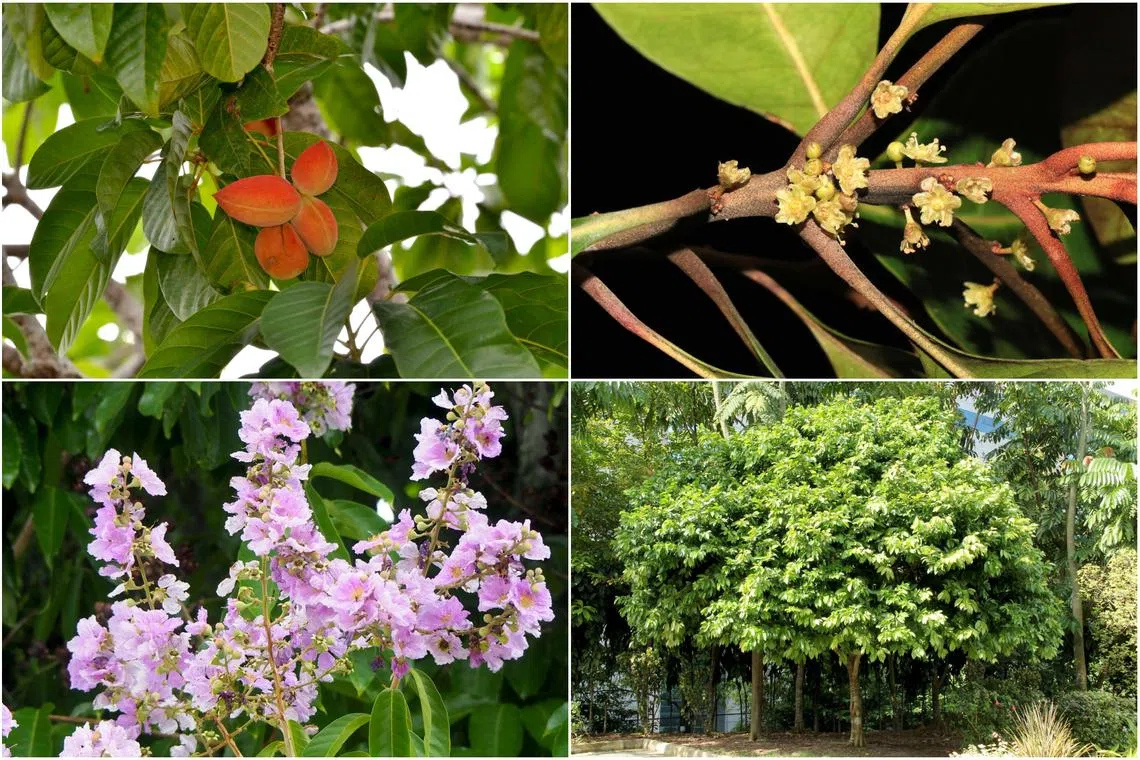
SINGAPORE – Trees are an integral feature of Singapore’s landscape, but the composition of tree species lining the country’s streets and parks has evolved over time.
The Straits Times looks at how species are selected for planting by the National Parks Board (NParks), as well as why some are being replaced.
More than 900 tree species are planted by NParks across streetscapes, parks and park connectors. Each has a role to play, such as improving connections between Singapore’s green spaces, said NParks’ group director for streetscape Oh Cheow Sheng.
“Species are selected for different purposes, including providing shade, visual relief, supporting biodiversity, and strengthening ecological connectivity across our green spaces,” he said.
NParks also engages in urban forest renewal efforts, which involves the selective replacement of trees and introduction of greater species diversity. As part of these efforts, species are carefully selected based on their ecological value and suitability to site conditions, said Oh.
Yellow Cow Wood (Cratoxylum cochinchinense)

This tree species is the preferred host plant for caterpillars of butterflies such as the common grass yellow.
PHOTO: PATRICIA YAP
Growing up to heights of 30m, this tree has green leaves with a waxy grey-green underside, and serves as the preferred host plant for caterpillars of butterflies such as the common grass yellow. Its flowers, which are usually deep red and faintly fragrant, are pollinated by insects.
Shore Laurel (Neolitsea cassia)

This tree species is a host plant for the common bluebottle, a species of swallowtail butterfly. Its fruits are eaten by birds.
PHOTO: ANG WEE FOONG
This tree produces tiny greenish flowers. When its fruits are ripe, they turn reddish and then black. The fruits are eaten by birds.
It is a host plant for the common bluebottle, a species of swallowtail butterfly recognisable for a bright blue band spanning its wings.
Common Sterculia (Sterculia parviflora)

The flowers of this critically endangered tree species are pollinated by insects such as flies and beetles. Birds feast on the seeds of this native tree.
PHOTO: BOO CHIH MIN
Trees from this species can grow up to 35m tall, with trees producing fruits four to five years after planting. The flowers of this critically endangered tree species are pollinated by insects such as flies and beetles. Birds feast on the seeds of this native tree.
Sparrows’ Mango (Buchanania arborescens)

This tree species is often found in parks and large gardens because of its ability to tolerate roadside conditions and adapt to a wide range of soils.
PHOTO: JESSICA TEO
This tree has leathery leaves and small cream-coloured flowers. It is often found in parks and large gardens because of its ability to tolerate roadside conditions and adapt to a wide range of soils.
It is the preferred local food of a species of small moth found in South-east Asia. The flowers of the Sparrows’ Mango are pollinated by insects.
Rain Tree (Samanea saman)

This tree species is widely cultivated in South-east Asia and highly recognisable for its umbrella-shaped crown.
PHOTO: SOH WEIJING
Originally from tropical America, this species is widely cultivated in South-east Asia and highly recognisable for its umbrella-shaped crown. It is selected for its broad canopy, which provide shade and cooling benefits.
It can grow up to 30m in height, while its crown can measure around 20m to 30m across. Epiphytes such as ferns and orchids can typically be found on the tree.
Lagerstroemia genus

This tree species is widely cultivated in South-east Asia and highly recognisable for its umbrella-shaped crown.
PHOTO: JESSICA TEO
These trees have brightly coloured, ornamental flowers and distinctive barks, which are usually grey-brown. They are selected for their appearance, which enhances the surrounding landscape and contributes to the visual character of public spaces.
River Tristania (Tristaniopsis whiteana)

This endangered native tree can grow up to 24m tall, and can be found in Singapore’s parks and streets.
PHOTO: JESSICA TEO
This endangered native tree can grow up to 24m tall, and can be found in Singapore’s parks and streets. The bark of this tree species has a unique mottled appearance, because of its peeling bark that transitions through a range of colours from whitish grey to coppery brown.
Sea Gutta (Planchonella obovata)

This native species is usually found in habitats such as coastal forests and sandy shores, and is tolerant of salt spray.
PHOTO: JESSICA TEO
This native species is usually found in habitats such as coastal forests and sandy shores, and is tolerant of salt spray. They are often planted along roadsides as they can also withstand urban pollution.
Katong Laut (Cynometra ramiflora)

Found near rocky, sandy shorelines and near mangroves, this coastal tree provides food for a species of moth.
PHOTO: ANG WEE FOONG
Found near rocky, sandy shorelines and near mangroves, this coastal tree provides food for a species of moth. Its flowers are pollinated by insects.
NParks said it progressively replaces tree species that have been observed to be more susceptible to diseases such as basal rot, or which pose a higher risk of failure – such as the breakage of the trunk, branches or roots – where necessary.
Trees such as Senegal Mahogany and Sea Apple are undergoing replacement across HDB estates and spaces managed by NParks for safety reasons.
“This is increasingly important in the context of climate change, as more frequent and intense weather events may bring higher wind speeds, increased rainfall, and potentially greater risks of tree incidents in urban environments,” said Oh.
Senegal Mahogany (Khaya senegalensis)

Native to Africa, these trees were first used for roadside planting because of their rapid growth rate and ability to tolerate dry urban environments.
PHOTO: NPARKS
Native to Africa, these trees were first used for roadside planting because of their rapid growth rate and ability to tolerate dry urban environments.
However, there have been instances of Khaya trees toppling. In 2017, a heavy downpour caused an 18m-tall tree to fall on a car in Tampines, though its driver remained unhurt. And in 2015, an 11-year-old boy was injured when a falling tree crashed through the balcony of his unit.
Sea Apple (Syzygium grande)

This coastal tree was planted along roadsides in Singapore as it was able to tolerate the harsh urban conditions and provide shade.
PHOTO: NPARKS
This coastal tree was planted along roadsides in Singapore as it was able to tolerate the harsh urban conditions and provide shade. It is also believed to be relatively resistant to fire, serving as a natural fire-break during colonial times.
NParks said that Sea Apple trees have been observed to be susceptible to basal rot, which can compromise their structural stability.
-
SOURCE: NATIONAL PARKS BOARD, NPARKS FLORA AND FAUNA WEB