
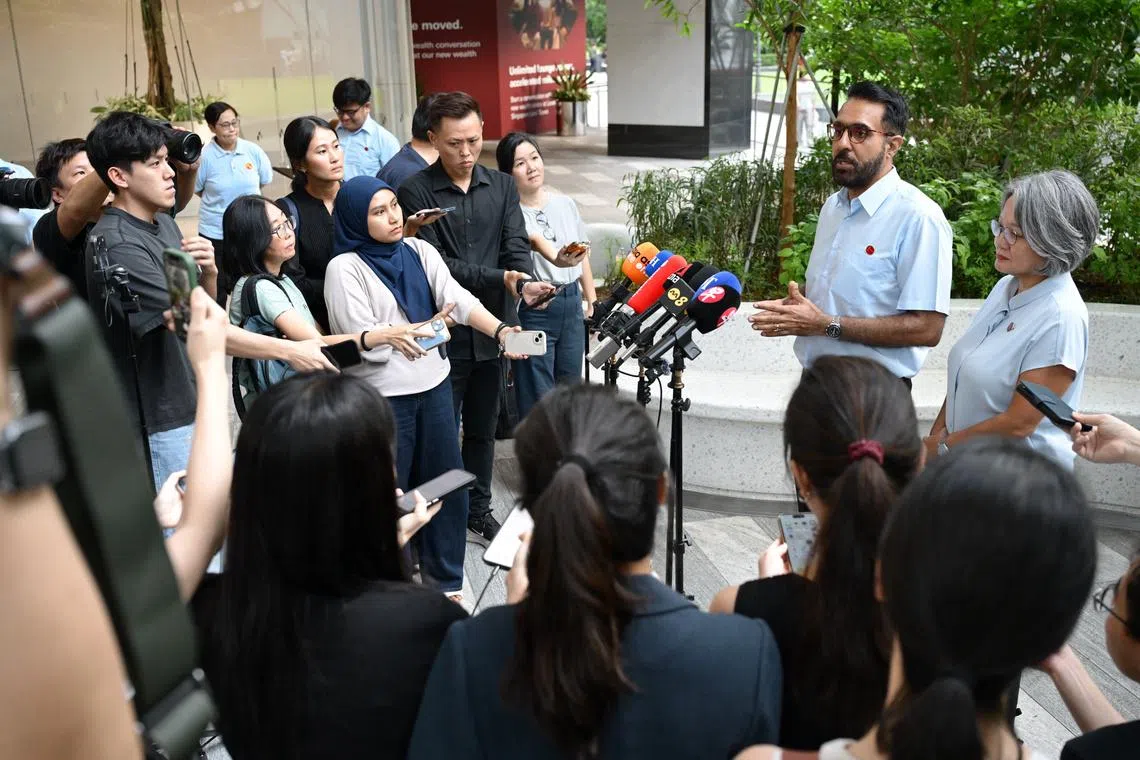
SINGAPORE – After close to six hours in two meetings on June 28 where he faced his biggest leadership challenge to date, Workers’ Party chief Pritam Singh emerged with a friendly wave and a broad smile to take questions from the media.
His manner relaxed and assured, he told reporters: “Based on the vote of the special cadre members conference, I would say the party is pretty united.”
Since he was voted in as secretary-general of the opposition party in 2018, Singh had returned unopposed in every single party election.
On Sunday, he faced a vote of no confidence called by a group of the party’s cadres, and another vote thereafter at the biennial party election where the WP chooses its leaders.
He survived the first with a supermajority and then returned unopposed as party chief.
Party sources say 82 of 106 cadres had voted for Singh to remain as WP’s leader. Singh himself did not vote.
This was not what a group of unhappy cadres had hoped for going into the meetings.
They had signed a letter triggering the first meeting, a special cadres conference, to hold Singh to account for his conviction over lying to Parliament.
But the inquisition they envisioned had reportedly fizzled out – party sources said that while Singh was questioned, some of those who stood up had also spoken in support of him.
The group had also lobbied for a challenger to step up, but could not convince anyone to do so in the end even with the effort under way until the week of the party conferences.
Sunday’s outcome concludes the uncertainty that has hung over the party since 2021, following revelations that former Sengkang GRC MP Raeesah Khan had fabricated an account of police mistreatment of a sexual assault victim in Parliament.
The matter had gone before Parliament’s Committee of Privileges, which found that Singh had played a part in Khan prolonging her lie.
He was eventually charged and convicted in court of lying to Parliament, and the guilty verdict was upheld by the High Court in December 2025 on appeal.
This sparked a parliamentary motion where the House deemed Singh unsuitable to stay on as Leader of the Opposition (LO) following his conviction. Prime Minister Lawrence Wong subsequently removed Singh from the post.
Through all of this, the party’s leadership was firmly behind Singh, refusing to nominate another WP MP for the role of LO despite being given the opportunity to do so.
And while a WP disciplinary panel looking into his actions found that he had contravened the party’s Constitution, the party’s top leadership body issued him a formal letter of reprimand for his infraction – a move that some observers have described as a slap on the wrist.
Sunday’s votes show that whatever the party’s cadres might think of the saga, they too have decided to close ranks behind their leader. This includes former party chief Low Thia Khiang. When asked by reporters ahead of the Sunday meetings, the veteran politician stated that he still supported Singh.
As the architect of the modern WP, Low’s endorsement carries influence within the party.
Crucially, the show of solidarity has also put paid to any talk of internal rifts, which are often damaging for opposition parties. Several have been beset by public infighting and periodic leadership upheavals.
Now, with the Raeesah Khan saga settled within the party, the WP can refocus on its parliamentary work to raise its growing national profile.
It will also be able to focus on leadership renewal, which party chair Sylvia Lim had touched on at the doorstop interview with reporters after Sunday’s election.
Acknowledging that she has been party chair for 23 years now, she quipped: “We are very conscious of the fact that leadership renewal is very critical to the organisation. So, we have been working at that.
“Hopefully in the next media conferences you will see someone else here.”
Singh’s re-election also shows that the WP currently has no one with the public stature and deep parliamentary experience necessary to challenge him, and that its cadres are prepared to stomach the potential political cost of backing him.
Yet, this show of solidarity also raises questions about whether political survival has trumped principles.
At the interview, Singh was asked for his response to those who might say that the WP is being run by a “convicted liar”.
To this, he directed people to his website and said his position has not changed from what he had said in Parliament.
For some within the party, the May 2025 general election results are proof that the saga has already been settled in the court of public opinion. Held when Singh had already been convicted in the lower court, the election saw the WP not only consolidating its existing constituencies but expanding its footprint with two Non-Constituency MP seats.
To many WP supporters, Singh’s legal troubles will likely be viewed primarily through the lens of politics.
Despite its growth, the WP also still retains its status as the political underdog against the People’s Action Party and faces less scrutiny from voters.
Yet as the party grows further and works to attain its stated goal of capturing one-third of the seats in Parliament, it can no longer rely on preaching to the converted.
Voters are likely to hold the WP to higher standards, and it may then have to reckon with its decision to close ranks behind a convicted leader when it attempts to win over the risk-averse, middle ground voters who are likely to demand the same standards of integrity and accountability from both sides of the aisle.