
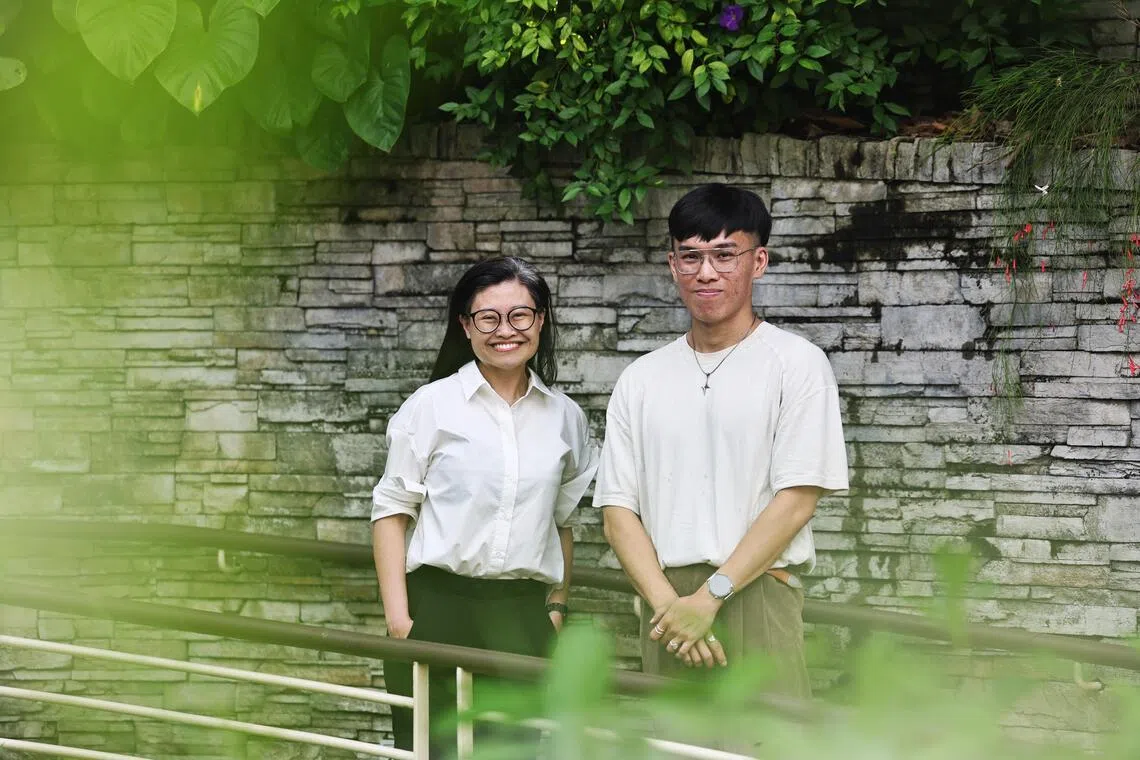
SINGAPORE – What began as back pain turned into a double whammy of life-threatening ailments for financial analyst Ranald Lai.
The 32-year-old began experiencing lower back pain in early 2025, which he initially dismissed as body aches from exercising.
“I kept telling myself this would probably go away within a few weeks or a few months,” Lai said.
However, in May that year, he realised it was something more serious when he was unable to sit or stand up straight and began feeling a tingling sensation in his legs.
Over time, even lying down became uncomfortable, he recalled.
Lai thought it was a slipped disc, but an MRI, or magnetic resonance imaging scan, revealed something more: compression fractures and lesions at the base of his spine.
On his doctor’s advice, he underwent a PET/CT scan, which combines positron emission tomography and computed tomography to produce highly detailed images of the body. The scan revealed that he had Stage 4 lung cancer.
He felt the pain in his back because the cancer had already metastasised, or spread, to other parts of his body, said Valerie Yang, senior medical oncologist at OncoCare Cancer Centre.
“It had affected even the lining of the spinal cord,” she said.
While Lai’s parents were devastated, he said he saw his diagnosis as something to be overcome.
“I didn’t take cancer as a death sentence,” he said.
For the regular gym-goer, the biggest adjustment was being much less physically active.
“I was dependent, physically, on having people around me, and at my age, that was not something I was comfortable with,” he said.

Ranald Lai began undergoing chemotherapy in June 2025, in addition to taking several types of medication.
ST PHOTO: KELVIN CHNG
Lai began undergoing chemotherapy in June 2025, in addition to taking several types of medication. Yang noted that her patient’s high tolerance for pain eased the treatment process.
His condition showed improvement with the chemotherapy. A scan in September after his fourth cycle of chemo showed a significant reduction in the cancer in his lungs, as well as a more modest reduction in his spine.
“I asked Dr Valerie if I was okay enough to do some very light work in the gym, and she gave the green light. I did not hesitate,” he said, adding that he also began going back to the office.
By November, the cancer was in remission and Lai was taken off all but one type of medication.
However, he was dealt yet another bad hand.
During the same doctor’s appointment where he learnt his cancer was in remission, Lai discovered that he had Li-Fraumeni syndrome – a rare hereditary condition associated with a higher risk of a range of cancers.
Estimated to affect one in 20,000 people, the genetic condition is caused by a faulty TP53 gene. The gene helps prevent cancer by producing the p53 protein, which suppresses tumours by preventing cells from growing and dividing too rapidly.
When the gene is mutated, the protein loses its ability to suppress tumours, allowing mutated cells to proliferate.
Those with the condition have a more than 90 per cent chance of developing one or more types of cancer by the age of 60.
Yang noted that in Lai, the TP53 mutation appeared not just in the cancer cells but also in normal cells – an indication of Li-Fraumeni syndrome.
Lai’s case was atypical as lung cancer is not one of the more common cancers associated with the syndrome, said Yang, who is also an adjunct assistant professor at Duke-NUS Medical School.
Osteosarcoma, a type of bone cancer, and adrenal cortical cancer – an aggressive cancer affecting the adrenal gland – are more commonly associated with Li-Fraumeni, she noted.
The syndrome increases Lai’s risk of developing other cancers in future, she said.
“Radiation, whether from scans or from treatment, can increase the chance of another cancer forming in someone with Li-Fraumeni,” said Yang, noting that Lai now undergoes MRI scans – which do not use ionising radiation – rather than CT scans.
She said that doctors also try to avoid giving such patients chemotherapy.
As the syndrome is hereditary, Lai was concerned that his parents might have the condition and thus face an increased cancer risk. However, genetic tests showed that neither parent had the mutation, which came as a relief to him.
Revealing that he did not intend to have children, Lai said his diagnosis strengthened his conviction, as he did not want to pass the syndrome on to any children he might have.
“Knowing that I have this and making the conscious decision to pass this down, for me, it doesn’t sit right,” said Lai, who is single.
He said he has come to accept that the syndrome is part of his life and is not anxious about the possibility of developing another cancer.
“I won’t pretend that it doesn’t gnaw at me sometimes, but I understand that acknowledging it is part of the process of healing and living.”