
SINGAPORE –On a Saturday in May at the Singapore Expo, a crowd gathered around a booth in the middle of the exhibition hall. People craned their necks, phones raised, trying to catch a glimpse. Murmurs rose into audible gasps.
At the centre of it, two men stood facing each other, a glass display case perched on a foldable table between them. They shook hands.
A deal had just been struck: $17,500 for a mint-condition, first-edition 2002 Japanese Mysterious Mountains holo Gengar Pokemon card.
Pokemon, a Japanese media franchise built around collectible creatures that battle one another, has grown from a children’s game into a global pop-culture and collectibles phenomenon.
Introduced in the franchise’s early years, Gengar – a ghost- and poison-type Pokemon – has become one of the franchise’s most coveted characters among collectors. The card’s value lies in its rarity: It came from a limited-print Japanese expansion set and, as a pre-2003 release, is considered vintage. It had also been authenticated and graded mint by a professional card grading service.
The vendor buying it reached into his backpack and pulled out thick wads of cash, carefully counting the notes in neat piles atop the display case before handing them over.
The seller, who wanted to be known only as James, grinned. He had acquired the card just four months earlier after trading away other cards.
“In cash terms, it was less than $9,000,” says the 31-year-old, who sees himself as both a hobbyist and investor.
Although he believes the card’s value could climb further, James says the decision to sell came down to timing.
“Sometimes you have to take profit and redeploy the cash. There are cards I’ll never sell, and others I’m willing to let go if the price is right. He made a good offer, so I took it.”
The deal took place at Kyo Cards Con, a trading card event held at Singapore Expo Hall 3 on May 2 and 3.
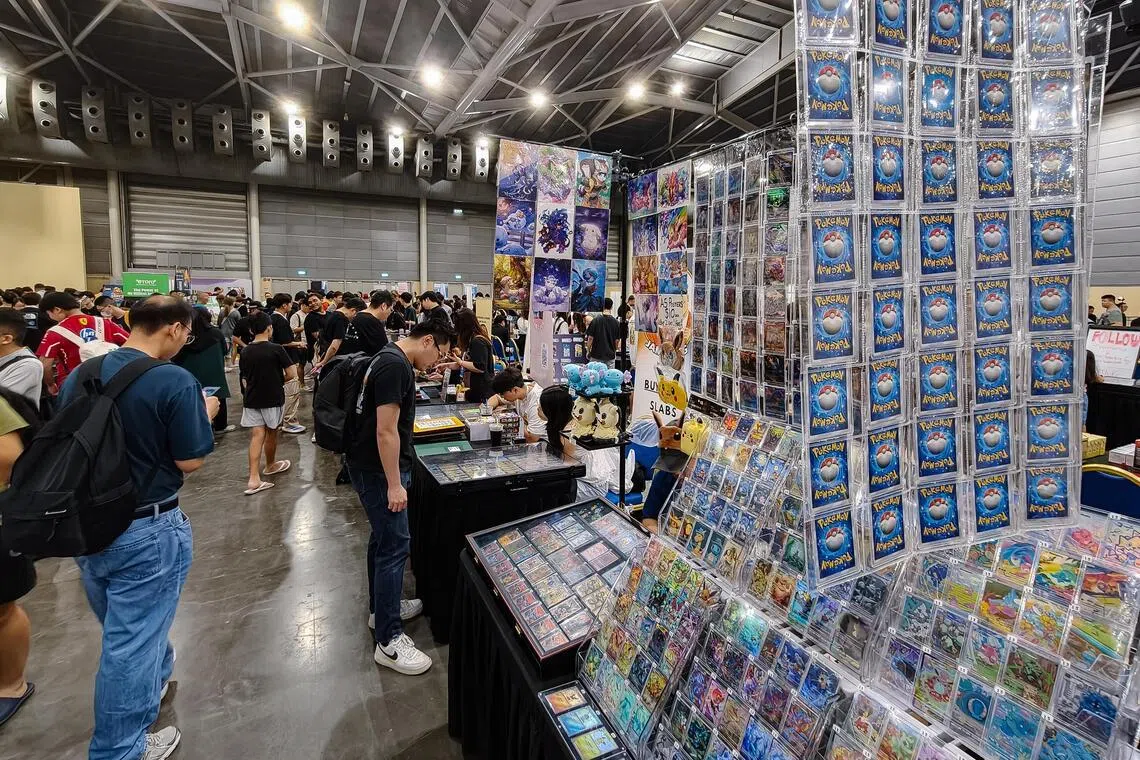
Across the 2,000 sq m floor – roughly the size of two Olympic swimming pools laid side by side – more than 90 booths bought, sold and traded Pokemon cards, and other collectibles.
Buyers weaved through the crowd carrying cube-shaped storage cases that resembled safety deposit boxes, while thick wads of cash changed hands in the open and five-figure PayNow transfers flashed across phone screens. Not every deal involved money: Some collectors swopped cards directly, negotiating trades based on market value and rarity.

Thick wads of cash changed hands in the open at Kyo Cards Con on May 2.
ST PHOTO: ARIFFIN JAMAR
By the fourth hour after doors opened at 11am on the first day, more than $300,000 worth of deals had changed hands among vendors and collectors. Tracked by The Straits Times, the value of recorded transactions could easily hit $1 million over the two days.
With sums like these at stake, trading card events have exploded in popularity. What began as a hobby built around collecting, trading and chasing rare cards has evolved into a fast-growing secondary market, drawing collectors, investors, families and part-time traders to events held almost every weekend.
At least three trading card events were held in Singapore over the Labour Day weekend. ST visited two: Kyo Cards Con and CTRL-ALT Play Show (CAPS) at Leisure Park Kallang.
Kyo Cards Con, started by online trading card marketplace Kyo Cards, drew about 10,000 visitors, matching its February debut. Organiser Jayf Soh says: “We are not fundamentally in the business of organising trade shows.
“Events are simply one part of our broader offering in fostering stronger community interaction and engagement within the hobby.”
CAPS took over nearly the entire first floor of Leisure Park Kallang, with more than 70 booths and a focus on trading cards, sealed packs and professionally graded “slabs”. A slab is a professionally graded card locked inside a hard, tamper-evident plastic case, assessed and authenticated by a trading card grading company.
Organiser Amos Ker, 26, says the three-day event attracted around 12,000 visitors. Since his events management company was launched in May 2025, it has run more than 10 such conventions.

CTRL-ALT Play Show took over nearly the entire first floor of Leisure Park Kallang, with more than 70 booths and a focus on trading cards, sealed packs and professionally graded “slabs”.
ST PHOTO: ARIFFIN JAMAR
At both events, sealed packs were among the biggest draws. Although sold at manufacturer’s suggested retail prices at FairPrice, Don Don Donki, Toys “R” Us and the Pokemon Center online store, they are often snapped up almost instantly.
Collector Jonathan Lim says releases on the Pokemon Center website can disappear “within seconds”. That shortage has created an opportunity for vendors, who resell the packs at steep mark-ups. An Ascended Heroes booster bundle with a suggested retail price of $38.40 was selling for between $125 and $145 at the shows.
Mr Ker says a well-curated vendor line-up is crucial.
“We want to ensure our attendees have plenty to explore, rather than having 80 per cent of vendors selling the same products and chasing the same popular cards.”

Traders carrying high-value trading cards at Kyo Cards Con often kept their collectibles in protective cases.
ST PHOTO: BRIAN TEO
The sums changing hands at these trade shows echo a global boom that many in the community jokingly refer to as Pokeflation.
Within the community, the latest surge in interest is often linked to a string of headline-grabbing sales, including American internet personality and professional wrestler Logan Paul’s record-breaking sale of a Pokemon card for US$16.5 million (S$21 million) at auction in February.
In comparison, a 1901 Claude Monet painting – Vetheuil, effet du matin – was sold for about US$12 million at Sotheby’s in April.
So how did a mass-produced children’s trading card, once swopped in schoolyards, come to be worth more than a Monet?
The story began in 1996, when Pokemon debuted in Japan as a video game for Nintendo’s Game Boy, followed later that year by the Pokemon Trading Card Game (TCG). Its original Base Set featured 102 cards, with players building decks around Pokemon, Energy and Trainer cards to battle one another.
By the late 1990s, Pokemon had become a global phenomenon, with children around the world collecting and trading cards in schoolyards and playgrounds. Over the next two decades, the franchise kept expanding, introducing new generations of Pokemon, increasingly rare cards and limited-edition releases.
Then came the Covid-19 pandemic. Locked-down millennials rediscovered the cards of their childhood just as grading services, live-stream breaks and social media made rare finds more visible – and more valuable – than ever.
By 2021, sealed first-edition Pokemon card boxes were selling for around US$400,000, while a mint-condition Charizard reached about US$300,000, up from roughly US$16,000 in 2019, according to auction reports.
On valuation platforms like PriceCharting and Card Ladder, rare cards such as first-edition Charizards regularly log confirmed sale values exceeding US$500,000.
According to Strategic Market Research, the global trading card market was worth about US$15.8 billion in 2024 and is projected to hit US$23.5 billion by 2030, with Pokemon cards driving much of the growth.
But even as these record prices dominate headlines, economists and seasoned collectors caution that not every card tracks those trajectories, and not every listed price is a realised gain.
Many valuations floating around social media and convention floors are based on the highest recent sale or ambitious asking prices rather than what a card can reliably fetch on demand. A handful of spectacular outliers can set expectations for thousands of more ordinary, harder-to-move cards.
Verifiable scarcity has reshaped the market. Professionally graded slabs allow collectors to distinguish a flawless specimen from a worn childhood copy. Limited print runs, special promotions and niche Japanese sets add further layers.
Professor Sumit Agarwal, who teaches finance and economics at the National University of Singapore, says: “Once you introduce verifiable scarcity – such as graded cards, limited print runs and condition rankings – pricing becomes easier, trading becomes scalable, and speculation follows naturally.”
What makes today’s market different from past collectible booms in baseball cards or comics is speed.
Assistant Professor Chua Yeow Hwee from Nanyang Technological University points to social media, live streams and grading services as forces that make prices transparent and hype easier to amplify. Unlike past collectibles crazes, today’s market runs on infrastructure that allows information and speculation to spread almost instantly. A single influencer’s post can send buyers flocking to a particular art variant or promotional card overnight.
But he urges caution – that same attention can disappear just as quickly.
“Their prices depend heavily on beliefs and community attention. That does not mean they have no value, but it means the value is culturally and socially produced, rather than grounded in cash flows like stocks or bonds.”
On the ground, the boom has drawn in a new generation of traders.
Shipping executive Haziq Yaakob, 32, started collecting Pokemon cards in 2013, building up a collection that he estimates is now worth close to $40,000 at current market rates.
He and a group of fellow collectors regularly meet to compare collections, trade cards and discuss the market. Around 2024, he and a friend turned the hobby into a side business, setting up booths at trading shows to buy, sell and swop Pokemon cards.
Mr Haziq is part of a wider wave of Gen X and millennial collectors who re-entered the hobby during the Covid-19 pandemic. For some, that leap has gone further.
One 28-year-old vendor, who declined to be named, quit his engineering job in April to trade Pokemon cards full time. He says he now earns more than twice his previous salary.
He estimates that a single booth could generate between $20,000 and $30,000 in transactions over a weekend. He now travels regularly for trade shows, which he describes as essential not just for sales, but also for tracking demand and prices in real time.
“Although you sell online, I think a lot of people pull the trigger more in person,” he says.
Others straddle the line between hobby and side hustle.
Tommy (not his real name) runs Goodloot TCG and began selling Pokemon cards through TikTok live-streaming in 2024.
Since then, he has invested close to $200,000 buying cards to resell online and at trading events. About once a month, he rents a booth at a card show, where his inventory typically ranges from $50 to $2,000 per card.
Revenue from a single event can reach about $10,000, he says.

The three-day CTRL-ALT Play Show at Leisure Park Kallang attracted around 12,000 visitors.
ST PHOTO: ARIFFIN JAMAR
Singapore has become a key hub for cross-border trading in South-east Asia, attracting buyers and vendors from Indonesia, Malaysia, the Philippines and China.
One vendor, who wanted to be known only as Mr Teo, is among sellers targeting the higher end of the market.
He tells ST that he has clients overseas and recently travelled to Japan to deliver a card worth about $100,000.
Mr Teo started with a collection worth roughly $10,000 two years ago and has since rolled profits from card sales back into acquiring more cards. He estimates that his collection is now worth more than $1 million.
Less than two hours after speaking to ST, he bought a set of seven cards for $12,000.
The most expensive card he had on sale that weekend was a Mario Pikachu card priced at about $40,000. Several would-be buyers, he says, had already expressed interest.
“Some overseas vendors come to buy cards at Singapore events, while others trade with local dealers who may have the network to move cards that are harder to sell in their home markets,” he adds.
Indeed, the secondary Pokemon card market now operates as a travelling, high-liquidity ecosystem, where deals are struck across borders and executed in real time on the convention floor.
Mr Sony Rehan, 38, who runs Sony’s TCG in Dubai, flew to Singapore for his first local trade show after meeting Singaporean collectors at another event in Dubai.
“I barely had any time. I have two days free, so I’m going to fly in and fly back out,” he says.
Polymon, one of the larger vendors at Kyo Cards Con, displayed a set of eight cards featuring Mario Pikachu and Poncho-Wearing Pikachu valued at about $240,000 based on recent online sales data.
Another vendor highlighted what it described on Instagram as an “insane” transaction involving 13 Japan-exclusive limited-edition cards. Based on prices on card-tracking platforms, the cards together are worth over $240,000.
These headline numbers, however, sit atop a much larger base of more modest deals and unspectacular cards that may take months to sell.

Polymon, one of the larger vendors at Kyo Cards Con, displayed a set of eight cards featuring Mario Pikachu and Poncho-Wearing Pikachu valued at about $240,000 based on recent online sale data.
ST PHOTO: ARIFFIN JAMAR
The appetite for trading is not confined to adult collectors.
At the two events, children and teenagers could be seen haggling with vendors, asking for prices, making counter-offers and debating whether to cash out or hold on for better deals.
At one booth, a 12-year-old boy carrying two graded cards worth close to $2,000 turned down offers from a vendor.
Others are more detached. Mr Tan, who works in the car industry and declined to give his full name, started buying Pokemon cards in 2025 after seeing his friends make profits.
At the Expo event, the 33-year-old traded several cards from his collection for a mint-condition 2004 Charizard EX #105 Pokemon FireRed & LeafGreen card, valued at about US$30,000 on platforms such as Alt and Card Ladder. No cash changed hands.
Mr Tan says he has little emotional attachment to the cards.
“For me, it’s a pure investment. Anything can move at the right price.”
Then, there is Mr Lee, who works in the construction industry, and likens Pokemon cards to an alternative investment comparable to cryptocurrency.
In March, he bought a Snap Pikachu card for $11,000. Less than two months later, he sold it to a buyer in Hong Kong for US$65,000. A similar card later sold for US$87,800 at an auction by Pokecolor Inc in China.
At the Expo event, he was looking to trade rather than buy, swopping three cards valued at about US$15,000.
“Prices are insanely high now,” he says. “It’s all paper value.”
Stories like these highlight a key tension in the market: Headline-grabbing flips exist alongside growing unease that many prices may not hold if sentiment cools.
A card’s “value” is often based on a recent record sale or a rare auction result, rather than frequent, broad-based transactions. Collectors who buy near the peak can end up holding a slabbed card that looks valuable on paper but draws little interest when it is time to sell.

Visitors at Kyo Cards Con at Singapore Expo on May 2.
ST PHOTO: BRIAN TEO
The same traits that attract enthusiasts – portability, global demand, opaque and fast-moving prices – also make rare cards an appealing way to move value out of sight. High-end vendors routinely deal in five-figure sums, and cash remains common for larger transactions.
At some booths, men sling bags filled with notes over their shoulders; at others, storage cases containing slabs worth more than $100,000 change hands between buyers and sellers.
The rise of high-value cash deals has sparked questions over whether the fast-growing market could be vulnerable to money laundering.
Sony’s TCG’s Mr Rehan notes that rare, high-value cards can be slipped into pockets, carried across borders and quietly converted back into cash. It is not surprising if some cards are being manipulated for money laundering, he adds.
Associate Professor Soh Kee Hean, who heads the Criminal Investigation Minor programme at the Singapore University of Social Sciences, says criminals are often drawn to markets where illicit proceeds can retain or increase in value while remaining easy to transport and trade.
They also look for opportunities to co-mingle criminal proceeds with legitimate business activity, he adds.
“Collectibles such as trading cards could be an avenue for money laundering because they function as a store of value,” says Prof Soh.
Rare cards can hold, or sharply increase, in value as global demand rises and influencers bring more attention to the hobby, he notes.
Criminal proceeds that enter such markets may not be easy to trace if buyers and sellers do not keep proper records of identities and transaction details, he adds.
Mr Sunil Sudheesan, director and head of the criminal law department at Quahe Woo & Palmer LLC, says: “Depending on how the market develops, these cards can attain the status of prized watches or artwork, so the risks are similar.
“Ultimately, the issue is how the money is transferred. Bank transfers carry the lowest money laundering risk because of strict protocols. Crypto to some extent, and obviously large cash transactions, carry greater risk.”
In December, the Singapore police warned of e-commerce scams involving Pokemon trading cards, with at least 477 cases reported in just a couple of months and losses totalling at least $958,000. Victims allegedly paid deposits for pre-orders through PayNow or bank transfers but never received the cards and were unable to contact sellers afterwards.
In Japan, concerns have emerged over how high-value cards could be exploited. Gaming news publication IGN, citing Japanese magazine Shunkan Gendai, reported allegations that Japanese crime syndicates had used high-value Pokemon cards to move illicit funds overseas, underscoring concerns about how easily the cards can be transported and resold.
Tommy of Goodloot TCG agrees that large, poorly documented transactions could create opportunities for abuse, though he believes such activity would involve only a small minority.
“Most people at trading shows are here because they love Pokemon cards.”
Even so, Singapore’s fast-growing trading card scene has attracted closer scrutiny from regulators. In February, a spokesman for the Ministry of Home Affairs (MHA) told ST that trading card packs sold here will fall under new rules aimed at managing gambling risks linked to blind boxes, sealed products whose contents are unknown at the point of purchase.
For the Pokemon secondary market, the regulations are expected to affect sealed packs more than opened cards or professionally graded slabs, though details and timelines have yet to be announced. MHA is expected to share more about the rules around mid-2026.
For Mr Tan, the Pokemon trader who treats cards purely as an investment, the prospect of regulation is not a concern. He deals exclusively in opened, professionally authenticated and graded cards, and sees no gambling element in what he does.
“Trading cards themselves do not feature gambling, and they have genuine recreational and collectible value,” he says.
Some vendors say they welcome clearer rules if it means curbing irresponsible behaviour in the market.
Collector Jonathan Lim says he hopes tighter regulation could give hobbyists a fairer chance of buying cards at standard retail prices, instead of competing with scalpers and resellers.
Whether Singapore’s role as a regional hub for high-end Pokemon card trading proves to be a durable new asset frontier or a particularly vivid chapter in collectible history will depend on how both the community and regulators respond.
For now, the convention floor remains the place where all these forces converge.