
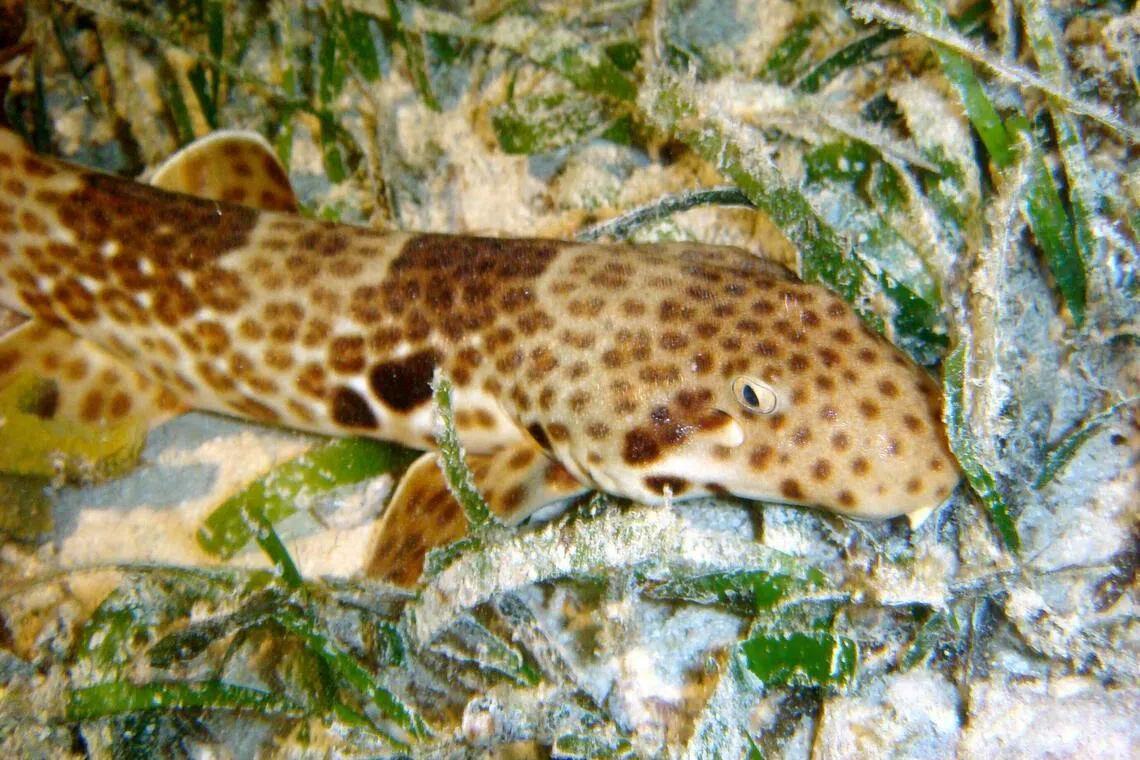
SINGAPORE – In the dead of night, a small shark less than a metre long crawls among seagrass meadows, using its fins to push itself along as it searches for a meal.
Known as the Indonesian speckled carpetshark, this creature belongs to one of the six species of walking sharks found in Indonesia and is found exclusively in the Raja Ampat archipelago in Indonesia.
While all walking shark species are protected in Indonesia, their nocturnal behaviour and tendency to hide in coral crevices make it difficult for scientists to map the distribution of each species accurately.
To better monitor these creatures, Indonesian scientists have developed a new method to detect walking sharks in the waters of Raja Ampat using only seawater samples.
By testing for genetic material in the water left behind specifically by the sharks, researchers can determine their presence without diving or carrying out nocturnal reef surveys, which in turn informs their planning and management of conservation areas.
The research was conducted by a team of scientists from research non-profit Elasmobranch Institute Indonesia, Indonesian government agency National Research and Innovation Agency (BRIN), national foundation Konservasi Indonesia, and other partners.
After collecting around three to five litres of seawater from a site, scientists then take it to a laboratory where it is tested for environmental DNA (eDNA). These are tiny particles of genetic material left behind by living organisms passing through the water, be it their skin cells, mucus or faeces.
As these fragments are unique to each species, they can serve as a “fingerprint” for scientists to trace what creatures are present in the waters. To sift out the “fingerprints” of walking sharks, Indonesian researchers at BRIN developed a novel genetic primer, which is able to pick up a gene unique to the walking shark genus even at relatively low concentrations.
Lead conservation scientist at Elasmobranch Institute Indonesia Edy Setyawan said that this new method is used to complement field surveys, and can help with mapping the distribution of the walking sharks and confirming the presence of sharks before the survey begins.

Walking sharks’ nocturnal behaviour and tendency to hide in coral crevices make it difficult for scientists to map the distribution of each species accurately.
PHOTO: MARK ERDMANN
“We can now detect these sharks even when they are not directly visible, including during the daytime,” he said. “It saves a lot of time in terms of determining the distribution of the animals on a large scale in various regions.”
The method also reduces the risk of encounters with other marine creatures such as saltwater crocodiles and stingrays, the latter of which researchers encountered a lot during their surveys, added Edy.
There are nine known species of walking sharks around the world and they are found only in eastern Indonesian, Papua New Guinea, and northern and eastern Australia. They typically inhabit coastal mangroves, coral reefs and seagrass meadows.
Using their pectoral and pelvic fins, which are located at the sides and bottom of their body respectively, walking sharks are able to “walk” along the sea floor.
The species present in Indonesia have different conservation status, ranging from not threatened to vulnerable, so they require varying strategies for protection and conservation, said Konservasi Indonesia’s senior manager of focal species conservation Mochamad Iqbal Herwata Putra, who was involved in the study.
“As the Indonesian speckled carpetshark is an endemic species, they are unique and their ecological function probably cannot be replaced by other species,” he said.
He added that walking sharks play an important role in balancing the food web in the coral reef ecosystem as predators, and also have the unique ability to withstand higher temperatures, allowing them to serve as an indicator of marine resilience in the light of climate change.

The species present in Indonesia have different conservation status, ranging from not threatened to vulnerable.
PHOTO: MARK ERDMANN
Danang Prabowo, a researcher from BRIN’s research centre for biosystematics and evolution who developed the primer along with two other researchers, said: “When I participated in the visual surveys for the walking sharks, it was really exhausting work because we would have to get up late at night and search for the sharks for hours.
“With the development of this marker, it immensely helps the monitoring efforts for walking sharks,” he added. “It’s a very simple method, but we can detect them all without seeing them or going to the field for a long-term survey.”
The new method will be used to detect and map the distribution of walking shark species in other parts of Indonesia such as Halmahera, an island west of New Guinea, and Papua New Guinea later in 2026.
“The successful development of this method made me so happy – it took more than 1½ years of work and collaborations with different people. It’s a good thing for Indonesia as well, because we developed this method ourselves,” said Edy.
“We often forget that every animal in the marine and terrestrial ecosystem has a role that we don’t understand, so it’s important for us to take a closer look at the importance of every animal and understand that they are there for a purpose.”