
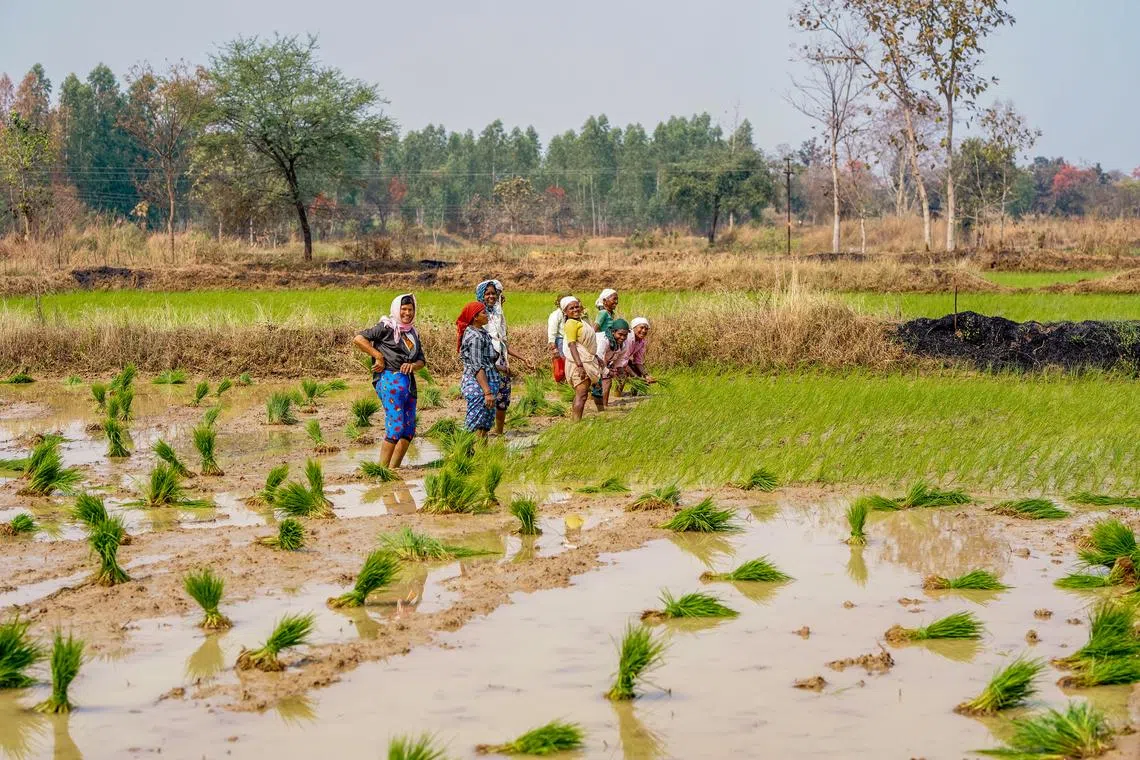
SINGAPORE – With a new government grant, global carbon project developer Value Network Ventures is planning to hire more people in Singapore and trial an eco-friendly rice farming method in parts of South-east Asia that could also produce carbon credits.
The method will involve periodically drying paddy fields instead of keeping them in a continuously flooded state, which emits more methane, a planet-warming greenhouse gas 80 times more potent than carbon dioxide.
The methane reduction can be monetised as credits that carbon tax-paying companies or the Singapore Government could potentially buy to offset a portion of their emissions. This rice farming practice also saves water, enabling food production in water-scarce and drought-hit regions.
On May 22, Value Network Ventures was one of two carbon project developers to receive the second set of the Economic Development Board’s (EDB) Carbon Project Development Grant.
The other recipient was US-headquartered Anew Climate, which recently set up office in Singapore and has been running carbon projects for 20 years.
The EDB grant – which is an undisclosed total amount – aims to support companies in performing early-stage carbon project development and financing activities that could generate high-quality credits.
In 2025, the grant received a $20 million injection from a fund by EDB and Temasek Trust’s philanthropy advisory arm. That year, the first set of three grant recipients was announced: climate solutions provider 3Degrees, project developer Climate Bridge International, and environmental non-profit The Nature Conservancy.
One carbon credit represents one tonne of planet-warming emissions that is either prevented from being released, or removed from the atmosphere. They can come from technological solutions, such as replacing firewood stoves with cleaner cook stoves, or nature-based ones like peatland conservation.
The grant recipients will conduct feasibility trials for carbon projects in the 11 countries that Singapore has existing carbon trading pacts with, as well as those in the early stages of such agreements. The 11 countries include the Philippines, Vietnam and Rwanda.
Value Network Ventures co-founder Sandeep Roy Choudhury said the firm intends to use the grant money to beef up its Singapore team, which currently comprises two management-level staff members.
“We need the new hires to build up skills in documentation, issuing credits and managing projects. Singapore is a hub for carbon markets, but not so much project development yet,” he added.
The firm will also explore projects in agroforestry and blue carbon, among other nature-based solutions.
Blue carbon ecosystems, such as mangroves, sea grasses, peatlands and coastal wetlands, can store carbon up to four times more efficiently than forests on land.
The grant recipients were announced on May 22 during the finale of a blue carbon innovation challenge to unlock global technological solutions to better protect and restore marine and coastal habitats.
The Blue Catalyst challenge – organised by the World Wide Fund for Nature (WWF) Singapore and aquaculture investment firm Hatch Blue – drew over 130 applications from start-ups and technology providers from 37 countries.
Ten finalists were selected to participate in a two-week accelerator programme hosted in Singapore, where they learnt from practitioners across conservation, finance, and technology, to find out the realities of on-field project development in South-east Asia.
The finalists brought solutions across areas such as geospatial mapping, carbon stock modelling and biodiversity monitoring.
These technologies could be piloted in WWF-Singapore’s Blue Carbon Support Programme, which aims to overcome hurdles in conserving and restoring mangroves and seagrass across Asia.
Globally, 50 per cent of mangrove restoration projects fail because of high sapling mortality, poor project design and lack of scalability.
One area the technologies can be tested in is the Rajang River Delta in Sarawak, home to mangrove forests and the endangered Irrawaddy dolphins.
WWF is developing mangrove conservation and restoration projects in the area, and satellite technology can be used to frequently track the survival rate of saplings and carbon storage of project sites, said Mr Rueban Manokara, the organisation’s global lead for the carbon finance and markets task force.
He cited Kumi Analytics, a local firm that combines satellite imagery and artificial intelligence to help project developers identify suitable planting sites and monitor them more efficiently.
At any coastal site, the firm can measure the rise and fall of tides, elevation levels and map the types of soils to recommend the optimal planting sites.
Field measurements are paired with satellite data and, using a machine learning model, can estimate the biomass stored across a vast area, said Kumi Analytics’ managing director, Mr Clinton Libbey.

Kumi Analytics managing director Clinton Libbey said field measurements are paired with satellite data and, using a machine learning model, can estimate the biomass stored across a vast area.
ST PHOTO: LIM YAOHUI
WWF’s Mr Manokara said: “More that 130 technologies are now part of the toolkit on what we can bring to the landscape to help the local communities improve and protect their land.”
Switzerland’s Inverto Earth is another shortlisted firm that has created a biodegradable and pointed container to anchor mangrove seeds, or propagules, directly into the soil using drones. Each capsule also holds additional nutrients supporting early root growth and seedling formation. A type of gel is used to coat the seeds to protect them from disease.

Inverto Earth’s co-founders Cameron Dowd (left) and Jurg Germann. In the background is a picture of the container they created to plant mangrove seeds.
ST PHOTO: LIM YAOHUI
Most projects rear saplings in nurseries before replanting them, but that is a costly undertaking, said Inverto Earth’s chief executive, Dr Jurg Germann. Their solution can reduce the costs by half, while increasing the seeds’ survival by 40 per cent, compared to just planting seeds manually.
A month ago, the firm planted 1,000 Grey mangrove seeds using their method in the Red Sea gulf region.