
SINGAPORE – Food waste accounted for about 11 per cent of the total waste generated in Singapore in 2025. That year, 649,000 tonnes of food waste was disposed of here, up from 646,000 tonnes in 2024. To help shrink this mountain of waste, the National Environment Agency has awarded three projects a total of $5.3 million to transform what would usually end up in the bin into useful products. Jemima Ryan explains what they do:
Barley spent grains (BSGs) are a byproduct of the brewing process of products like beer and Milo. They are a major cause of food waste, with about 55 tonnes of BSGs produced daily in Singapore.
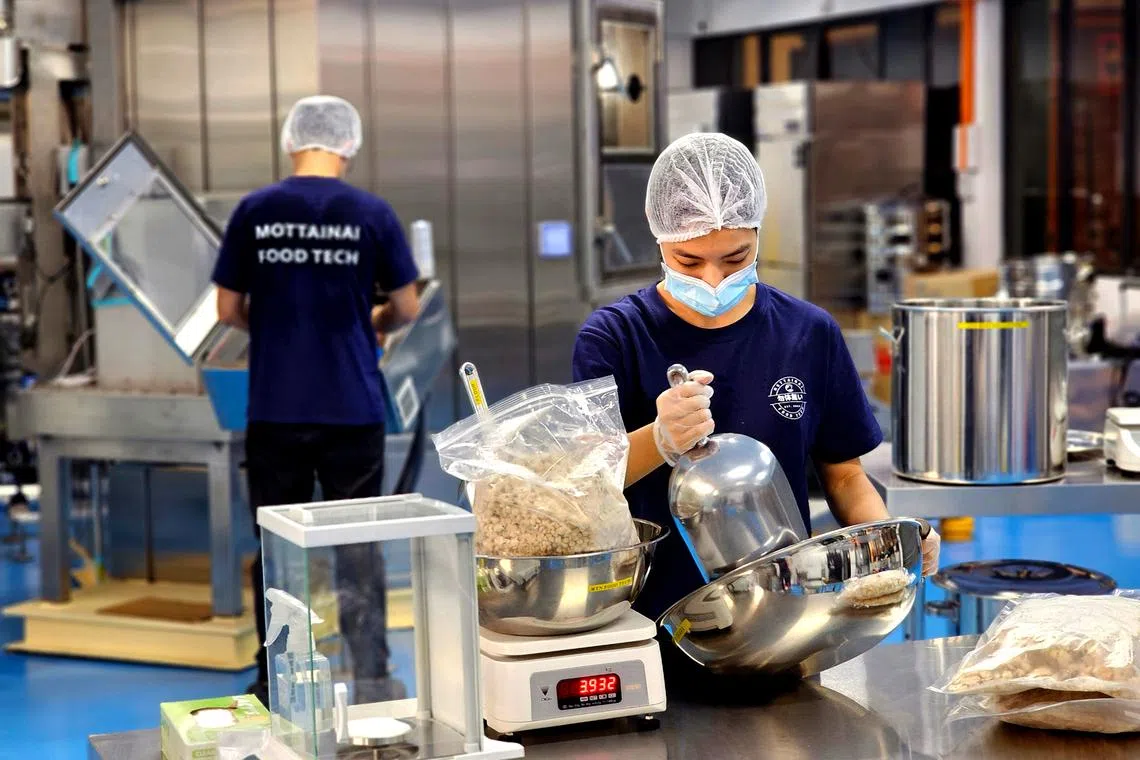
Mottainai Food Tech collects these high-fibre BSGs from breweries and other companies like Nestle and converts them into plant-based tuna flakes through fermentation.
In the long term, Mottainai aims to sell plant-based tuna products such as pastries. Their model follows the successful commercialisation of a plant-based meat product made from fermented soya byproduct okara.
The company works with Nanyang Technological University’s Asian Centre for Health Behavioural Insights & Interventions and Singapore Polytechnic’s Food Innovation and Resource Centre.

Plant-based tuna prototypes made by Mottainai Food Tech.
PHOTO: MOTTAINAI FOOD TECH
Daryl Pek, the company’s co-founder, explained that the Japanese phrase ‘mottainai’ translates to the lament ‘What a waste!’.
“It’s our philosophy that every resource is valuable and holds a lot of potential. That’s why we find ways to recycle, upcycle, and use them in different ways,” he said.

Mottainai Food Tech co-founder Daryl Pek preparing a batch of barley spent grains for valorisation.
PHOTO: MOTTAINAI FOOD TECH PTE LTD
A project by the A*STAR Institute of Materials and Research Engineering aims to turn used coffee grounds into phase change materials (PCMs), which can keep products at a controlled temperature.
PCMs are useful in supply chains of temperature-sensitive goods, known as cold chains. They are able to keep these goods at stable temperatures during transport, such as during food delivery.

Kai Dan (left) and Zhu Qiang from the A*STAR Institute of Materials and Research Engineering with samples of treated spent coffee grounds and bio-based heat-absorbing materials from the project.
PHOTO: A*STAR IMRE
The project’s goal is for their new material to achieve heat storage comparable with commercial materials like paraffin wax, which is derived from the fossil fuel petroleum.
Zhu Qiang, the principal investigator of the project, said: “Although coffee grounds are often treated as waste, they possess a naturally sponge-like structure that makes them valuable for heat management applications.
“We saw an opportunity to address two challenges simultaneously: reducing waste sent for disposal and developing greener materials for the cold chain industry.”
Ferm2Farm focuses on transforming food waste like vegetable peel into higher-value products, such as food flavourings, protein-rich animal feed and crop fertiliser.
It uses a two-step process of first extracting aroma and essential oils, before using fermentation to break food waste down into separate, useful components. This can be applied to a wide range of food waste.
The project’s lead principal investigator Christian Henderson said: “The bioeconomy is projected to contribute up to US$4 trillion (S$5 trillion) annually within the next decade.

Christian Hermansen is the lead principal investigator of Ferm2Farm at A*STAR Singapore Institute of Food and Biotechnology Innovation.
PHOTO: A*STAR SINGAPORE INSTITUTE OF FOOD AND BIOTECHNOLOGY INNOVATIONS
“Singapore is well-placed to take part, with strength in research, advanced manufacturing, and access to regional markets. We are building the capabilities, infrastructure, and industry partnerships that allow companies to develop and scale bio-based innovations here in Singapore.”
Ferm2Farm is run under the A*STAR Singapore Institute of Food and Biotechnology Innovation.