
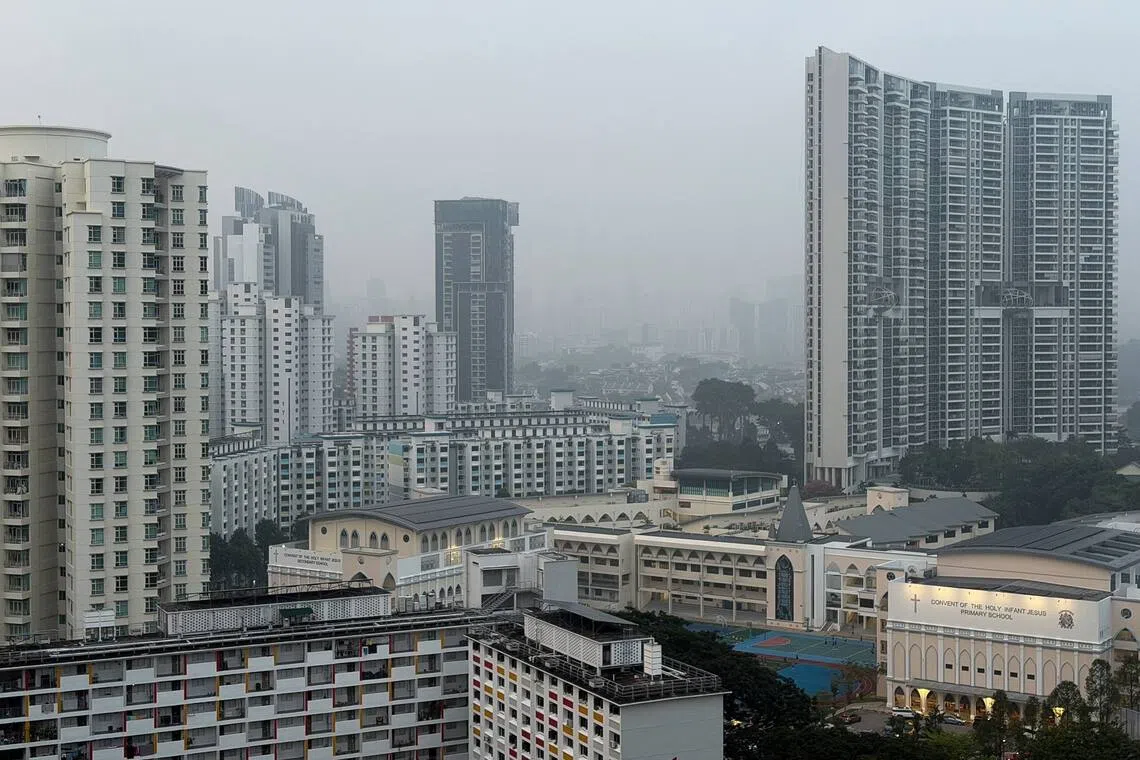
SINGAPORE – The air quality in Singapore remained in the unhealthy range early on Sept 29, with the 24-hour PSI readings above 120 across all parts of the island.
PM2.5 readings, which are used as a gauge for immediate activities, were also elevated nationwide.
At 7am, the 24-hour Pollutant Standards Index in the north crossed into the unhealthy range with a reading of 101, moving up from 98 an hour earlier.
It joined the south (129), east (128), west (139) and central (155) regions, which had all crossed the 101 threshold the night before.
Air quality is considered unhealthy when the 24-hour PSI is in the range of 101 to 200, while an hourly PM2.5 reading between 56 and 150 indicates an elevated concentration of fine particles.
At 7am, the PM2.5 readings improved slightly but remained in the elevated range: 66 in the north, 60 in the south, 86 in the east, 122 in the west and 123 in the central region.
The 24-hour PSI re-entered the unhealthy range on the night of Sept 28, with the south (103) and central (104) areas crossing the threshold reading at 8pm.
At 9pm, the west also entered the unhealthy range with a reading of 101. This was joined by the east at midnight, with a reading of 103.
The readings across all four areas stayed in that band overnight.
NEA advisory
In its daily haze advisory at about 6pm on Sept 28, the National Environment Agency (NEA) said air quality in Singapore for the next 24 hours was forecast to be in the high moderate to mid-unhealthy range.
It said that dry conditions are expected to persist over southern Sumatra and parts of Kalimantan.
While showers are forecast over Singapore on Sept 29, there remains a risk of smoke haze affecting the island with the prevailing winds expected to blow from the east or south-east, NEA said.
For periods when the air quality crosses into the unhealthy range, NEA has advised healthy people to reduce prolonged or strenuous outdoor activities, while vulnerable groups like the elderly, children and pregnant women, as well as people with chronic lung or heart disease, should minimise or avoid such activities altogether.
The PSI first returned to the unhealthy range on Sept 4, the first time since October 2023. Readings in the central region were the highest, peaking at 154 on Sept 15.