
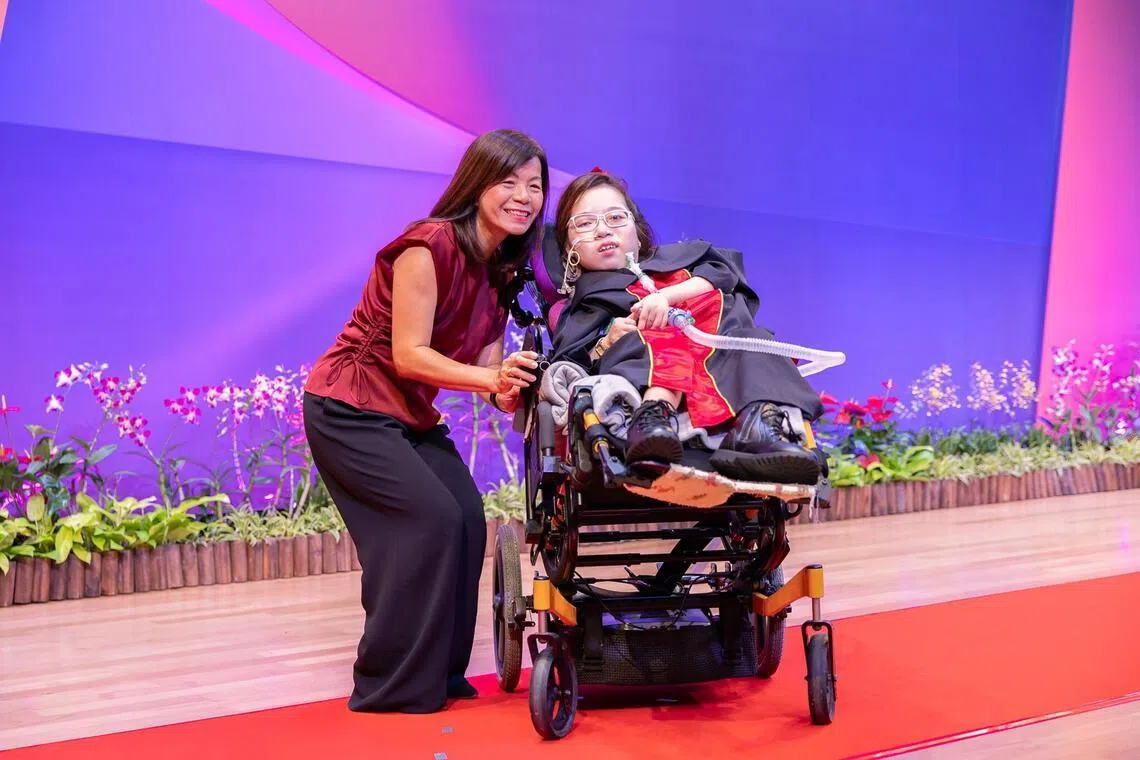
SINGAPORE – Born with critical genetic illnesses, Ms Gwyn Lim Qi Zheng’s mobility is limited to her fingers.
The only thing she can do independently is to use her smartphone for schoolwork. Prolonged periods of sitting are excruciating, and chronic fatigue is a norm.
Yet the 19-year-old diploma in business graduate was one of the recipients of Temasek Polytechnic’s (TP) Ngee Ann Kongsi Most Outstanding Overcomer Award on May 8. She was among nearly 5,400 students from 39 full-time and 47 part-time diploma courses who graduated from TP.
As a child, Ms Lim was diagnosed with trilateral retinoblastoma, a rare cancer affecting her eyes, and a tumour on the pineal gland of her brain. Her right eye was removed, while the left one was saved through chemotherapy and cryotherapy.
She also suffers from spinal muscular atrophy, a chronic neurodegenerative disease that leads to the progressive weakening of her muscles and requires her to use a wheelchair.
The muscle weakness also causes respiratory distress. Ms Lim has to undergo at least two nebuliser sessions daily to maintain clear airways and take oral medication that costs around $5,000 a bottle.
A tracheostomy tube inserted into her windpipe to support her breathing makes speaking more strenuous and affects the clarity and rhythm of her speech. She also uses a feeding pump for liquid nutrition.
Due to her health conditions, her family chose to homeschool her during primary school, with medical students from the National University of Singapore as her volunteer tutors. She sat the PSLE as a private candidate.
Ms Lim later attended secondary school, where she faced new challenges.
“I encountered social situations with peers that I had limited experience dealing with,” she told The Straits Times.
At the end of Secondary 2, she had to undergo complex spinal scoliosis surgery lasting over 12 hours.
“Dealing with chronic illness can sometimes be frustrating and anxiety-inducing, and it can feel isolating, especially when you do not know many people who can relate with… similar experiences,” she said.
Her examination experience also looked different from that of her peers. She had to type her answers on a small mobile device during prolonged exam periods and work closely with scribes.
Before enrolling at TP, Ms Lim was unsure if the polytechnic could provide her with a pathway to university, and whether her access arrangements could be accommodated.
However, she received support from the diploma in business course chair and the special education needs (SEN) officer, who helped ensure flexibility in her schooling. These included attending tutorials virtually on shorter days, as well as a permanent classroom secured so that she could be connected to her feeding pump with minimal disruptions.
They also checked in on whether she was coping emotionally and managing her stress.
Ms Lim also found ways to adapt, such as using an artificial intelligence tool to clone her voice and generate voice-overs for presentations.
“This significantly reduced the inordinate amount of time I would otherwise have spent manually recording voice-over clips multiple times and reviewing whether what I was presenting (could be understood),” she told ST.
Ms Lim also took up additional enrichment activities, such as an internship at an art gallery, where she did market research and business model development.
“This real-life work scope was new to me and pushed me beyond my comfort zone,” she told ST.

Ms Gwyn Lim Qi Zheng received support from Temasek Polytechnic staff, who helped ensure flexibility in her schooling.
PHOTO: TEMASEK POLYTECHNIC
Ms Lim earned a place on the Director’s Honours List in TP, ranking among the top 10 per cent of her cohort. She was also a recipient of the SAWL Scholarships Fund and the Daisy Phay TP Foundation Scholarship.
She wants to further her studies at a Singapore public university and pursue law. Recognising that she might not be suitable for courtroom advocacy, she hopes to work behind the scenes in legal research.
Ms Lim told ST: “I want to help and protect innocent children, secure fair treatment for vulnerable individuals, attain access to equitable and fair medical insurance coverage for people with chronic conditions, and advocate stronger disability rights and greater inclusivity in societal practices.”