
SINGAPORE – Finding community support will get easier for the Malay/Muslim community with a new online platform that compiles programmes and services across various organisations.
The M3+ Directory, which spans categories including financial assistance and employability, aims to provide an easier pathway for individuals to discover the support they need without having to go through hoops.
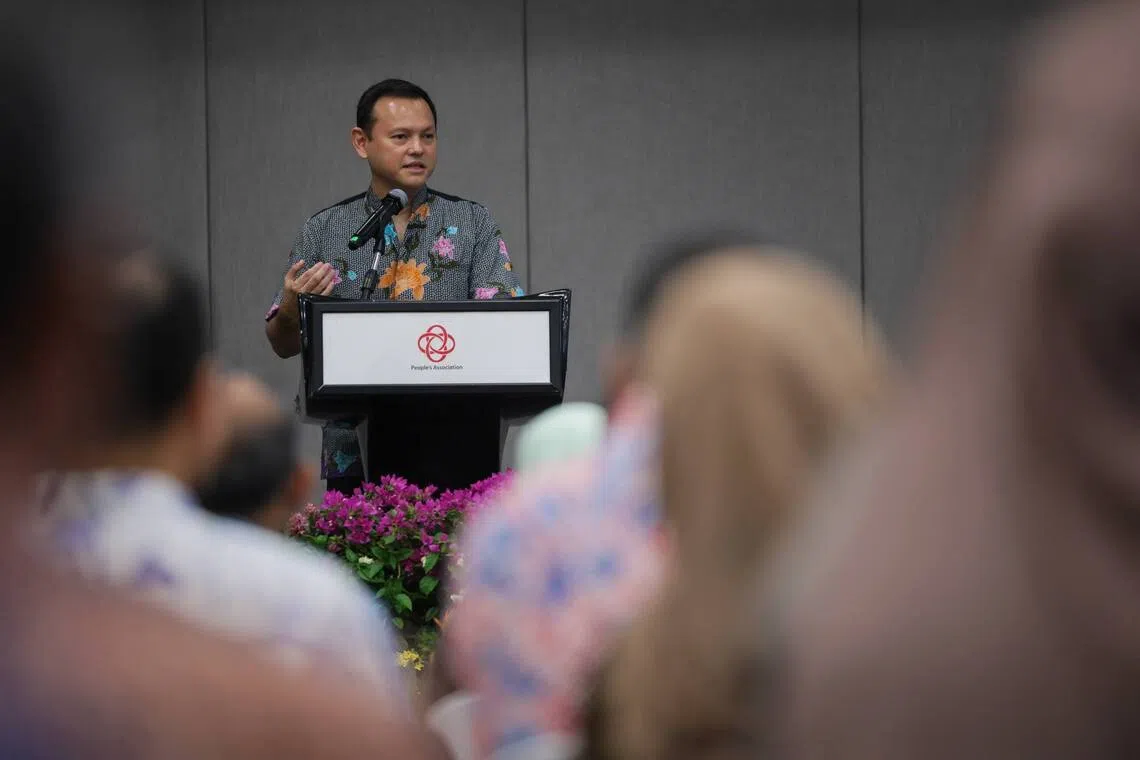
Announcing the initiative on Aug 30 at Heartbeat@Bedok, Acting Minister-in-charge of Muslim Affairs Zaqy Mohamad cited three examples: a parent, a young person and an individual going through a career transition, and how they should not have to wonder which organisation could render the necessary opportunities.
“Our institutions should make that journey easier,” he said, adding that the directory’s purpose is also to allow organisations across the M3+ network to identify gaps and spot ways to collaborate.
M3+ is an expansion of the original M3 framework that supports the Malay/Muslim community.
Formed in 2018, it was originally a tie-up between self-help group Mendaki, the Islamic Religious Council of Singapore (MUIS) and the People’s Association Malay Activity Executive Committees Council, before being expanded to include other partners.
In a speech in which he set out his vision for the Malay/Muslim community, Zaqy called the new directory a “visible first step” and said more initiatives will be announced in the coming months.
He framed such efforts as vital steps in preparing the Malay/Muslim community for a changing world.
Zaqy also introduced an expanded CiptaSama@M3+, which builds upon a Malay/Muslim focused programme introduced in 2019 that aims to encourage the community’s participation in policymaking.
Instead of being carried out on occasion, he said involving the community in policy making would be a more active process, adding: “Because if the future belongs to all of us, then all of us should have a hand in shaping it.”
Even as younger generations embrace new opportunities, Zaqy stressed the importance of the community being grounded in four anchors: faith, knowledge, humanity and identity.
These concepts are not abstract ideas, but already part of the Malay/Muslim community’s history and ongoing progress, he added.
The community is deeply rooted in its faith, noted Zaqy, adding that the upcoming Singapore College of Islamic Studies will be an important milestone to develop future generations of religious leaders.
He said that knowledge reflects how far the community has come through education, and that the next chapter will be to help people embrace new technologies with confidence.
Humanity meanwhile is important to remind the community that progress cannot be measured by some individuals’ succeeding, but also how many others are uplifted.
He added that no matter how far the community progresses, its identity will always be part of it, and that identity is about engaging the world while feeling secure in one’s heritage and culture.
Speaking in Malay, Zaqy added: “Success has no meaning if we forget our identity.”
Ultimately, he said these four pillars are not separate areas, but go hand-in-hand to shape the community they want to continue building in Singapore – namely one that is “grounded, capable, compassionate and confident”, as well as confident about its roots and ambitious about its future.
East Coast GRC MP Hazlina Abdul Halim, who is an adviser for M³+@Bedok, said the launch of the new directory represents a milestone in the collaboration between different organisations.
She said: “We’re able to share what’s out there, find opportunities to collaborate, and for when we notice there are gaps or areas for partnership, I think that is exactly the intention of starting something together.”
Achieving this means fostering an environment that empowers the next generation, he noted.
Zaqy said: “This is our responsibility. Not to decide how far our children can go. But to give them the confidence to go further.
“And when they do, they will know where they come from, who they are, and the community that stands with them.”