
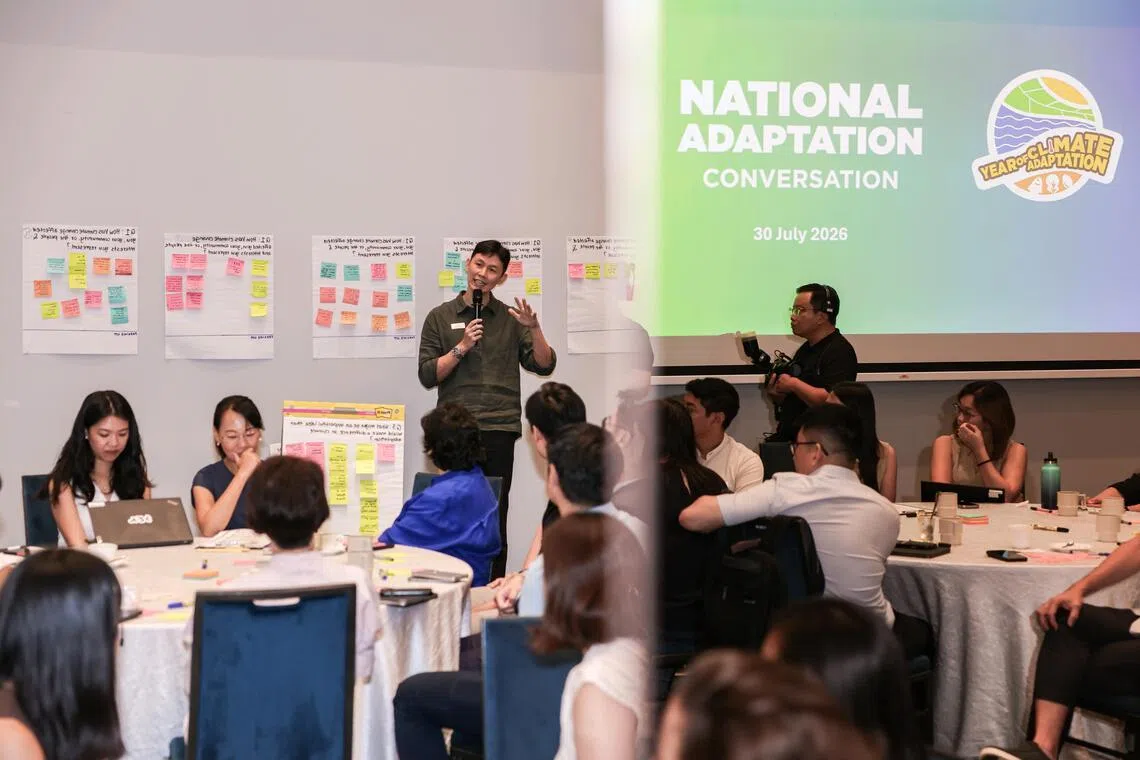
SINGAPORE – From July 30, residents can share their ideas and feedback on Singapore’s inaugural climate adaptation plan, helping the Government to develop a long-term strategy to shield the nation against climate change.
This call to action was announced at the launch of the Ministry of Sustainability and the Environment’s (MSE) first National Adaptation Conversation, a series of discussions that brings together stakeholders to exchange ideas, share aspirations and weigh the trade-offs of strengthening Singapore’s resilience to the impacts of climate change.
On July 30, more than 100 representatives from businesses, academia, community groups, youth organisations and the public sector gathered at Sentosa for the inaugural dialogue on the city-state’s climate challenges and opportunities.
Over the coming months, these conversations will focus on key adaptation areas, including heat, coastal, flood, water and food resilience; urban liveability and infrastructure; biodiversity and greenery; and public health.
The dialogue was joined by Minister for Sustainability and the Environment Grace Fu, who broke ground for a “living classroom” billed as Asia’s first experiential climate adaptation hub.
Set to open to the public for free by the end of 2026, the education space situated on the defunct Sijori Wondergolf course in Sentosa will allow visitors to learn first-hand how habitats and ecosystems adapt to a changing climate.
Fu told participants at the dialogue that the conversations will help clarify the appetite for risk and behavioural changes that policymakers, business leaders and community leaders are willing to take.
She said: “(These) adaptation conversations are not really about finding one single solution because the actual fact is that the solution lies in all of us, in policy, in government giving the resources as custodian, allowing us to apply resources for the future in a way that is cost-effective, that gives us option for future generations to decide to shape the future of business, the future of living.”
Siestas or afternoon naps – allowing people to work during cooler times of the day; wearing cooler attire and wider adoption of setting the indoor air-conditioning temperature to 25 deg C were among ideas floated by participants at the dialogue.
In May, Fu noted that the overarching adaptation plan, targeted for publication in 2027, will take stock of current measures and identify climate risks rather than immediately prescribing solutions.
The stocktaking exercise will pave the way for further discussions among government agencies, businesses and banks, which could help finance solutions stemming from the plan.
Since designating 2026 as the Year of Adaptation in March, the MSE has held some 50 engagements with stakeholders on their perspectives regarding climate change, before the launch of the National Adaptation Conversation.
The ministry and relevant agencies will now step up these efforts through focus groups, community dialogues, sector-specific engagements and public events.
This includes an interactive public exhibition in October and November to help Singaporeans understand how a changing climate will impact their daily lives and what they can do.
“Together, these platforms provide deeper conversations on adaptation challenges and opportunities, and opportunities for co-creating solutions and building ownership amongst stakeholders,” MSE said in a statement.
Insights and feedback gathered through these initiatives will shape Singapore’s plan, which will be submitted to the United Nations Framework Convention on Climate Change, the body that drives the UN’s response to climate change.
The MSE noted it will review and update the plan periodically to ensure the strategy remains underpinned by the latest climate science and aligned with national priorities.
The public can submit their feedback and suggestions online at go.gov.sg/NAPfeedback.

(From left) Terra SG co-founder Kelvin Wong introducing the site of the climate adaptation hub to Minister for Sustainability and the Environment and Minister-in-charge of Trade Relations Grace Fu, Sentosa Development Corporation chief executive Thien Kwee Eng, and Permanent Secretary for Sustainability and the Environment Melvyn Ong during the hub’s ground-breaking ceremony at Sentosa Nature Discovery on July 30.
ST PHOTO: BRIAN TEO
The education space at Sentosa marks the first project funded under the SG Eco Fund’s $5 million Climate Adaptation Package, designed to drive community action.
Fu said the space exhibits the spirit of cooperation that underpins the response to climate change.
She said: “We also hope that this will be a place where people, all the users, whether it’s tourists or local residents, could actually benefit from a better understanding of what adaptation is about, because we are going to embark on this multi-decade exercise of adapting Singapore for a warmer world, for a world with more variability in the weather pattern, and that is something that requires all of us to adjust.”
To further these efforts, Sentosa announced a three-year partnership with the SG Eco Fund to engage the community on the nation’s sustainability and climate adaptation initiatives.
From 2027, paid guided learning journeys will be conducted at the climate adaptation hub, which is a collaboration between the statutory board and environmental social enterprise Terra SG.