
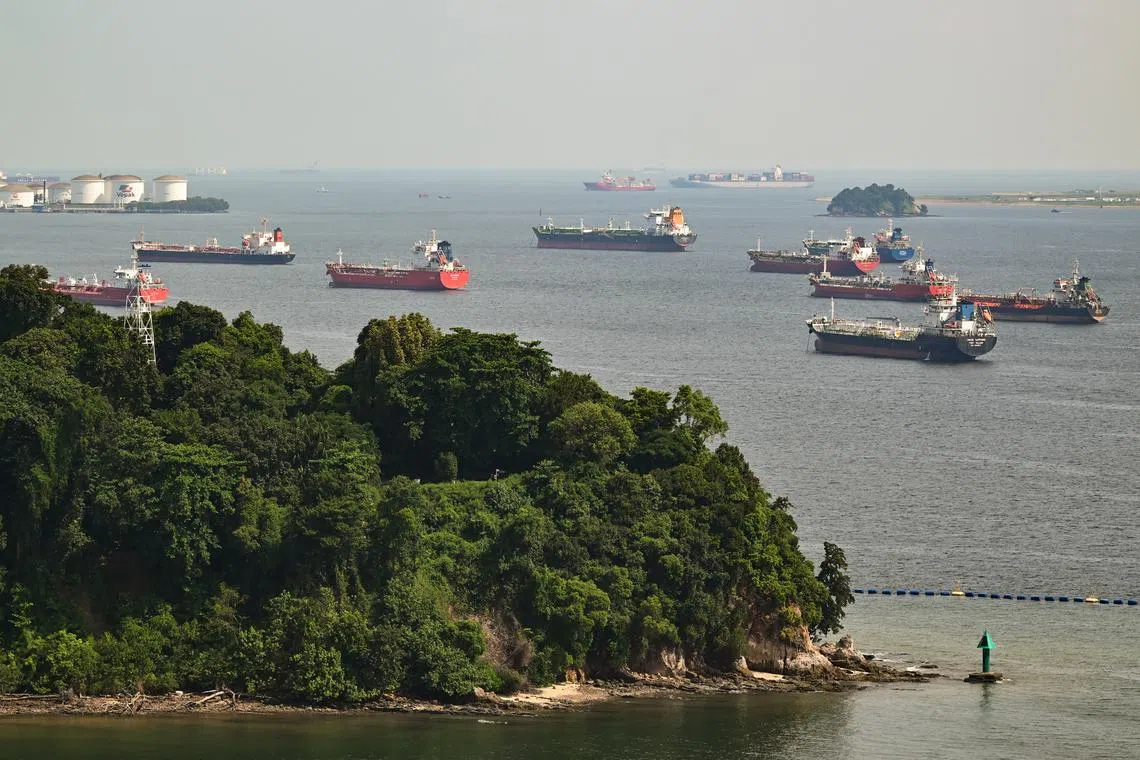
SINGAPORE – To prevent one of Singapore’s last coastal cliffs and rocky shores from crumbling, rock masses at Sentosa’s western tip need to be nailed in place and brittle outcrops shielded from rough waves.
In 2027, a suite of measures will be undertaken to strengthen parts of Tanjong Rimau, a biodiversity haven that has been experiencing slope damage, rock falls and erosion over the years.
They include drilling metal rods or nails into the rock and soil, laying erosion-control blankets and lining X-shaped concrete blocks – called XblocPlus – at the foot of some slopes to protect the shoreline from coastal erosion.
These works across four weak slope areas within a 400m stretch of Tanjong Rimau are expected to take nine months to complete. The measures were revealed in an environmental assessment released in June on Sentosa’s website.
A few hundred of the interlocking XblocPlus blocks, each weighing about a tonne, will be placed at three sites in Tanjong Rimau, in partnership with national water agency PUB and the solution’s creator Delta Marine Consultants, among others.
This solution is also one of five novel coastal protection measures that will be tested islandwide over three years to help determine whether they can be used for future coastal protection works.
As one of Singapore’s remaining natural rocky shore and coastal cliff habitats, its richness in biodiversity and the unique geology of its intertidal zone make it a popular site for nature lovers.
“Tanjong Rimau is the best and one of the last of the accessible places in Singapore to see the type of coastal forest that clings to rocky outcrops,” said Shawn Lum, a senior lecturer at NTU’s Asian School of the Environment.
Muhammad Nasry Abdul Nasir, executive director of Singapore Youth Voices for Biodiversity, noted that the coastal flora are adapted to regular disturbances caused by slope damage.
“The small landslides dump rocks on the shore, which create numerous tiny pockets for marine creatures to inhabit – that’s how a rocky shore habitat forms,” he explained.
But all it takes is erratic weather to trigger a huge landslide and wipe out highly endangered species that are no longer widespread in Singapore, he said.

Slope failure observed in Tanjong Rimau in early 2020 after heavy rainfall.
PHOTO: SENTOSA DEVELOPMENT CORPORATION
The study recorded 94 flora species, including four seagrass types. Of the 94, more than a quarter are threatened or important for conservation. These include the nationally critically endangered nyireh laut tree and the vulnerable Raffles’ pitcher plant, of which Tanjong Rimau is one of the last major strongholds.
Lum said: “In addition to safeguarding the physical site and its flora and fauna, earthworks at Tanjong Rimau might allow people to visit and study the area in a safe and sustainable way.”
But the measures, like any human activity, will cause impacts.

The environmental study, done by biodiversity consultancy firm Camphora, found that more than 12 per cent of seagrass meadows along Tanjong Rimau may be lost as temporary bunds will be constructed within the intertidal zone to enable works. Materials and machines such as excavators will be transferred along the bund.
Some loss is unavoidable, but the habitat can recover after works are completed, stated the report.
Another risk is how soft, sandy and seagrass habitats – which support creatures such as sea sponges, the galloping sand star, mudskippers and coastal horseshoe crabs – are likely to transform into artificial hard, rocky habitats at the locations of the XblocPlus armours.

Part of Tanjong Rimau’s intertidal shore, taken in 2021.
PHOTO: ST FILE
With the possibility of losing some soft habitats, nature experts have concerns about the suitability of XblocPlus at a rare, fragile spot like Tanjong Rimau.
“While stabilising the slopes is necessary to prevent progressive collapse (of the cliff), the approach should minimise impacts to Tanjong Rimau’s biodiversity,” said Lester Tan, chairman of Nature Society Singapore’s Marine Conservation Group.
“I’m always in favour of not changing one habitat to another. There could be a loss of connectivity,” added Tan.
Nasry added that while the XblocPlus armours may not directly bury seagrass, they could alter the energy of waves and how sediments move, which could gradually bury or destabilise nearby seagrass meadows.
For example, patches of critically endangered tape seagrass are abundant on the southern shores of Tanjong Rimau, near two planned armour systems.

To compensate for any loss, the 200-page report by Camphora suggested that man-made micro-habitats be created alongside the revetments. These could include rock pools, grooves and crevices to mimic natural rocky shores for algae, corals and crustaceans.
Rock surfaces can be roughened, with spaces between the concrete blocks widened to create shaded, moist refuge for intertidal creatures.
“These interventions are expected to partially restore habitat functionality lost during construction, increase species richness and functional diversity relative to unmodified armour rock… while maintaining its primary coastal protection function,” said the report.
Tan acknowledged that XblocPlus enables the creation of new rocky habitats and is a better option than building a uniform sloping wall that is not conducive for wildlife.
But while new rocky habitats can be created, soft habitats could still be lost.

XblocPlus blocks at a booth at Singapore International Water Week on June 16.
PHOTO: ST FILE
Nasry said: “If you’re protecting an existing seawall or a reclaimed shoreline with little ecological value, (adding XblocPlus) for habitat complexity is a no brainer.
“But Rimau is not a blank canvas; there’s a lot of life there. Are there alternatives we can consider that are less drastic in terms of reshaping the shore, that can still provide the coastal resilience we are looking for?”
In response to queries, Sentosa Development Corporation (SDC) said the current environment at the toe of the slope comprises rocks and sandy substrate.
“The impact is therefore best characterised as a change from soft to hard substrate within the works footprint, and hence has minimal impact on existing biodiversity,” it added.


During construction, work areas will be sensitively managed and any disturbance to the biodiversity be kept minimal as technically possible.
“The XblocPlus system will incorporate eco-engineered features such as crevices and tidal pools, if feasible, to replicate the complexity of Tanjong Rimau’s natural rocky shores and support a diversity of intertidal fauna and algal communities,” added the statutory board.
An environmental monitoring and management plan will also be implemented throughout the project to ensure regulatory compliance and minimise impacts.
Steps recommended include salvaging seagrass for researchers before they get affected, and saving threatened coastal plant species before works begin.
The temporary bund alignment should also be adjusted to avoid three nyireh laut trees, with appropriate tree protection zones in place, stated the report.
Tan suggested that the Singapore Oceanarium’s intertidal surveys should continue, alongside monitoring by marine experts, after construction.
Lum said: “The work needs to be done sensitively, and the teams on the ground may have to be flexible and resourceful enough to adjust their workflow as any work, not least of all in a dynamic environment like the coastal zone, requires.”