
SINGAPORE – Seven local vegetable farms will be partnering wholesale suppliers at Pasir Panjang Wholesale Centre to widen the reach of their produce, especially to caterers and food manufacturers.
The seven urban farms with the Singapore Agro-Food Enterprises Federation (SAFEF) include Yili Farm, MEOD, Metro Farm, Liteleaf and CropCiti.
The three wholesale suppliers – Lim Thiam Chwee Food Supplier, Thong Hai and CCL Impex – will distribute the locally grown vegetables to their institutional buyers including in-flight caterer SATS and large central kitchens.
The aim is to sell up to 600kg of local veggies each weekday under this tie-up, said SAFEF’s chief executive Ken Cheong.
During the signing of the agreement on July 29, Acting Minister-in-charge of Muslim Affairs Zaqy Mohamad said: “Being able to have (sufficient) demand gives our farmers the confidence to scale up their produce.”
Zaqy, who is also SAFEF’s patron, said: “Basically, we hope that over time we will have cost efficiency because of steady uptake.”
The partnership is the result of a three-year push by the federation to win over wholesalers, which typically favour cheaper overseas imports. Cheong said that the volume business from wholesalers will help local farms stay afloat, even if wholesale prices command lower margins than retail.
He said it is important to keep local farms in business to provide a buffer for when vegetable supply overseas are affected by wars, disasters and drought. “Cheap can be deadly for buyers if they don’t consider supply resilience for their business continuity,” he added.
In early July, The Straits Times reported that local vegetables from at least three farms here would no longer be available at supermarket giant FairPrice.
The decision, part of FairPrice’s regular product review, highlights the tussle between providing customers with value-for-money products and the national effort to improve food resilience.
Local vegetable production rose slightly in 2025 to 16,600 tonnes, up from 16,400 tonnes in 2024.
Thong Hai’s manager Yeo Wei Li said his company had been considering buying from local farms after the Covid-19 pandemic briefly cut off supplies from Malaysian farms.
But it took the company some time to get to know the local farmers, ensure their products are consistent and conduct taste tests.
Mr Yeo aims to source 20 per cent to 30 per cent of specific leafy greens from the local farms.
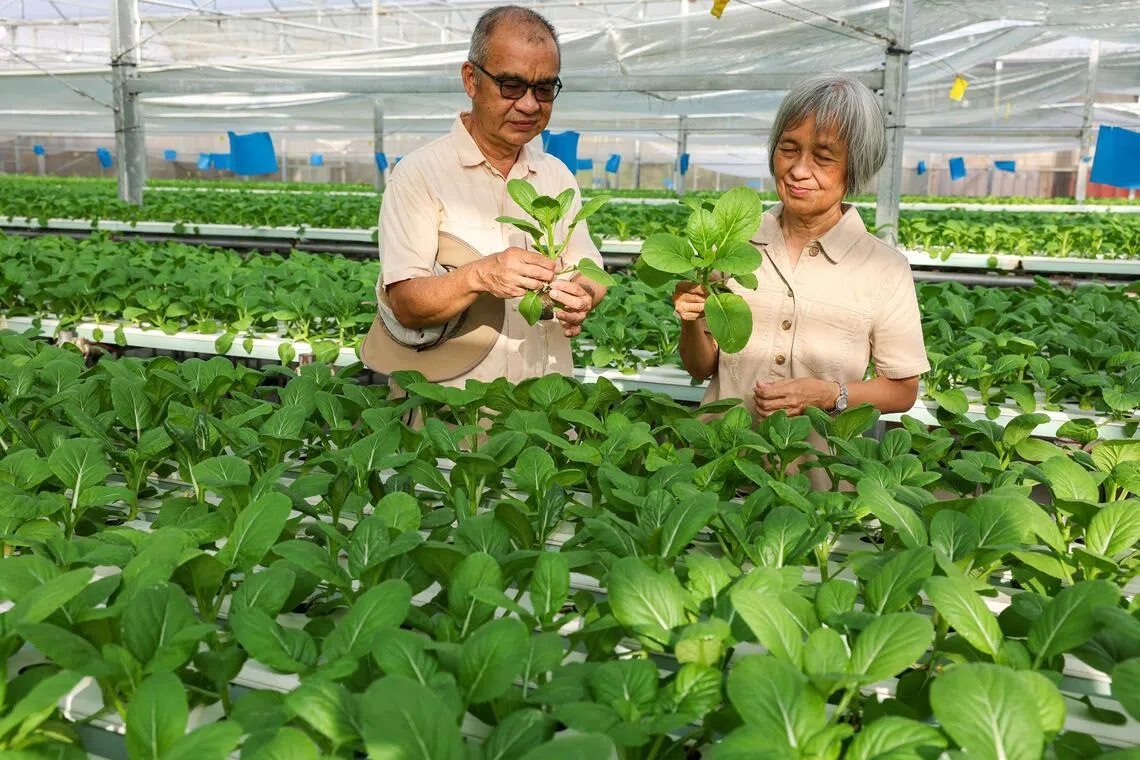
One of the seven farms, MEOD, will be producing at least 500kg of bok choy for wholesalers every week for the first time. In the past, MEOD sold to wholesalers only on an ad-hoc basis.
While the farm will be selling its produce below its regular price point, MEOD is drawn to guaranteed regular sales, said its head of sales and distribution Daniel Lua.
Wholesale vegetables also do not require packaging, helping the firm save 20 per cent of packing costs, he said.

Acting Minister-in-charge of Muslim Affairs Zaqy Mohamad, Coriander Leaf founder and culinary director Samia Ahad, and SAFEF chairman Thomas Pek viewing an assortment of produce under the SG Farmers’ Market brand.
ST PHOTO: BRIAN TEO
On July 29, SAFEF also provided updates on its work to boost the retail and online sales of local farms.
One initiative is SG Farmers’ Market, a brand that consolidates produce from 14 local vegetable farms, including the seven that entered wholesale deals with the three Pasir Panjang Wholesale Centre suppliers.
The SG Farmers’ Market brand now carries 12 varieties of vegetables in supermarkets, more than double the five during the brand’s launch in 2024. By the end of the year, SAFEF hopes to add six more varieties, including mini radishes from GKE Agritech and nai bai from Vegeponics.
Retailers also prefer brands that can give consumers variety, added Cheong. Under the SG Farmers’ Market brand, a bag of local lettuce or xiao bai cai costs $2 per pack.
Cheong said: “Farming cost is high in Singapore. You either grow big or go home.”