
SINGAPORE – In the search for cooling solutions in the sizzling tropics, there is no shortage of innovations, but the challenge is to ensure that the solutions reach the people who need them the most, as soon as possible.
“We know that innovation is the way forward, but what we struggle with is that science (alone) doesn’t reach large-scale deployment, and that’s the biggest gap that we’ve observed as scientists,” said Irene Cheong, assistant chief executive of innovation and enterprise at A*STAR.
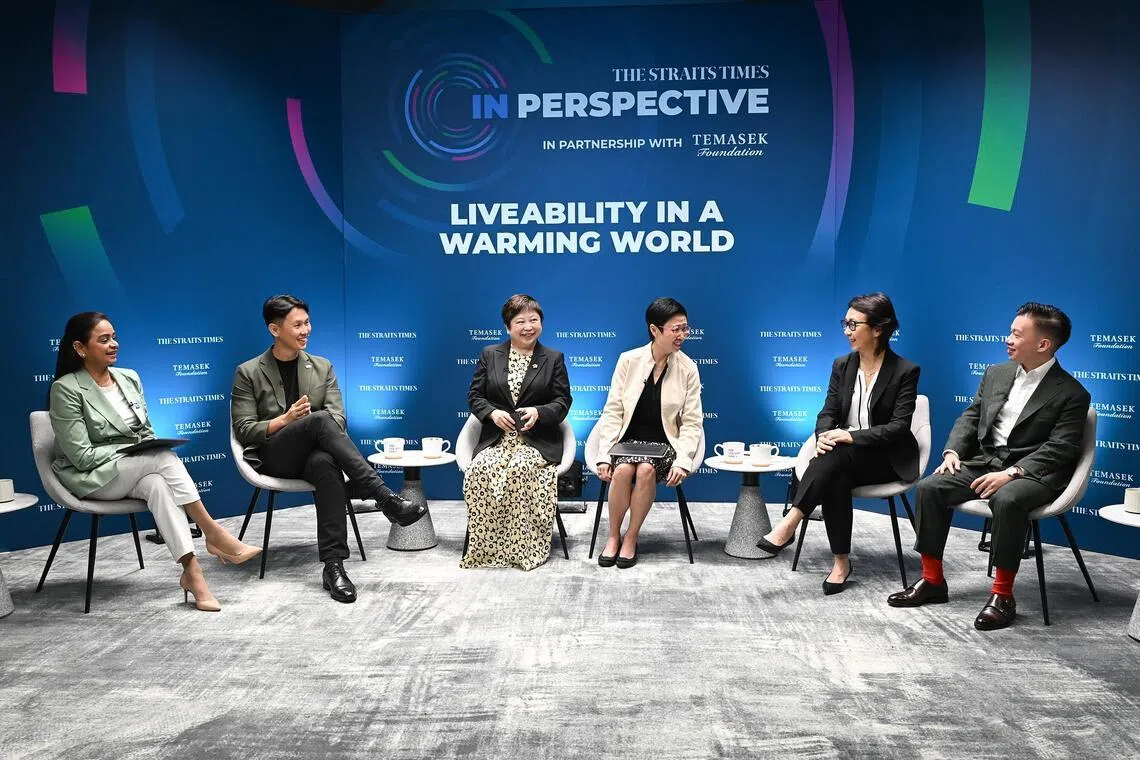
She was speaking at an In Perspective roundtable discussion on heat hosted by The Straits Times on June 4, moderated by ST’s Asia News Network editor Shefali Rekhi. The theme of the dialogue was “Liveability in a warming world: Is Asia getting climate adaptation and mitigation right?”
Over the 50-minute session, Cheong and four other panellists attempted to unlock the key ingredients needed to make cooling solutions scalable and worthy of funding.
Jane Zhang, head of South-east Asia and Singapore for climate-tech innovation platform Breakthrough Energy Fellows, noted that the highest-value innovative solutions are those that can help people stay cool while helping to reduce planet-warming carbon emissions.
“That’s what the investors are increasingly looking for,” she said.
Zhang cited a local start-up called Entropy Lab, which developed a type of heat-reflective paint that can cool buildings by around 5 deg C – further than the 2 deg C reduction that commercial cool paint offers.
She added: “(It) is specially formulated to be able to absorb moisture during the night and evaporate during the day to cool buildings.
“This product not only reduces heat exposure for buildings, but also reduces energy demand and emissions.”
When the paint helps to cool the surfaces of buildings, air-conditioning has less heat to tackle. This means less electricity and energy are used up.
A recent survey commissioned by SPH Media and Temasek Foundation found that heat stress ranks as the top climate change concern among the public, followed by rising food prices and utility bills. The survey involved 1,000 people aged 16 and above in Singapore.
Zhang added that investors are increasingly viewing climate adaptation more as a risk rather than an “abstract climate issue”.
“Heat will affect health, and also will impact productivity, and will impact food, so the whole system will get impacted because heat… is a risk to the economy,” she said.
A 2026 report led by the Centre for Impact Investing and Practices identified several barriers that constrain capital flow into adaptation solutions.
These include underdeveloped policy and regulatory environments; limited access to data on local climate, risk and costs; and mismatches between solutions and the funding available.
Many solutions are also highly context-specific – making them harder to implement at scale – and require longer investment periods.
Heng Li Lang, head of climate and liveability at Temasek Foundation, highlighted the role of philanthropic money in supporting early-stage solutions that may be considered too risky for private capital to come in.
Philanthropic players – who generally do not expect financial returns – act as the first layer of finance by allowing new cooling technologies to be tested, for example.
Heng noted that while philanthropic capital for climate is estimated at US$8 billion (S$10.4 billion) to $16 billion annually, this is just a fraction of the trillions of dollars needed.
“At Temasek Foundation, we catalyse innovative solutions, bring them to the market, de-risk it to show that it can work, and that will attract financial market capital to help them scale and commercialise,” she said.
Cheong added that working with investors has shown that early-stage innovations will need to be trialled and piloted – to be taken seriously – before they can be fully rolled out.
It would also be useful to test them digitally on simulators or virtual twins.
One company that has been conducting trials in Singapore is Eztia Materials – a US-headquartered firm that has developed singlets, arm sleeves and bandanas speckled with a jelly-like material that, when worn, can potentially reduce a person’s skin temperature by as much as 9 deg C.
The cooling technology behind Eztia’s gel absorbs the skin’s heat, and water in the gel slowly evaporates, making the skin feel cooler. The garment just needs to be tossed into the washing machine or soaked in water to be used again.

Eztia Materials has developed singlets, arm sleeves and bandanas speckled with a jelly-like material that, when worn, can potentially reduce a person’s skin temperature by as much as 9 deg C.
ST PHOTO: SHINTARO TAY
Eztia’s cooling garments are being trialled at a few places, including PSA Singapore and the NS Square construction site in Marina Bay. Through workers’ feedback, improvements were made to the gel material and hand sleeves.
Ultimately, solution providers and researchers are innovating to protect vulnerable groups.
Eztia’s Asia-Pacific market lead Darryl Tan said: “Heat resilience becomes a privilege where the slightly more affluent and wealthy are able to retreat to rooms where it is cooler and there is air-conditioning.
“People who are less fortunate actually have to bear that exposure. That’s a world that none of us wants to build towards.”

-
In Perspective is a research-led content programme by SPH Media that combines insight-driven storytelling with expert perspectives on key issues shaping society.