
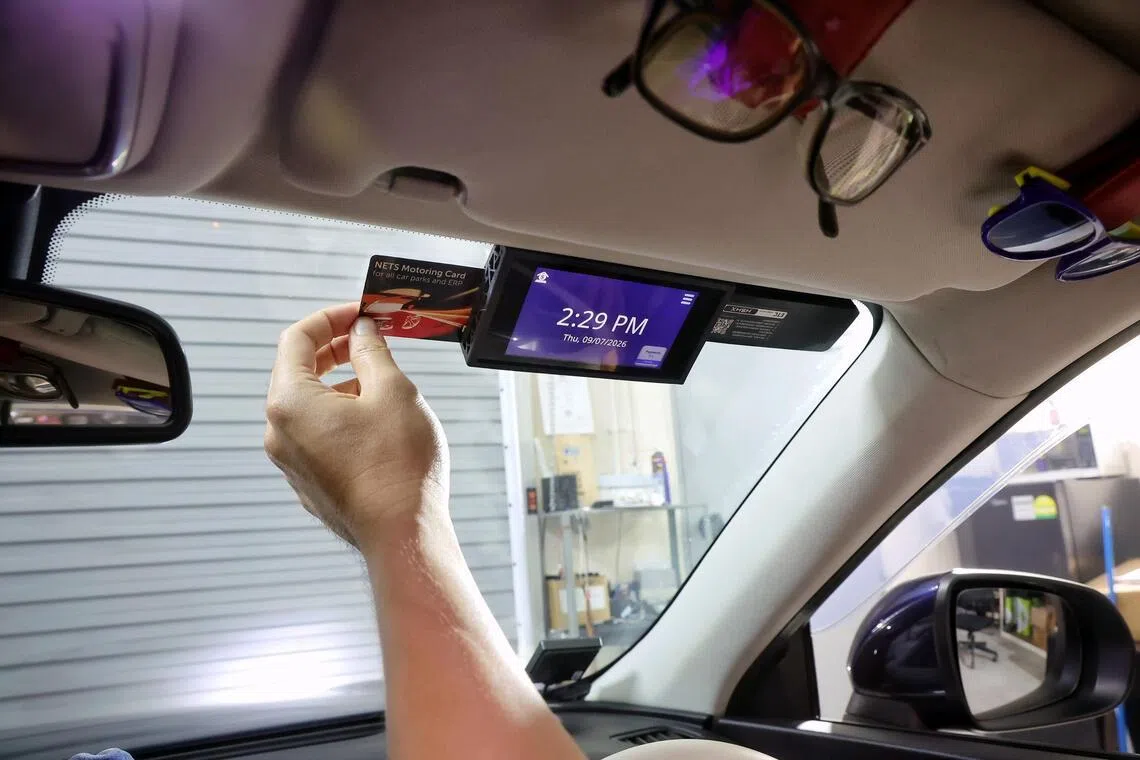
SINGAPORE – Some drivers are spending as much as $300 on third-party accessories to modify the placement of the on-board units (OBUs) in their vehicles. They do so to make their CEPAS payment cards easier to reach or to make their cabins look more visually pleasing.
Mok Chee Kin, 41, sent his Nissan Serena to have its OBU relocated on the day it was delivered.
For $300, a workshop moved the touchscreen display to the top right-hand corner of the windscreen using a third-party bracket, hid the processing unit in the glove compartment, and installed a separate card reader on the side of the dashboard near the driver’s seat. The installation took about an hour.
So far, Mok said the set-up has worked without problems.
Mok, who also modified his previous car, a Toyota Noah, in 2025, disliked the installation that came with his Nissan. He found it unsightly to have the touchscreen display sitting near the bottom of the dashboard, and did not like how his leg brushed against the processing unit in the footwell when he was driving.
The OBU is part of the next-generation Electronic Road Pricing (ERP) system and is mandatory for all Singapore-registered vehicles from Jan 1, 2027.
To work around the standard mounting limitations, online marketplaces and motor workshops now offer alternative brackets, card-reader extensions and relocation services costing between $10 and $300. Some owners are 3D-printing their own accessories.
On its webpage about OBU installations, the Land Transport Authority (LTA) acknowledged that some authorised installers offer such accessories during installation, adding that workshops are advised not to hard-sell these additional accessories to motorists.
In response to The Straits Times’ queries about such non-standard OBU installations, LTA said: “Motorists who use third-party accessories with their OBU bear the risk of voiding the OBU warranty if the accessory affects the proper functioning of the OBU.”
The OBU has a five-year warranty that starts from the date of installation.
Without that warranty, an owner can expect to pay more than $220 to replace the processing unit, $90 for the antenna and $50 for the touchscreen display, excluding installation costs, according to VX Audio, a car audio specialist authorised to install OBUs.
VX Audio founder Seow Kwan Heng said his company has sold at least 3,000 slim OBU mounting brackets that it designed since 2024, mostly to owners of larger multi-purpose vehicles and sports cars.
The bracket allows the display to sit flatter at the top right-hand corner of the windscreen so that the sun visor can still be extended.
Besides being installed in a separate location, the card reader can also be incorporated into the mount, directly behind the screen. This gives the user interface a layout similar to that of the old ERP system’s in-vehicle unit, which had the card reader and the digital display in a single unit.
Seow said customers mostly want a tidier layout and quicker access to their payment cards.

A separate card reader allows drivers to reach their CEPAS cards more easily than the standard reader, which is part of the on-board unit.
ST PHOTO: KEVIN LIM
With the standard installation, the card reader, which is part of the processing unit, can be located in the front passenger’s footwell, under the glove compartment, at the side of the centre console, or under the driver’s seat.
Alongside workshops offering OBU relocation services are online sellers such as Alex Kong. The trained design engineer has created 3D-printed OBU screen mounts, which he sells on platforms such as Shopee, Lazada and Carousell under the name 3DP Solver.
The 33-year-old has sold more than 800 pieces since August 2025 for either $15 or $24, depending on the design. On receiving the customised plastic mounts, buyers can relocate the touchscreen displays on their own or pay a workshop to do it.
LXG, another online seller, said slim mounts are also useful for vehicles with smaller cabins, such as sports cars, as they place the screens slightly farther from the driver’s face.

Slim OBU screen mounts are advertised for sale on various online platforms.
PHOTO: 3DP SOLVER’S CAROUSELL PAGE
Financial consultant Jeremy Hu found the standard bracket that came with his OBU too bulky. But instead of buying a ready-made customised mount, he downloaded a free 3D file for a slim OBU mount in 2025.
Through online shopping platform Taobao, he commissioned a vendor in China to print the 3D design using a heat-resistant material for less than $2.
He installed it in his Toyota Sienta himself. It was an “easy fix”, he posted on the Singapore Home DIY Facebook page, along with pictures of the relocated screen and the link to the 3D file.
While Mok, who owns the Nissan, admits that $300 is not a trifling sum, he said: “For me, appearance and comfort are important.”