
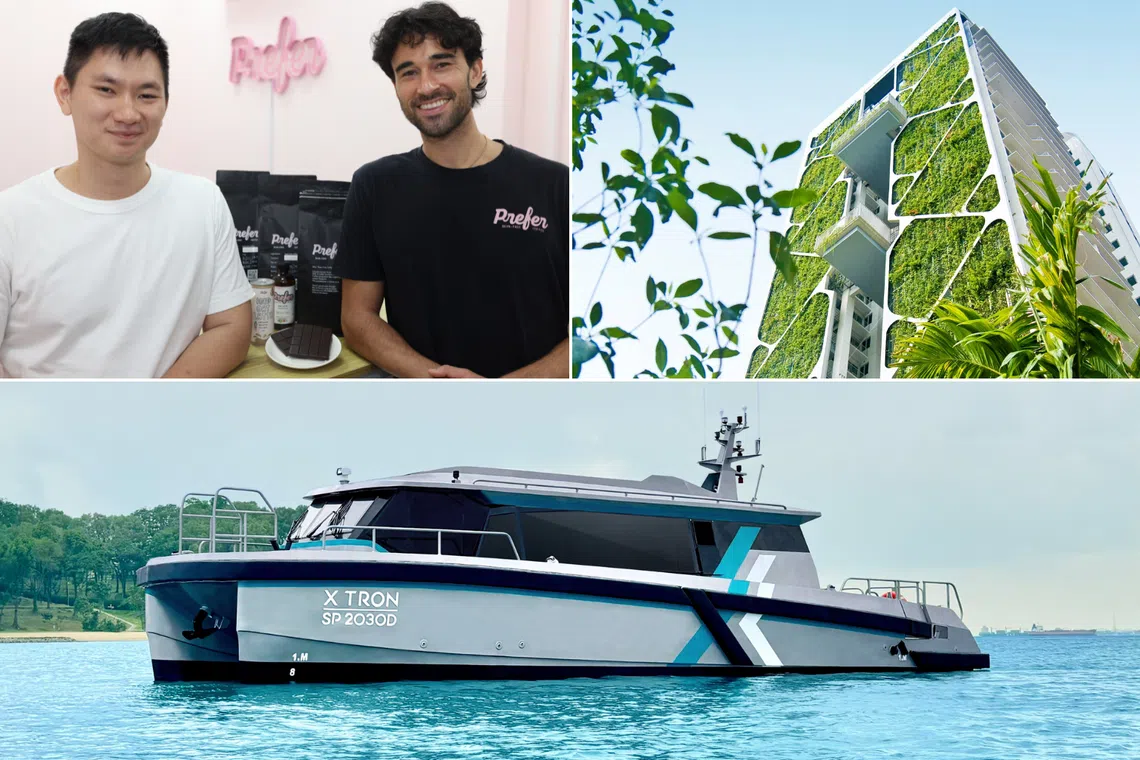
A coffee alternative made from food waste. Cooler, more resilient developments designed for a changing climate. Electric ferries helping to reduce emissions in Singapore’s waters. Slashing bills with solar energy.
At first glance, companies such as Prefer, City Developments Limited (CDL), Pyxis Maritime, Penguin International and Containers Printers have little in common. Yet all have found that sustainability delivers something many businesses are seeking: growth opportunities.
For Prefer, it has opened doors to international partnerships and investor interest. For CDL, it has strengthened access to sustainable financing while improving asset resilience. For Pyxis Maritime and Penguin International, it has created opportunities in the fast-growing marine electrification sector while reducing operating costs. For Containers Printers, it has reduced energy bills by leasing solar power.

Prefer’s bean-free coffee and cocoa products appeal to brands looking for cost and supply stability.
PHOTO: PREFER
Their experiences point to a broader shift. Sustainability is no longer simply about reducing environmental impact or meeting stakeholder expectations. Increasingly, businesses are finding that it can help lower costs, unlock new markets, strengthen supply chains and future-proof operations.
Director for enterprise capabilities at Enterprise Singapore (EnterpriseSG) Ong Lixia says successful companies tend to view sustainability not as an obligation to fulfil, but also as a business strategy.
“Those that thrive treat sustainability not as a compliance exercise, but as a core part of how they operate – and in doing so, they build resilience to weather energy volatilities and supply disruptions in an increasingly uncertain world,” she says.
The benefits can take many forms. Some companies use sustainability to strengthen resilience against future risks. Others uncover new revenue opportunities, reduce operating costs or gain access to financing that helps accelerate growth.
Here are five ways sustainability can create business value.
Every practical move counts in building resilience against future risks, says Ong. “Whether it is designing buildings that stay cooler naturally, or greening their operations and bringing their suppliers along on the journey, every step compounds over time.”
One company that has taken this view is real estate group City Developments Limited (CDL), which began its sustainability drive in 1995.
Across its portfolio, CDL has combined energy-efficiency measures with climate-resilient design.
While investments in energy and resource management have lowered both costs and carbon intensity, features such as vertical greenery, rain gardens and green roofs built into its developments help reduce flood risks and urban heat.

Developed by CDL, the Tree House condominium features a vertical garden of native trees and plants that helps protect biodiversity and cool the building.
PHOTO: CITY DEVELOPMENTS LIMITED
At City Square Mall, for instance, the CDL MicroForest is a regenerative microforest – a dense, self-sustaining mini-ecosystem of native plants – and spans 5,600 sq ft, with data showing temperatures up to 5 deg C cooler than surrounding areas. It is the group’s first in a retail mall in Singapore.
Over time, cooler developments can lower energy demand, while greenery and nature-based design can also make properties more attractive to occupants and tenants.
CDL’s chief sustainability officer Esther An says: “Projects that integrate rich landscaping and native ecosystems tend to achieve higher occupancy rates, stronger tenant retention and premium pricing.”
Its sustainability performance has also strengthened access to capital: Since 2017, the company has secured more than $11 billion in sustainable financing.
Says An: “Sustainability is not merely a compliance requirement but a long-term value driver. Our green transformation has delivered tangible business and industry outcomes, strengthening operational performance and long-term resilience.”
Through CDL’s SME (Small and Medium Enterprise) Supplier Decarbonisation Queen Bee Programme, supported by EnterpriseSG, An and her team are also helping suppliers plan and implement their own sustainability journeys.
“The programme’s structured approach, shared expertise and co-funding support helped reduce barriers for SMEs, enabling more efficient and widespread adoption of decarbonisation practices,” she says.
“This, in turn, strengthened the overall resilience and sustainability performance of CDL’s ecosystem.”
As market pressures reshape industries, they also expose the limits of older business models.
In sectors such as maritime transport, cleaner technologies are changing the competitive landscape. Firms that adopt them early may win new customers and markets, while slower movers risk losing ground.
Coastal and harbour craft operators have long relied on diesel-powered vessels. As cleaner technologies become more viable, adopting them is increasingly making both environmental and commercial sense.
Pyxis Maritime’s fully electric port passenger vessel X Tron, for instance, cuts fuel and maintenance costs by 20 to 30 per cent compared to an equivalent diesel vessel.
Says its founder Tommy Phun: “Since introducing X Tron in 2024, we’ve had growing demand from operators seeking to future-proof their fleets.”
Pyxis is also building an electrification ecosystem that combines electric vessels, charging infrastructure and a digital platform. Phun adds: “It opens up new growth pathways in recurring software revenue, energy management and regional expansion into ports that are beginning their own net-zero journeys.”

By building electric ferries, Penguin has turned rising demand for cleaner shipping into a new business opportunity.
PHOTO: PENGUIN INTERNATIONAL
Similarly, home-grown marine company Penguin International slashed operating costs by more than half after switching from diesel to electric power when it launched its fully electric seagoing ferries three years ago.
As part of the Electric Dream project, these replaced the diesel-powered vessels previously used to transport workers and visitors between Pasir Panjang Ferry Terminal and Pulau Bukom. Its three electric ferries and rapid shore chargers eliminate some 6,000 tonnes of carbon dioxide emissions annually on this route.
This project opened an opportunity: Penguin is now in talks with several overseas marine electrification project owners and developers to replicate Electric Dream, allowing the firm to scale its sustainable solutions globally and benefit from high-growth streams.
Says Penguin’s managing director James Tham: “Our experience in executing fully electric ship-and-shore systems, together with our work in hybrid-electric high-speed craft, has set us apart from traditional shipbuilders and ship owners. It has also strengthened our hand when bidding for projects in both conventional and renewable shipping.”
For many companies, especially start-ups and firms in capital-intensive sectors, one of the biggest hurdles is not spotting an opportunity, but finding the money to act on it.
New technology, equipment and infrastructure often come with higher upfront costs, even when the long-term business case is strong.
That is where sustainability-linked financing can make a difference. As more banks, investors and governments channel funds towards sustainability-linked projects, firms that invest in lower-emissions solutions may find new ways to raise capital and move earlier than they otherwise could.

Pyxis’ digital platform helps operators track vessel health, charging and fleet performance, making electrified fleets easier to run.
PHOTO: PYXIS
When Pyxis Maritime and Penguin International wanted to turn lower-emissions maritime solutions into commercially viable projects, they tapped the Enterprise Financing Scheme-Green (EFS-Green).
Under EFS-Green, EnterpriseSG shares part of the lending risk with banks, helping businesses secure loans for projects that lenders might otherwise be more cautious about.
Says Phun: “Without this support, our transformation would have been slower and more capital-constrained. We would likely have taken a more incremental path. This would have limited both the scale and long-term impact of our sustainability efforts.”
On the other side of the balance sheet, managing costs is another key priority for businesses – and another area where investing in sustainability can make a difference.
To that end, EnterpriseSG’s Ong notes: “Investing in energy efficiency and renewable energy is one of the most tangible ways for businesses to strengthen their operations.
“The cost savings speak for themselves – lower electricity bills, reduced operating expenditure and a buffer against volatile energy prices.”

By powering its factory operations with solar energy, Containers Printers could trim recurring operating costs.
PHOTO: CONTAINERS PRINTERS
Local packaging business Containers Printers reaped such benefits when it hired a solar leasing vendor to put solar panels on its factory rooftops.
Its chairwoman Amy Chung says: “That allowed us to buy renewable energy at below-market rates without the upfront cost of ownership, cutting energy costs by 20 per cent.”
The company later tapped the Energy Efficiency Grant to replace older motors with more efficient ones, further reducing power use and carbon emissions. It also took part in the LowCarbonSG programme under the Enterprise Sustainability Programme, which helps businesses track and find ways to reduce their carbon footprint.
Says Ong: “By reducing their energy footprint, companies can be more competitive where profitability and sustainability reinforce each other.”
As buyers grow more selective about cost, supply stability and sustainability, firms that can offer all three may find it easier to stand out.
That has helped create opportunities for companies such as Prefer. Its PreferRoast product is made by fermenting and roasting food manufacturing by-products such as broken rice to recreate the flavour of conventional coffee.
By cutting out traditional, carbon-heavy agriculture, the company says it can offer products that are up to 40 per cent more affordable than conventional varieties.
That mix of lower cost and lower emissions has helped Prefer win over a growing range of food manufacturers, private-label retailers and flavour houses in Singapore and overseas. PreferRoast has already secured partnership pacts with Thailand’s Ajinomoto.

Made from upcycled ingredients, Prefer’s offerings provide brands a lower-emissions alternative to conventional coffee.
PHOTO: PREFER
According to chief executive Jake Berber, Prefer’s products generate about 3.3kg of carbon dioxide equivalent emissions per kilogram of coffee, compared with 29kg or more for conventional coffee.
In the coffee sector, where Typhoon Kalmaegi and extreme rainfall in Vietnam have repeatedly dented harvests, sourcing from upcycled ingredients can also leave customers less exposed to supply disruption.
Berber says: “As climate pressures intensify and ingredient costs continue to rise, our technology becomes increasingly valuable, creating opportunities for FMCGs, ingredient manufacturers and flavour houses looking to future-proof their supply chains.”
The company has also expanded beyond business-to-business sales, launching a range of ready-to-drink beverages that are now stocked at more than 100 locations across Singapore.
For firms looking to embark on their own sustainability journey, they can find out more about the Enterprise Sustainability Programme here.
This story is part of a series on how companies can grow their business through sustainability, with the support of Enterprise Singapore.
