
SEPARATING RECYCLABLES AT THE SOURCE
The experts that CNA spoke to generally agreed that infrastructure improvements will be necessary if Singapore wants to improve recycling outcomes.
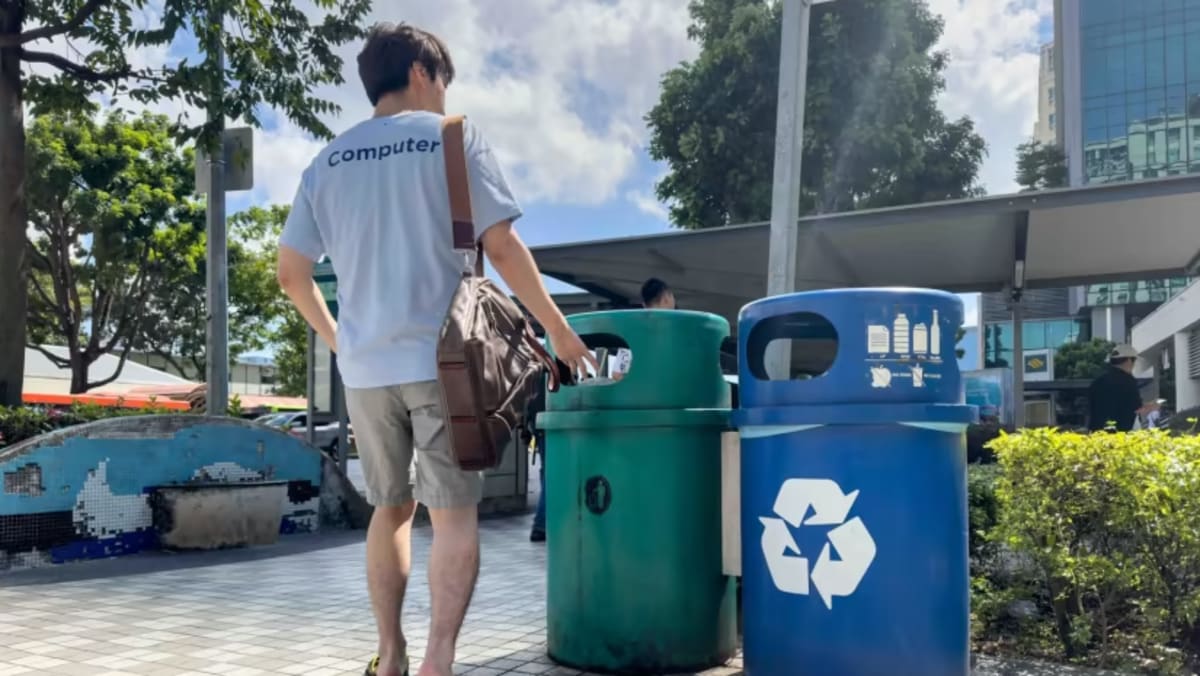
Underpinning the present day household recycling collection system is the co-mingled bin, more commonly known as the Bloobin or blue bin.
Over the years, the blue bins have been criticised because the co-mingled approach – in which recyclables are not sorted – leads to people disposing food and liquid waste in the bins, causing contamination. Contamination rates in blue bins have remained at about 40 per cent for years.
The blue bin “lowers the barrier to participation”, but the convenience comes at the expense of quality, said Prof Kuah.
Contamination reduces the quality and market value of recyclables, he added.
Hence, Singapore should consider moving from a purely co-mingled model to a more differentiated system, where blue bins are retained for selected dry recyclables, such as clothes and textiles.
This should be complemented by separate collection streams for other materials, with one example being the Beverage Container Return Scheme, Prof Kuah said.
“The challenge now is to strengthen incentives that encourage households to recycle more consistently and comprehensively, while also reducing the effort required to sort and dispose recyclables correctly,” said SUSS’ Dr Or.
“Improving both the rewards for participation and the convenience of proper recycling (reducing the cost of recycling) will be critical to translating awareness into higher recycling outcomes.
“These will help alleviate the misalignment between private incentives and social objectives, a key reason why Singapore has struggled to meet recycling targets.”
Source-segregated collection would therefore be an appropriate approach to reduce contamination and make proper recycling more convenient, he said.
Experts also called for more upstream efforts to reduce waste generation.
“Given the inherent challenge of recycling some waste streams, upstream waste reduction deserves more attention,” said Singapore Environment Council (SEC) executive director Cheang Kok Chung, citing measures such as product redesign and reduced packaging.
Consumers should be encouraged to be “waste-light” in their consumption, he added.
Assoc Prof Rosenthal pointed to the disposable carrier bag charge as one example of an effective upstream intervention.
“So people are more likely to think twice and take only what they need,” he said, noting that the charge adds “extra steps and a little extra cost” to using plastic bags.
“Singapore should adopt an ecosystem-wide circular economy design approach,” said Prof Kuah.
“This means treating domestic recycling not just as a household behaviour issue, but as a system involving producers, importers, retailers, consumers, waste collectors, recyclers, regulators and end-markets.”
Assistant Professor of Public Policy Sreeja Nair said past reliance on highly convenient waste collection systems may also have shaped household recycling behaviours and expectations.
“While participation has increased over time, developing consistent recycling habits and improving sorting quality remains an ongoing challenge,” said Asst Prof Sreeja Nair, who is from the Lee Kuan Yew School of Public Policy.
“These outcomes reflect not just individual behaviour, but also how waste systems, infrastructure, and social norms have evolved together over time.”