
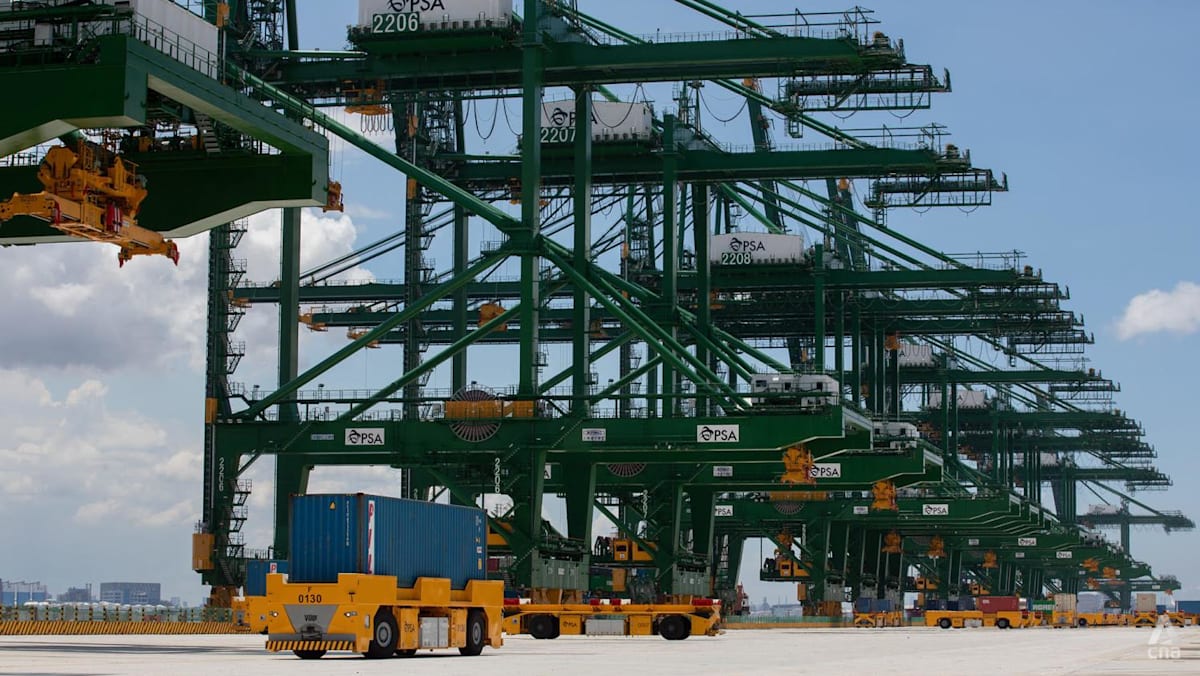
SINGAPORE: Singapore could be over-reliant on mega transport projects such as Tuas Port and Changi Airport Terminal 5 (T5), Workers’ Party (WP) Members of Parliament said during a six-hour debate in parliament on Tuesday (Jul 7) on the future of transport.
MP Gerald Giam (WP-Aljunied) said relying heavily on physical infrastructure exposes Singapore to long-term risks as global trade patterns evolve.
The six WP MPs who spoke also questioned why Singapore sold the majority stake in national shipping carrier Neptune Orient Lines (NOL) a decade ago, and asked whether Singapore should build up digital transport infrastructure alongside physical assets.
Mr Giam said he supported reinforcing Singapore’s long-term competitiveness as a globally connected aviation, maritime and logistics hub, with mega projects such as T5 and Tuas Port. However, he cautioned that focusing too heavily on physical infrastructure carries structural risks in a changing global economy.
“A neutral hub port holds traffic only by staying competitive, and a port cannot pick its carriers because carriers pick their ports,” he said.
He said the global trading system is under threat from protectionism and geopolitical rivalries, and possible new shipping routes, such as the Northern Sea Route through the Arctic or a land bridge or canal through southern Thailand, could divert maritime traffic away from Singapore.
Mr Giam gave the example of shipping company Maersk, which in 2000 shifted its transshipment hub to the Port of Tanjung Pelepas, rerouting traffic away from Singapore.
“The massive fixed cost of our expanded port may become a fiscal drag if shipping volumes fall short of the government’s projections,” said Mr Giam.
He added that the long-term justification for T5’s massive capacity relies on the traditional hub-and-spoke model, where long-distance travel requires consolidated transit nodes. But next-generation, hyper-efficient aircraft capable of travelling longer distances could completely disrupt this model.
“As a result, Changi Airport may face the risk of capital expansions outpacing the growth of traditional transit passengers,” said Mr Giam.
Associate Professor Jamus Lim (WP-Sengkang) echoed these concerns, saying that “placing our bets” on T5 and Tuas Port could backfire if globalisation is reined in in the future. These mega projects should not be abandoned, but should proceed with “greater caution”, he said.
“Perhaps by planning the build-out in tranches and making parts of the full blueprint contingent on whether future economic conditions justify the massive capacity expected,” he added.
Responding to Mr Giam, Acting Minister for Transport Jeffrey Siow said that while Maersk moved its transshipment operations to Tanjung Pelepas, its Asian headquarters remains in Singapore.
“Even when its cargo does not physically pass through our waters, the decisions about that cargo may still be made here, and we are able to capture value from it,” he said.