
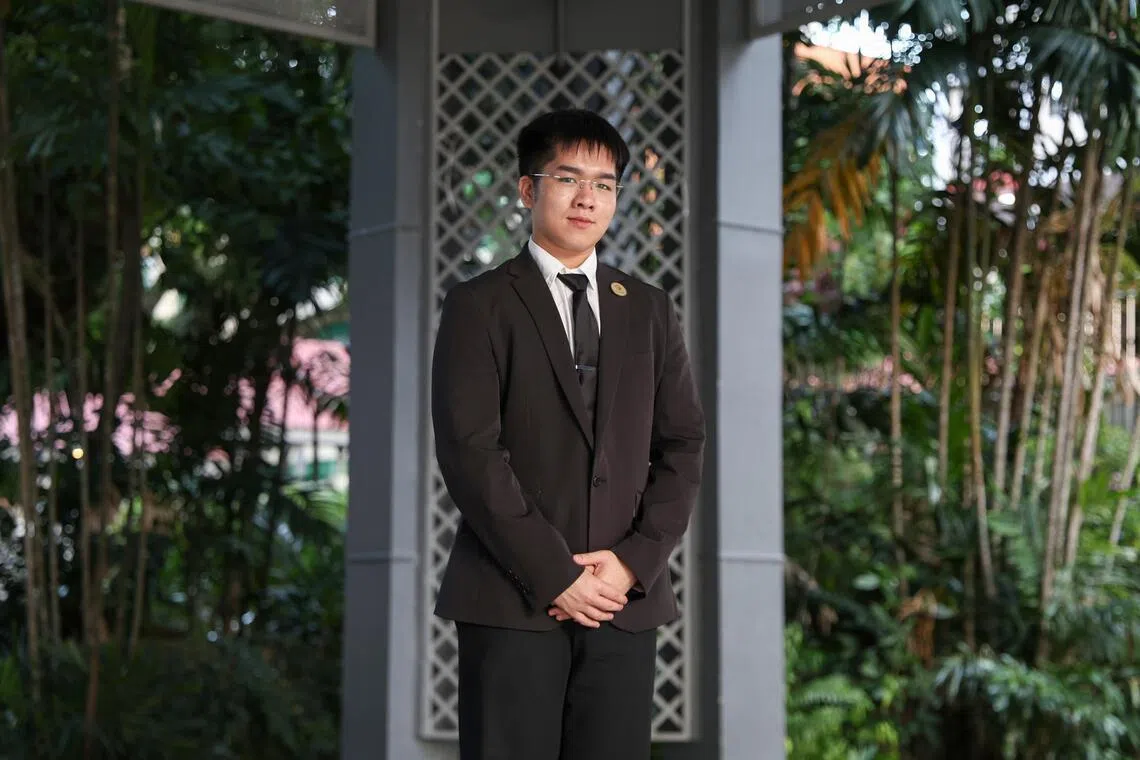
SINGAPORE – Shane Tan wakes up at 5am and reaches his “office” around 6am. More often than not, this office is a funeral parlour or an HDB void deck.
As the funeral director at SG 24 Hour Funeral Services, Tan arranges funerals and guides families through the entire process, transporting two bodies from their respective wakes to the crematorium on a typical day. At 21 years old, he is one of the youngest funeral directors in the business.
He got in early.
He started shadowing his father at the family business since he was 12 and got hands-on on the job when he was 16. Though he has two older siblings and one younger one, Tan is the only one interested in joining the company full-time. He is now slated to take over the family business from his 56-year-old father, who is planning to retire.
Reacting to the unexpected is part and parcel of his work. “If you are doing a (funeral) ceremony now but receive a call, you have to swap around your schedule,” he said.
Tan’s day can end as late as midnight. He said: “You get home, get two to three hours of sleep, then wake up and do it all over again the next day.”
Despite graduating with a Diploma in Digital Design and Development from Republic Polytechnic in 2025, Tan chose to pursue a career in the funeral industry due to his interest in the work.
While not directly related, his diploma has taught him valuable skills that he applies to the business. He said: “It was a good foundation in design and marketing. It helped me with the branding of our company, social media and improving business operations.”
His family was initially worried about his decision to take over the funeral business full-time as it is a demanding job that requires him to be on call 24/7. However, he managed to convince them after many discussions.
Tan does not draw a typical monthly salary – he asks his parents for money when he needs some to spend.
He recalled accompanying his father to the mortuary for the first time when he was 12. “The first time (my father) received a call (at midnight), I was curious and asked why he needed to leave at this hour,” he said. “The second time he received a call, I asked if he could bring me along so I could see what it’s like working during midnight.”
Recalling how he felt during that experience, he said: “I was scared, because I didn’t know what was going to happen. The mortuary is dark and quiet, and you don’t know what is going to happen around you. You need to step out of your comfort zone and be brave.”
He learnt the ropes of the business through shadowing his father – accompanying him to the mortuary to collect bodies, taking part in funeral rituals and rites, and maintaining business contacts within the industry.
One notable experience involved an elderly woman who died after a bus accident. As she had no next-of-kin, Tan’s company was called to arrange a dignified send-off for her.
As is the custom for unnatural deaths, a “spirit-catching” ceremony had to be performed. Tan said: “We did it for (the deceased) at the junction of the road (where the accident occurred). We hired a monk to do chanting and lay her clothes on the road to ‘catch her soul’.”
This experience stuck with Tan as a reminder of his dedication and the importance of his work.
“I stepped up to do the (spirit-catching) ceremony for her. I told her, ‘Even though I don’t know you, you’ve been handed over to me in my care, so I will make sure I send you off well’,” he said.

Shane Tan sometimes gets strange or doubtful looks from peers and clients, but he takes them in his stride.
ST PHOTO: SARAH LEE
Tan sometimes gets strange or doubtful looks from peers and clients, but he takes them in his stride.
“I (became) a funeral director at the age of 20. That’s not something many people expect,” he said. “You deal with people who are older than you. It’s usually a younger person listening to an older person, but (with me), it’s the other way around, so, of course, they’re sceptical.”
He added: “I lost some of my friends after they learnt I’m a funeral director because I often had to cancel our hangouts. But this career is stable – I will never be out of a job.”
Though meeting up with friends can be difficult because of irregular hours and unexpected call-ups, Tan said it is a matter of understanding. “Some feel that I always have no time. If they feel that way, they are a fake friend. If they can understand, they are a true friend who will stay with you for life,” he said.
Despite dealing with many funerals, Tan says death never gets easier to process. “It’s emotional,” he said. “Especially when (the deceased) is young.”
It is this deeper care and emotion that makes the work meaningful for him. He said: “(The funeral industry) is not just (about) dealing with death; it’s caring for families and supporting them during their period of grief. It’s about helping their loved ones to have a meaningful and dignified farewell.”