
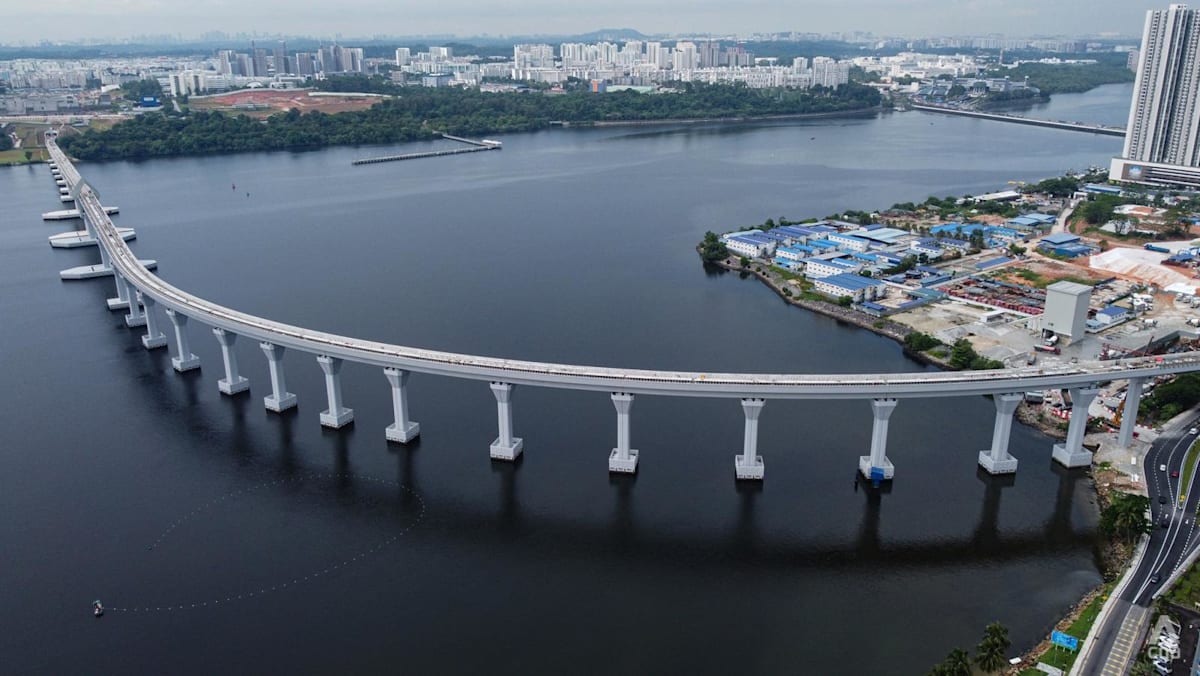
SINGAPORE: Singapore residents are projected to spend S$1.05 billion (US$810 million) more a year in Johor Bahru once the Johor Bahru-Singapore Rapid Transit System (RTS) Link opens, widening Singapore’s net outbound spending gap, a study released on Thursday (Jul 16) has found.
Johor Bahru visitors, in comparison, are expected to spend S$756 million more in Singapore annually. This leaves Singapore with a S$290 million net increase in outbound spend each year, equivalent to 0.4 per cent of the country’s total retail and food and beverage sales in 2025.
The study also projects a 51 per cent increase in outbound trips by Singapore consumers, adding 11.2 million Singapore-to-Johor Bahru round trips a year. Trips in the other direction are expected to grow by 3.3 million.
The study was commissioned by the Singapore Business Federation (SBF), Restaurant Association of Singapore and Singapore Retailers Association to assess how the RTS Link, set to open in January 2027, could affect consumer spending, tourism flows and business competitiveness in Singapore’s retail and F&B sectors.
About 1,700 Singapore consumers and 400 Johor Bahru consumers were surveyed in March this year for the study. Historical credit card spending and government statistics were also used to estimate the RTS Link’s potential impact.
Groceries are expected to account for the largest share of outbound spend, followed by drug stores, dining and beauty services.
SBF chief executive officer Mr Kok Ping Soon said the RTS Link will create opportunities for Singapore businesses to attract more visitors, but also raises competitive pressure “especially for our retail and F&B sectors”.
“Businesses must adapt beyond price competition by strengthening their offerings, experiences and productivity, while industry and government must work together to help them compete in a more connected cross-border market,” he said.
“Many are already under pressure from manpower constraints, from rental costs and operating costs, and RTS Link adds another layer of competitive pressure, which is structural.”
Heartland retailers in Woodlands told CNA earlier this year they were worried the RTS Link could send more shoppers to Malaysia, adding to pressures from slowing sales, rising costs and weaker consumer spending.