
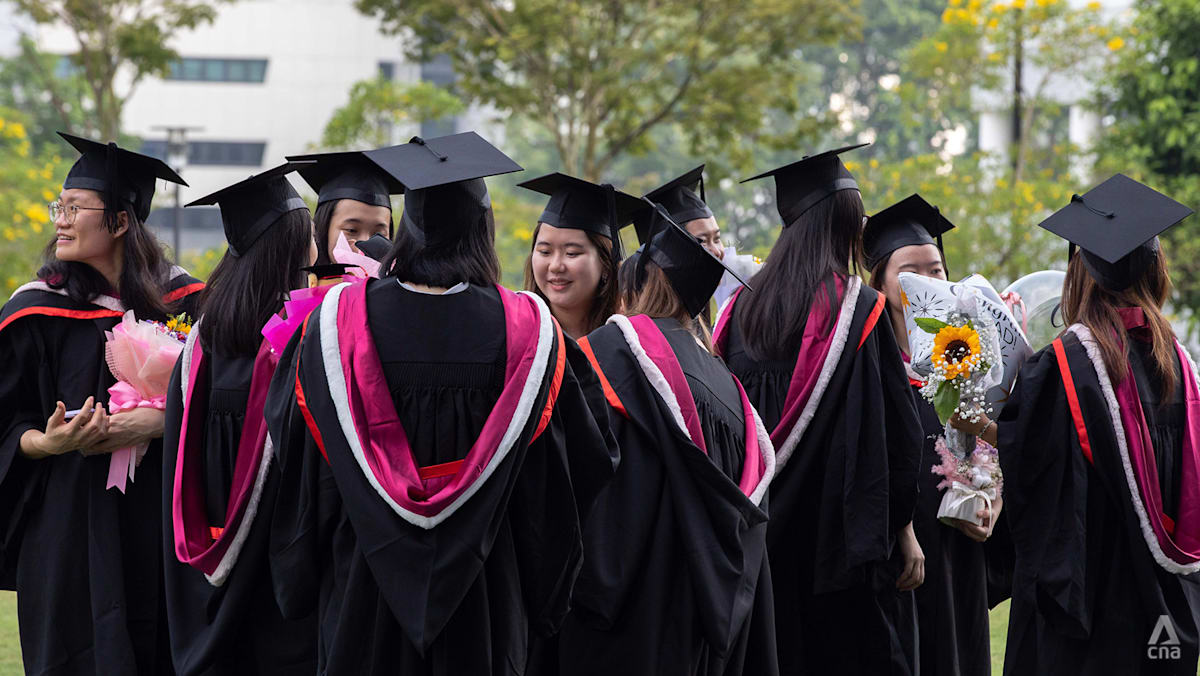
Initially, the psychology graduate at Singapore Management University (SMU) had thought about starting a home-based baking business after graduation to “see where it takes me”.
But facing the prospect of high ingredient costs and worries about sustaining a food business in a tough economy, she decided to take a more stable path.
Ms Toh’s job search was the most selective of the fresh graduates interviewed. She applied to fewer than 10 roles she believed would help her pursue further studies in psychology.
She was offered a full-time role shortly into an internship in the social services sector, and accepted the job. The salary exceeded her expectations, which she had set at a floor of S$3,000.
AI AND UNCERTAINTY
Several fresh graduates also spoke about the nuanced impact that AI has had on their job searches, which is not simply a case of the technology squeezing junior hires by reducing the availability of entry-level roles.
After all, MOM’s entry-level job vacancies data shows that openings are still widely available across all industries.
Rather, the graduates pointed to the uncertainty over how AI can create job opportunities and their worries about how the technology can quickly alter the demands of entry-level work.
NUS sociology and political science student Chloe Chan, 23, is set to graduate later this year.
Keen on a career in research and academia, she said that her worries about AI actually bothered her less as she read up on and applied for more jobs in her field.
Earlier this year, she completed an internship as an AI safety analyst at a tech giant. She acknowledged that the role was one that would not exist without AI adoption.
“Maybe for me it’s opening more doors, because I did get (an internship) thanks to AI. But I’m not sure how many doors it will close in the future. AI is moving so fast and we don’t know what it’s capable of,” she said.
No one can rule out the possibility that in five years’ time, AI could conduct interviews and people would not be needed to do qualitative analysis for research projects, she said.
NTU communications graduate Abdillah Akmal, 26, echoed the trepidation about AI even after accepting a role in a statutory board.
“I’m excited to start work, because in a sense it almost feels like having a job is a privilege,” he said.
But pointing to his friends who started work in the past few years, Mr Akmal said many of their job descriptions and responsibilities have already changed because of AI.
“There is that uncertainty that I come in with certain expectations, but then within maybe a few months something might change, and then I will need to readjust as well.”
SMU’s Ms Guda said the job search itself is a learning journey where graduates develop the judgment to evaluate offers thoughtfully and adjust their expectations along the way.
For fresh graduates making their way in the job market, a learning attitude may be the best way to ride out the sting of rejection and fears about the future.