
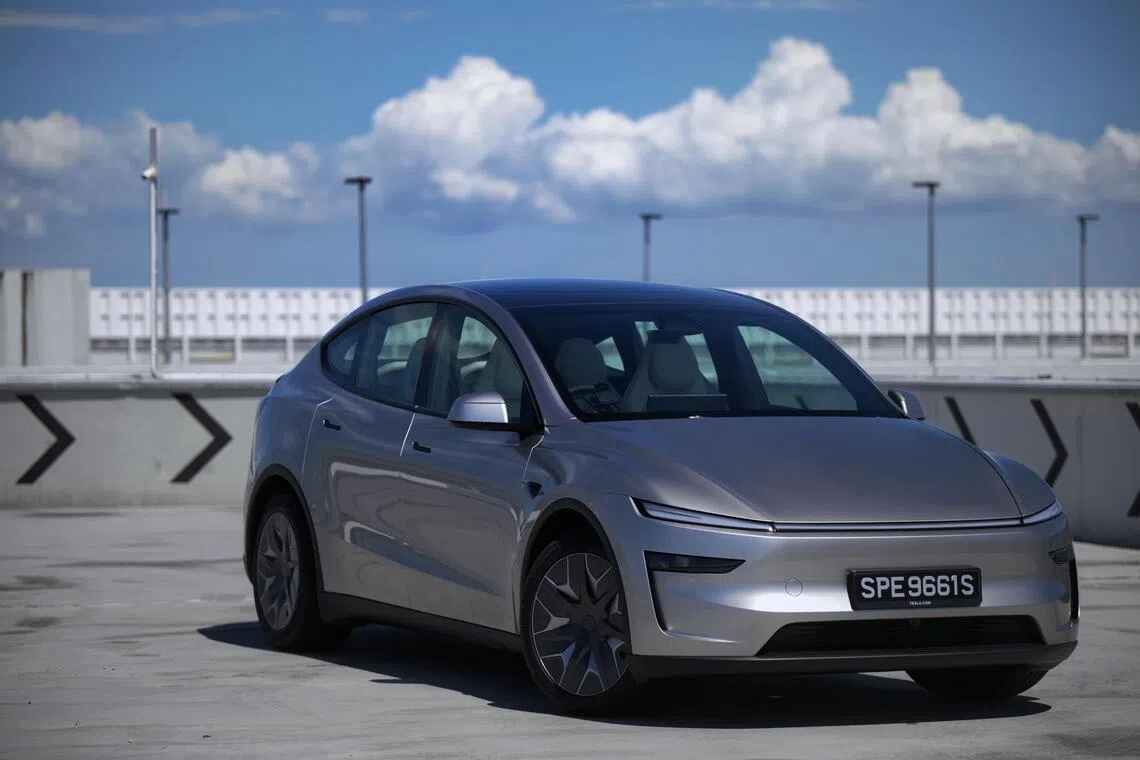
SINGAPORE – Since switching to a Tesla Model 3 in June 2024, Charissa He has spent nothing on routine maintenance and has not returned to the dealership’s workshop for repairs since collecting her vehicle.
The closest thing to “servicing” that her electric vehicle (EV) has needed is its software updates. These updates happen every two weeks or so, when prompted by the car.
He, a media professional, said the update can be downloaded and installed while the car is parked and charging at her condominium carpark.
This is a stark contrast to the 37-year-old’s experience with her previous Hyundai i30. The petrol-engine car needed an annual visit to a motor workshop for routine servicing, which cost about $800 each time.
For motorists such as He, switching to an EV can mean not only savings on energy costs, but also fewer maintenance needs.
Like traditional internal combustion engine (ICE) cars, EVs still require parts such as tyres and wipers to be replaced periodically.
But an EV’s powertrain, including its electric motors and batteries, generally requires far less maintenance than the engines and transmissions of an ICE car, said motor workshop staff in Singapore.
When asked if EVs’ greater weight could result in quicker wear on tyres and brakes, vehicle specialists here said the lifespan of these parts depends more heavily on driving habits.
While hard acceleration and braking can hasten tyre wear in any vehicle, an EV’s instant torque and regenerative braking can place added strain on its tyres.
Instant torque refers to an EV motor’s ability to deliver the maximum force to the wheels immediately rather than building it up progressively as an ICE car does, while regenerative braking uses the motor to slow the vehicle.
Experts said adopting a smoother driving style will help extend the life of an EV’s tyres.
Traditionally, ICE cars need servicing and oil changes every 10,000km to 15,000km, or at least once a year. Some ICE cars come bundled with free servicing packages covering the first five years of ownership.
In recent years, some dealers have begun offering complimentary vehicle servicing for longer periods of up to 10 years.
For EV brands such as BYD and GAC Aion, the servicing interval is 20,000km or every 12 months. During such visits, the workshops mainly check that the car is in good working order. Depending on the mileage clocked, the EV’s coolant, brake fluid and gear reducer oil may also be replaced.
One exception is Tesla, which said its cars do not require annual maintenance or regular fluid changes at its service centre. The brand recommends that owners periodically check items such as cabin air filters and switch the positions of the tyres at specified intervals.
As for servicing costs, electric models from brands such as BYD, GAC Aion and Toyota are sold with 10-year servicing packages included. These packages come with mileage limits of about 200,000km, higher than the average 162,000km clocked by most privately owned cars in Singapore over 10 years.
A spokesperson for Borneo Motors, Toyota’s authorised dealer, said regular servicing is important to ensure that an EV’s parts, software and battery remain in optimal condition.
Premium Automobiles distributes the Chinese EV brands Avatr, Changan, Xpeng and Zeekr.
While each brand has its own maintenance regime, a spokesperson for the motor dealer said routine servicing typically includes replacing worn tyres, windscreen wipers and the 12-volt battery used to power low-voltage components such as the infotainment system. These are items that ICE cars also require.
The spokesperson added that an EV’s brake pads and discs often experience less wear than those in an ICE car. This is because the EV’s regenerative braking system reduces reliance on conventional friction brakes.
As for tyre wear, the spokesperson said tyres fitted on EVs are designed to meet the specific demands of such vehicles, including their weight and instant torque.
So far, He’s Tesla Model 3 has covered more than 34,000km with no issues.
Given its lower maintenance needs and the vehicle’s driving comfort, she said she is unlikely to return to a petrol-powered car any time soon.