
SINGAPORE – Playgrounds in Singapore are getting a design rethink aimed at making play more meaningful for children.
In upcoming BTO estates in Mount Pleasant Crest, Woodlands and Bishan, new playgrounds will be built with a set of national guidelines to feature aspects of play that are important for children’s development.
These include mandatory elements such as sliding, balancing and climbing, with features tailored to different age groups and site contexts.
Developed by the HDB, the guidelines set out core requirements for new playgrounds in HDB estates and neighbourhood parks. These include physical, social and cognitive play.
The Mount Pleasant Crest launch was in November 2025 and will be completed by 2031, while Woodlands and Bishan are set to launch in June.
Announced in December 2025, the guidelines will also be used by town councils when they revamp existing playgrounds in older estates, to ensure children have access to more varied and engaging play.
Upgrading of such infrastructure and facilities typically takes place every five to seven years.
HDB said the 19 town councils will be briefed on these new guidelines in May. There are around 2,800 public playgrounds in HDB estates and parks in Singapore.
Speaking to Insight in April, Senior Minister of State for National Development Sun Xueling said that playgrounds here have evolved to take on more creative designs. But many may have become too focused on aesthetics at the expense of play value, with limited opportunities for child development.
Said Ms Sun: “As we learn more about how children play, and the benefits of play, we want to move away from just designing playgrounds that look pretty. Playgrounds must be useful, meaningful and purposeful.”

An artist’s impression of a playground at Mount Pleasant Crest. The Mount Pleasant Crest launch was in November 2025 and will be completed by 2031.
PHOTO: HDB
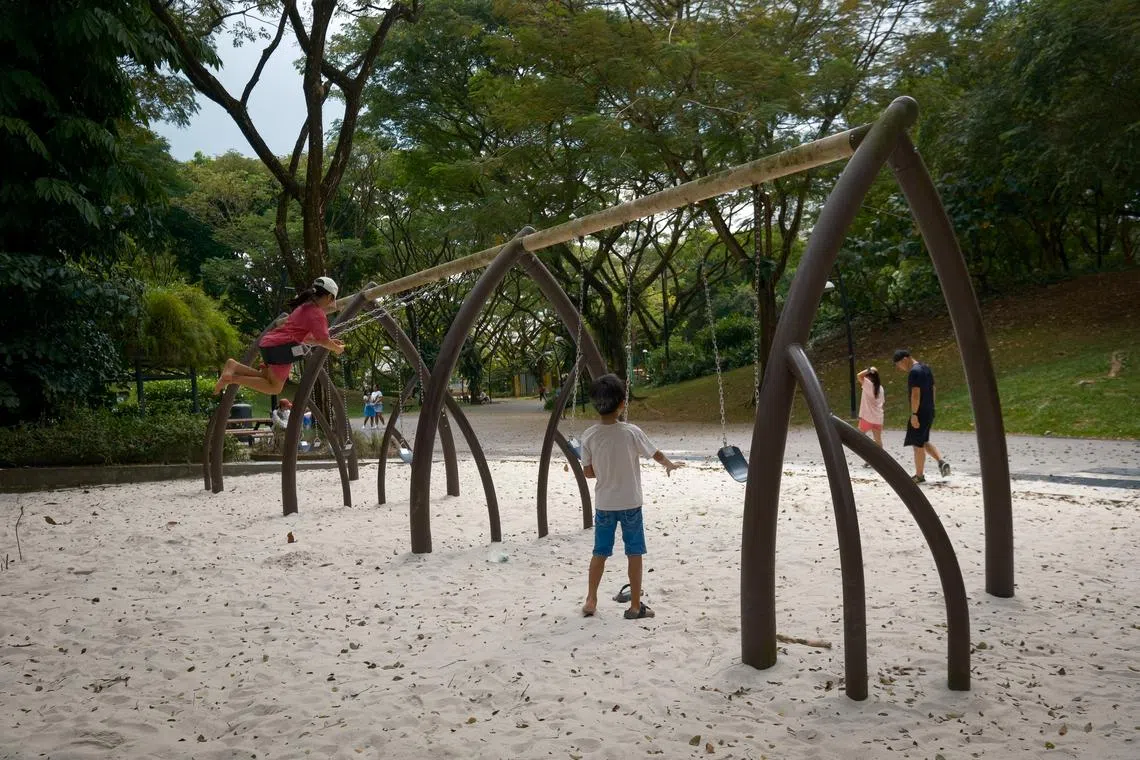
The guidelines also seek to address the rigidity of current structures, which can limit creative and imaginary play. One idea being explored, based on feedback from parents, educators and healthcare professionals consulted by HDB, is bringing back sandpits where feasible.
“Sand is something that children can do all sorts of things with – build sandcastles, dig a hole, engage in pretend play. And the interesting thing about sand play is that it’s not fixed,” said Ms Sun.
Ms Sun, who has been part of several national-level work groups on children’s well-being, said a recurring concern from parents was the growing dominance of screen time among young children.
Many parents want children to be more active outdoors, instead of spending time on digital screens, she said.
Other factors like a growing body of local studies have led government agencies to look decisively into better support for children’s growth, she added.
Findings from the Growing Up in Singapore Towards healthy Outcomes (GUSTO) study highlight the importance of physical interactions and early development of social emotional skills.

Senior Minister of State for National Development Sun Xueling said that many parents want children to be more active outdoors, instead of on digital screens.
ST PHOTO: LIM YAOHUI
A 2023 report by the Saw Swee Hock School of Public Health at the National University of Singapore found that children and adolescents were not making full use of the spaces Singapore provides for physical activity and movement.
Researchers made this observation after a study on physical activity among children up to 18 years of age found that more than half of them do not hit the recommended one hour of moderate to vigorous exercise per day.
These insights have prompted agencies to take a more coordinated look at children’s development, under a national strategy known as Grow Well SG.
This has resulted in screen time guidelines for children, and health plans in schools to track children’s diet, sleep and physical activity, for instance.
Though her ministry is not formally part of Grow Well SG, Ms Sun said it wants to play a part in children’s development through the design of HDB estates and meaningful use of community spaces, for playgrounds in particular.


HDB first engaged about 30 parents and children in a focus group discussion in November 2024, to identify what they considered important features of playgrounds.
Feedback was also gathered from residents through a series of HDB surveys. One of them involved residents from 50 HDB blocks.
Early childhood professionals, paediatric occupational therapists and playground developers were also consulted.
These specialists mapped out how different design features benefit children’s growth.
For example, bouncing on a trampoline and playing on a swing help children develop balance and coordination, while hanging on a raised bar builds arm strength.
HDB’s principal landscape architect Derek Loei said several factors were considered in creating the guidelines for the “ideal playground”. Apart from children’s skills development, the team also took into account practical considerations like space constraints and maintenance needs, as well as what playground users wanted.

HDB first engaged about 30 parents and children in a focus group discussion in November 2024, to identify what they considered important features of playgrounds.
ST PHOTO: JASEL POH
Mr Tang Wei Kiat, a paediatric occupational therapist who was consulted, said playgrounds are important spaces for free play in highly urbanised Singapore, where much of children’s time is scheduled for structured activities and lessons.
‘Unstructured play gives a child the opportunity to listen to his or her body, to engage with the equipment at their own pace,” said Mr Tang, who added that children need bigger spaces than most homes can provide to move their bodies naturally.
At home, digital devices compete for children’s attention, he said, while being outdoors with natural greenery is more conducive for unstructured play.
While her children enjoyed regular playground time in their pre-school years, their interest began to wane as they got older, said Ms Jacintha Sujatha. They are now aged 11 and 12.
“Once they entered primary school, and discovered screens and YouTube and online games, they gradually lost interest in going to the playground,” said the 42-year-old, who works in banking. She added that their schedules also became more packed with enrichment classes after school.
Other factors included changing relationships with children in the neighbourhood, who used to play with them at the playgrounds.
“I still try to bring them to the waterfront area near my house for cycling and in-line skating, but due to my working hours, we can only do so on weekends,” said Ms Jacintha.
It is recommended that children between one and six years old have 180 minutes, or three hours, of physical activity a day, and older children up to 18 years of age should have 60 minutes of such activity.
But many Singaporean children are falling short of these targets due to their packed schedules, said Mr Tang.
He added: “Play is movement. Movement is a need, not a reward.”
His advice to parents is to take small steps. “Go out for maybe 30 minutes, once a week. Start small first, do that week after week, and you’ll notice the benefits and how much your child enjoys it,” he said.
Mr Loei said that besides calls to bring back sandplay, another common feedback was the lack of swings in existing playgrounds.
“It’’s really about speed. Children always want to find out their limit, and they will try to swing as hard as possible,” he said.
Ms Jewel Yi, 34, who has an 18-month-old son, is looking forward to having swings in more playgrounds.
Ms Yi, an occupational therapist, said the intensity of movement swings provide is important for development.
“It’s that intensity that they’re going to fly up in the sky, then counterbalancing it, and then pushing up again. It’s even better if they can compete with another friend to see who can do it faster and higher,” she said.
She also hopes to see more estates integrating green spaces and playgrounds, in order to address space constraints.
Play can also involve the natural environment, she said, adding: “Why can’t kids play near trees again, by integrating playgrounds with nature?
“I think Singapore is a beautiful garden city, but it’s an untouched garden.”
Mr Loei said that sand in playgrounds was replaced by padded rubber flooring during the 1990s, because of safety and maintenance concerns.
He said back then, there were more stray dogs and cats which would often defecate in the sandpits.
“There were also concerns about inconsiderate acts, as people would throw glass bottles, needles and other sharp items into the sand as well, making it unsafe for children to play,” he said.
At the time, the United States had moved towards building commercial-grade play structures for playgrounds, with padded flooring to meet safety standards.
HDB had taken note of this and made a similar shift locally.
“These proprietary playgrounds are manufactured in factories, so the quality and safety aspects are all tested… The rubber mats also cushion falls, thus minimising the risk of serious injuries,” said Mr Loei.
Mr Patrick Lee, a playground specialist who has been working with HDB for over 30 years, said there are operational and maintenance challenges to consider for sandpits.
“Over time, sand needs to be turned. If not, it will breed bacteria and harden,” he said, adding that maintenance also involves sifting out trash and animal droppings.
This requires using machines to go through about 40cm of sand and turning it.
Sandpits with higher footfall, like those located in parks, require monthly maintenance, while those with lighter use can be serviced once every three months.
Most parents Insight spoke to said they are happy to see that sandpits are making a comeback, as their children enjoy using sand creatively to build and explore.
Ms Michelle Ling, 42, a business adviser, said the lack of sandpits in playgrounds near her home in Toa Payoh meant that she had to carve out time to travel to East Coast Park with her daughter, who is now 12.
Ms Ling made it a point to ensure her daughter had playground time every day between the ages of three and seven.
Recalling her own childhood playing with sand, she said the decline in such experiences may have contributed to a generation of children who refrain from messy play in the natural environment.
“Kids nowadays are too clean. When they touch sand, they say it’s dirty. I think we need to bring back sandplay so that they are more grounded,” she said.