
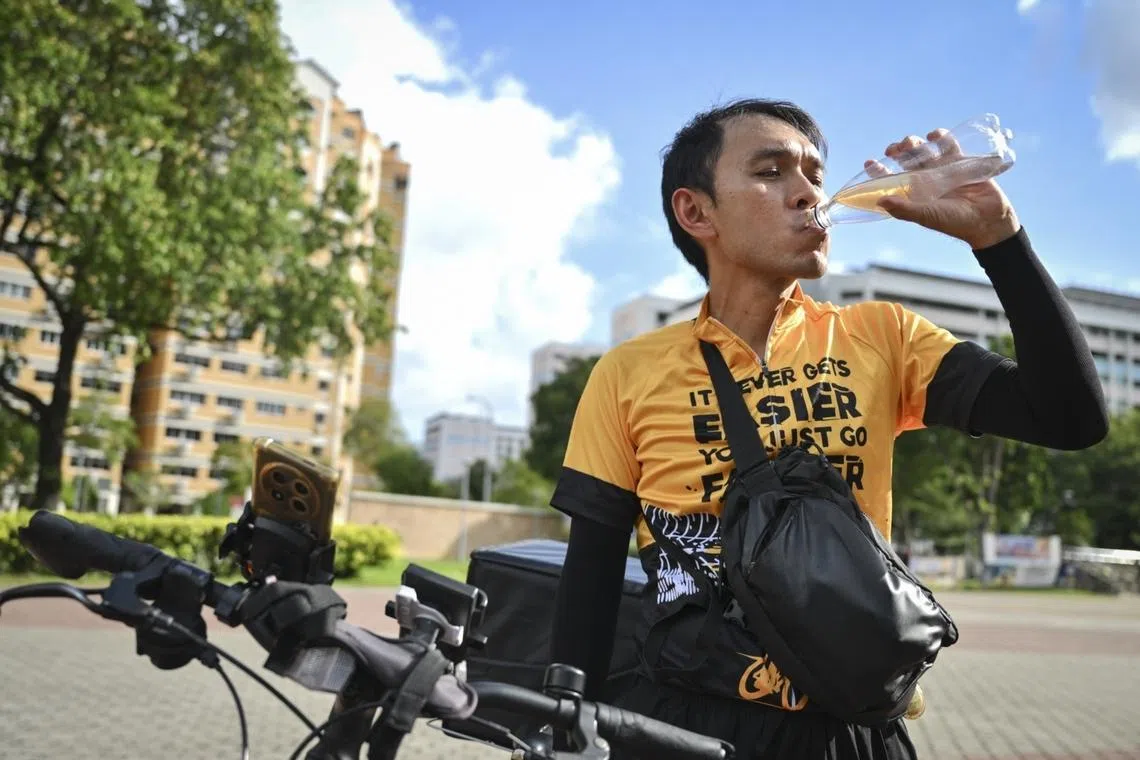

Delivery rider Kelvin Zeng, 43, spends most of his days drenched in sweat.
For the last five years, he has cycled around Tampines and Simei almost daily, delivering food to residents from around 8.30am to 8.30pm.
Aside from lunch and brief lulls between orders, he is usually on the move.
Lately, though, the heat has become harder to endure. Zeng says he has taken more breaks to hydrate over the past month, stopping at Our Tampines Hub and community centres to refill his bottle.
Twice – on particularly hot days in March and May – a splitting headache forced him to end work two hours early.
But there is no respite at home; heat follows him inside.

Kelvin Zeng cycles almost daily to deliver food around Tampines and Simei, working long hours under the sun.
PHOTO: CAROLINE CHIA
He shares a five-room Housing Board flat with his parents, in their seventies, and children, aged 13 and 11. Without air conditioning, he has been sweating through the night, losing sleep three to four times a week in June. By morning, fatigue slows his delivery pace, he says.
The reduced pace and more frequent breaks shave three to four deliveries off his daily average of 30, he estimates, cutting his earnings by around $14 to $19 every day.
For Zeng, the worry is not just the heat he faces now.
Meteorologists warned that the mercury may continue to rise. A stronger version of El Nino is forecast for later this year, potentially bringing drier, hotter conditions to South-east Asia.
El Nino is a weather pattern where trade winds weaken and warm water shifts eastward across the Pacific, raising sea surface temperatures in the central and eastern Pacific. It last occurred in 2023 to 2024.
“I’m (especially) concerned if (intense) heat drags on and I’d need to take longer breaks,” says Zeng, who believes climate change is contributing to warmer temperatures.

Food delivery cyclist Kelvin Zeng says hotter days means more breaks and greater fatigue, cutting three to four deliveries from his usual 30.
PHOTO: CAROLINE CHIA
His experience is not uncommon. A survey of 1,000 Singapore residents suggests that heat is increasingly affecting people’s lives and well-being. They ranked hotter weather and heat stress as their top concern arising from climate change.
Conducted in April 2026, the survey was commissioned by SPH Media and Temasek Foundation, with respondents drawn from Kantar’s Profiles Audience Network. Kantar is an independent market research firm.
Eighty-two per cent of them said heat stress disrupts their daily lives at least once a month. Of this, about half said it happens at least weekly.
Forty-six per cent of people reported excessive sweating and dehydration due to heat, while 41 per cent experienced fatigue, and 39 per cent poor sleep.

Eighty-two per cent of survey respondents said heat stress disrupts their daily lives at least once a month.
ST PHOTO: BRIAN TEO
Heat strains and drains
Delivery riders face higher heat risks due to prolonged sun exposure and pay tied to speed, potentially discouraging them to slow down or take breaks, says Associate Professor Jason Lee, director for Heat Resilience & Performance Centre at NUS’ Yong Loo Lin School of Medicine.
What we are concerned about is a ‘hot body’, or heat strain, not (just) a hot environment,” says Lee.
Heat strain occurs when the body cannot remove excess heat, causing internal temperature to rise.
Enabling a more liveable world
Global temperatures could hit near-record highs in the next five years, warned the World Meteorological Organisation in a May report.
The urgency to act is rising, says Heng Li Lang, Head of Climate & Liveability at non-profit organisation Temasek Foundation.

Temasek Foundation chief executive officer Ng Boon Heong (left) and its Head of Climate & Liveability, Heng Li Lang (right), presenting the awards to winning teams Metha8 and YAMA at The Liveability Challenge 2026.
PHOTO: COURTESY OF TEMASEK FOUNDATION
The critical gap, Heng says, lies in funding that can take promising solutions for reducing emissions and adapting to climate change past the prototype stage and into full-fledged commercial adoption. Platforms like The Liveability Challenge (TLC) aim to bridge that gap.
Presented by Temasek Foundation and organised by media company Eco-Business since 2018, TLC is an annual global crowdsourcing platform focusing on addressing urban challenges in the tropics.
It is Asia’s largest sustainability solutions platform, its website states, and has incubated 62 start-ups and deployed around $18 million.
At its latest finale on May 20, it committed its largest funding pool of up to $4.3 million, with two winners taking home $1 million each.
This year’s challenge called for solutions across two themes:
-
Decarbonisation focuses on reducing emissions where they are being generated, like power plants. One of this year’s winners, Singapore-based Metha8, converts the chemical methanol into clean electricity at 60 per cent efficiency – twice that of conventional diesel generators – without releasing harmful emissions, says Heng.
-
Cool Earth targets solutions that help people adapt to extreme weather events, particularly heat. Eztia Materials, one of last year’s finalists, developed a hydrogel-based passive cooling apparel that can reduce a person’s skin temperature by up to 9 deg C and sustain cooling for up to eight hours, says Eztia Materials chief executive officer Tiffany Yeh.

Eztia Materials wearables were trialled at the NS Square construction site at Marina Bay from October to November 2025.
PHOTO: COURTESY OF EXPAND CONSTRUCTION
The themes reflect the need to slow climate change and help people thrive in a warming world, says Heng, underscoring Temasek Foundation’s commitment to advancing solutions for a more liveable planet.
Clothing, physical activity and weather affect how heat in the body builds up and releases, Lee says. One common measure for environmental heat stress is the Wet Bulb Globe Temperature (WBGT), which accounts for air temperature, humidity, wind speed and solar radiation.
On high heat stress days, the heart pumps faster to move blood to the skin and sweating increases to release heat, Lee says.

Hydrogel technology – made of polymers that can absorb and retain water – is embedded in the dots on Eztia Materials’ inner shirt to reduce skin temperature and sustain cooling.
PHOTO: COURTESY OF THE BUILDING AND CONSTRUCTION AUTHORITY
But if clothes trap heat or if one is not acclimatised, heat-related injuries may develop. The most severe is heat stroke, characterised by body temperature usually at about 40 deg C or higher, with delirium, he adds.
In 2025, 398 people were treated for heat-related illnesses at accident and emergency departments in Singapore, nearly double the annual average of 200 from 2020 to 2023, according to Ministry of Health data cited by Chinese-language daily Lianhe Zaobao. Hospitalisations also rose to 81, up from an annual average of 50 over 2020 to 2023.
Lee says not all heat-related injuries are as severe as heat stroke. Some have milder, less distinct symptoms, like heat syncope, or sudden dizziness from standing too long in high temperatures.
Heat can affect how people function in their daily lives, influencing their ability to work, move around, rest and maintain well-being, says Research Assistant Professor Samuel Chng, head of the Urban Psychology Lab at SUTD’s Lee Kuan Yew Centre for Innovative Cities.
People experiencing heat stress often feel more fatigued, irritable and distracted, which can affect concentration, productivity, mood and social interaction, says Chng.

A survey found 36 per cent of respondents had to cut back or give up on exercising outdoors due to the heat, while 33 per cent each scaled back on leisure time in nature and walking over taking transport.
ST PHOTO: MARK CHEONG
Those who avoid outdoor activities due to heat may have fewer opportunities for physical activity and social connection over time, he adds.
Chng’s research also found that many residents experience significant heat exposure at home, especially at night. Nearly half of 416 HDB flats studied recorded warmer temperatures than outdoors, especially where ventilation was hindered by indoor clutter and closed windows.
With little relief from heat, the day’s stress can build up further, he says.
Managing the heat
The world is experiencing “global boiling”, says Heng Li Lang, Head of Climate & Liveability at Temasek Foundation.
“Heat stress is one of the most visible and immediate impacts of climate change,” she says, pointing to its growing effects on public health, productivity and liveability, particularly in Asia.
Asia has warmed faster than the global average in recent decades, at roughly twice the rate from 1991-2025 compared with 1961-1990, according to a World Meteorological Organisation (WMO) report in June.
The impact of heat extends globally. France, the Netherlands and Belgium recorded at least 3,700 excess deaths during the June heatwave according to local authorities, and the toll may still rise.
Addressing climate change requires solutions that help people adapt to rising temperature, adds Heng, alongside efforts to cut greenhouse gas (GHG) emissions. GHG like carbon dioxide and methane trap the sun’s warmth.

Heng Li Lang, Temasek Foundation’s Head of Climate & Liveability (left), is one of five committee judges for this year’s The Liveability Challenge, an annual global crowdsourcing platform focusing on addressing urban challenges in the tropics.
PHOTO: COURTESY OF TEMASEK FOUNDATION
The Liveability Challenge, an annual sustainability initiative presented by Temasek Foundation, aims to support such efforts. (See box above)
What does adaptation look like in daily life?
That could mean building heat tolerance through outdoor exercise and acclimatisation, because as Lee warns, “a small pot boils the quickest”. Consistently avoiding heat only makes us more vulnerable in a warming world, he says.
Lee recommends adjusting the intensity and duration of outdoor activities and taking more breaks.

Delivery rider Kelvin Zeng refills his water bottle at Our Tampines Hub to drink – one way he copes with the heat, along with cycling in the shade and wearing dri-fit tops to wick away sweat.
PHOTO: CAROLINE CHIA
But there are hard limits: feeling light-headed or unwell during outdoor exercise is a sign to stop, Lee says.
At the national level, Singapore already treats heat as a liveability challenge, not just a weather issue, says Chng. He points to the government’s investments in urban greenery, climate-responsive design such as sheltered walkways, and research into climate change’s impact on daily life.
Just this year, the Ministry of Sustainability and the Environment set up the Heat Resilience Policy Office to oversee heat management efforts countrywide, and recognised 2026 as the Year of Climate Adaptation.
As temperatures rise, the next phase of adaptation is ensuring these investments improve not only thermal comfort, but also wellbeing, Chng says.
“A heat-resilient city is not simply one where temperatures are lower,” says Chng. “It is one where people can continue to live well, work productively, move around comfortably, and participate fully in community life despite a warming climate.”

-
In Perspective is a research-led content programme by SPH Media that combines insight-driven storytelling with expert perspectives on key issues shaping society.
In partnership with Temasek Foundation